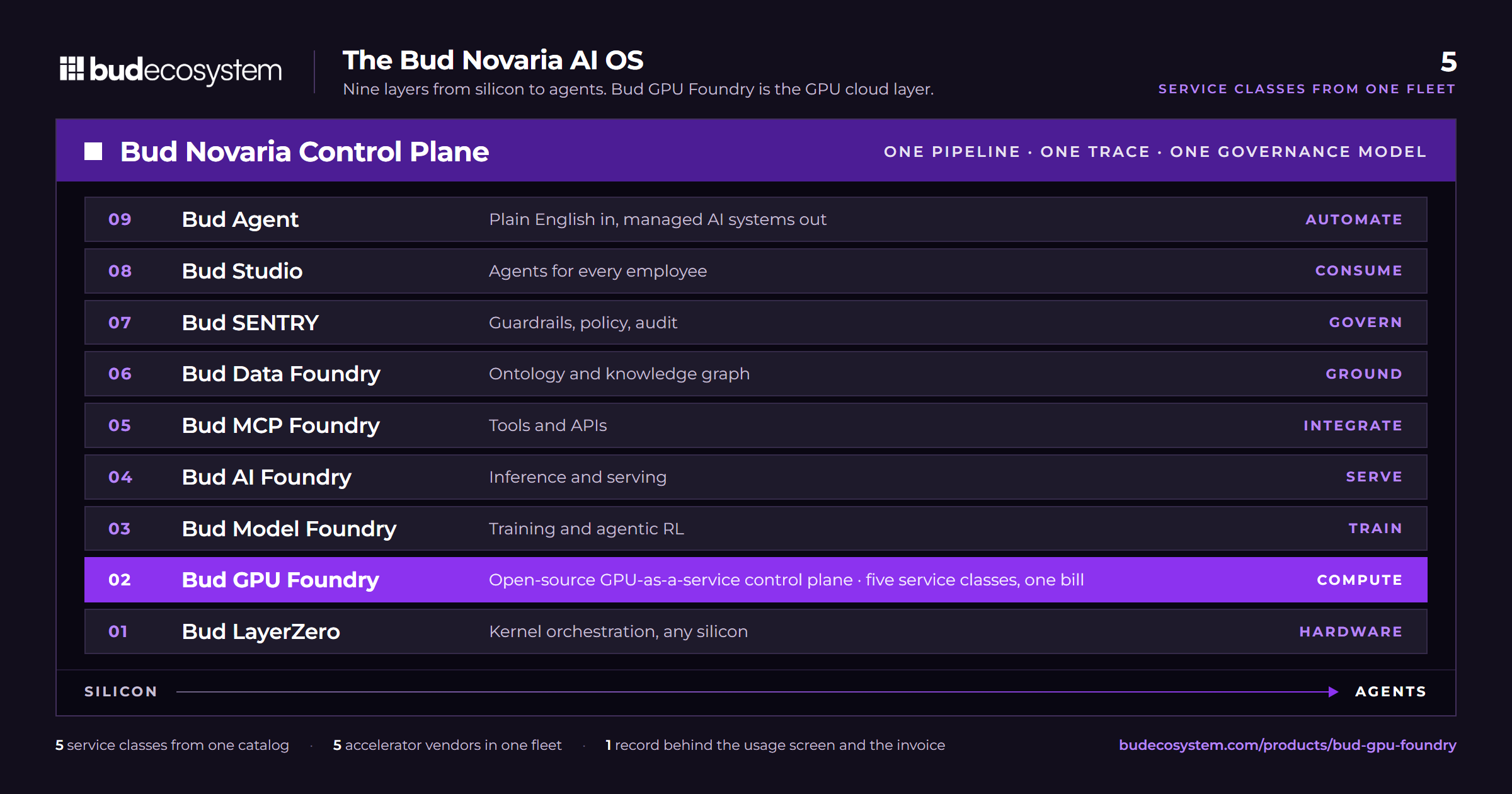
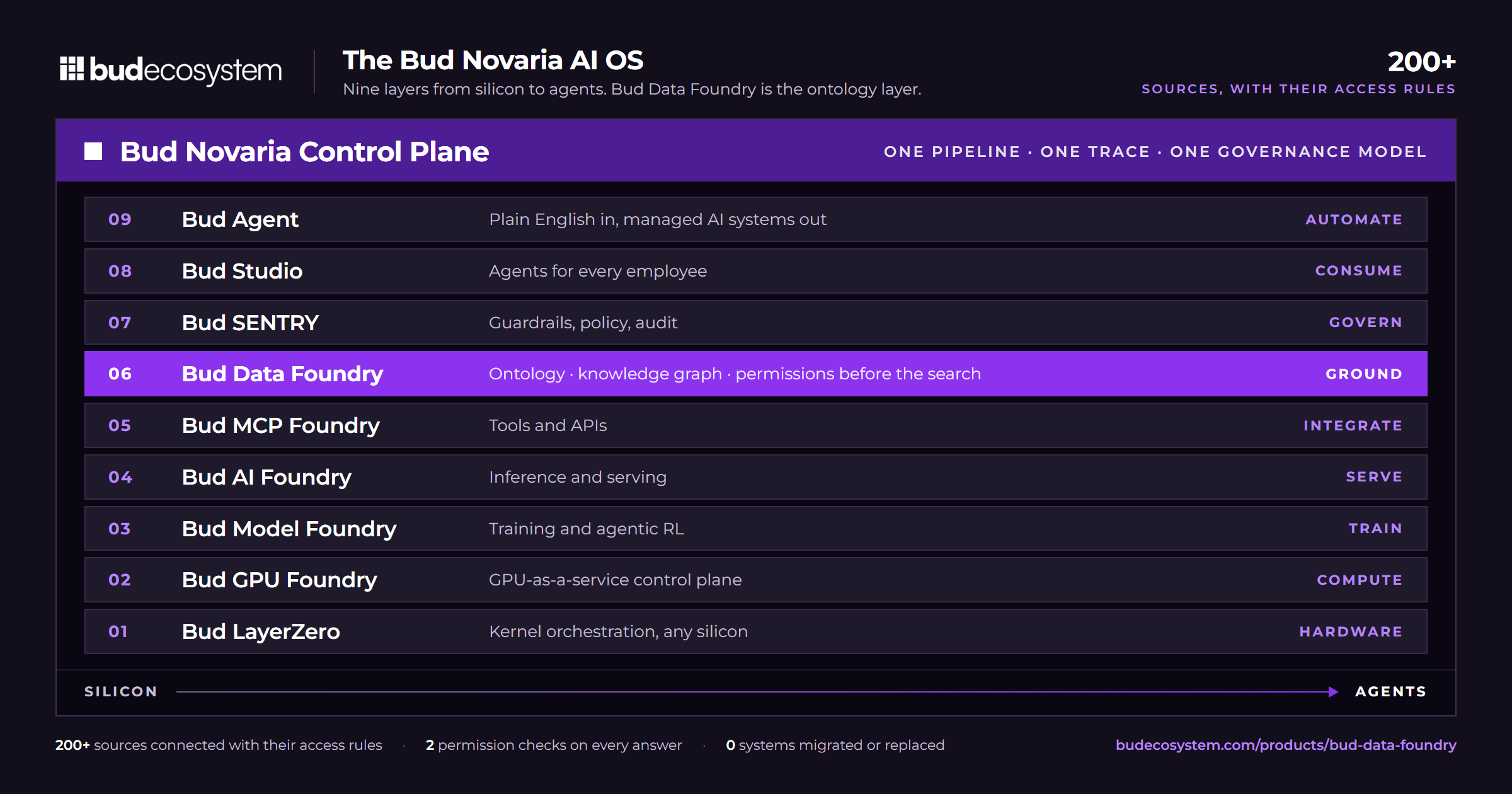
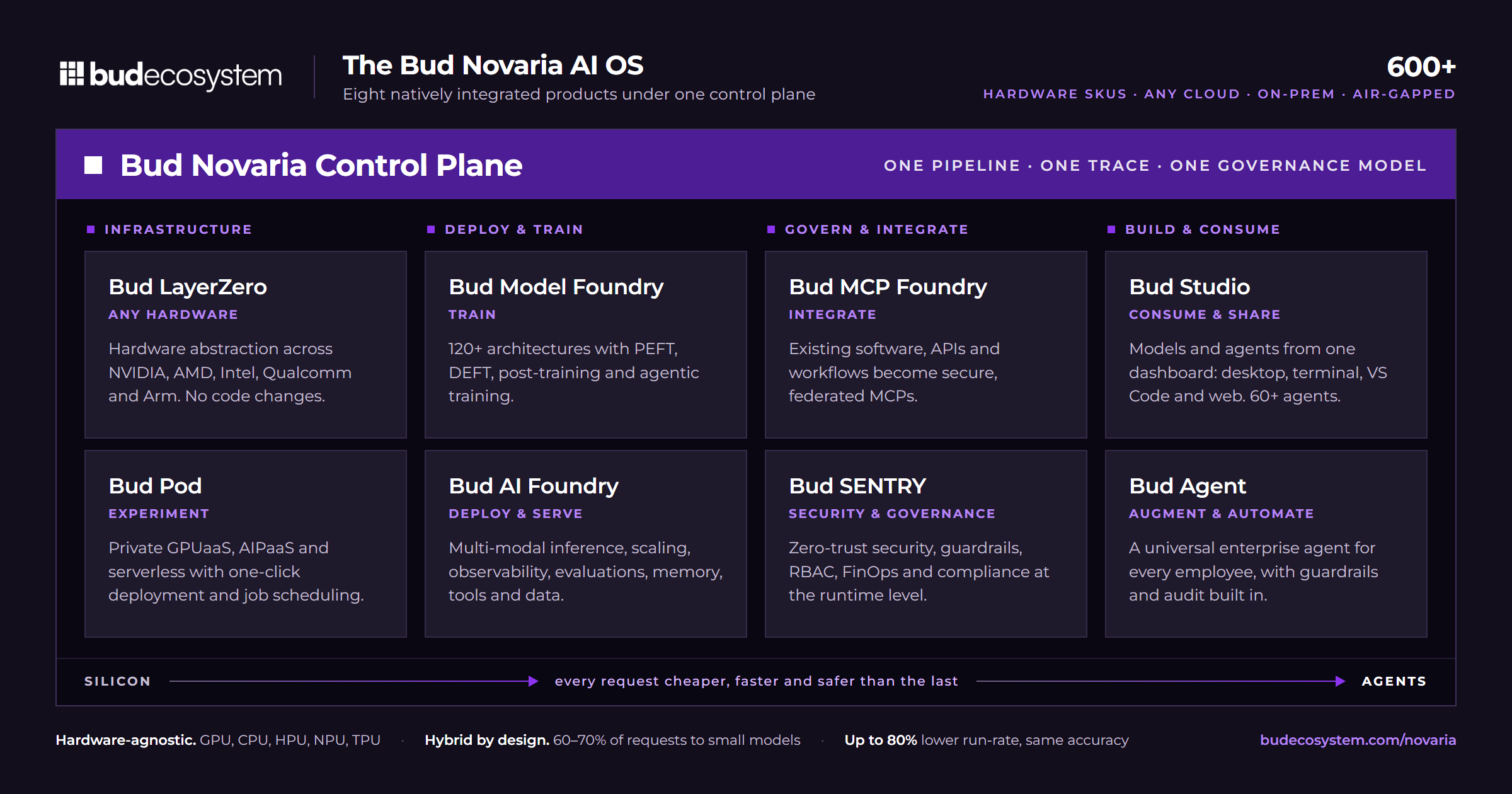
Bud AI Foundry

The all-in-one control panel for enterprise GenAI. Built to maximize infrastructure performance, minimize total cost of ownership, and give you end-to-end control from deployment and administration to compliance and security. Engineered to enable both technical and non-technical teams alike.

Bud AI Foundry Dashboard

Trusted by Industry Leaders

Production-Ready Enterprise GenAI Needs More Than Models and Throughput

A performant model deployment alone is not enough to ensure the success of your GenAI initiatives. You must have;

Cost Optimisation Performance Optimization Guardrails & Safeguards Observability, Analytics & Reports Seamless Builder for Agents and Workflows Evaluations & Experiments RBAC & Administration Security & Compliance Easy to Adapt and Scale Performant Models and Agents Tools for end users and consumers Zero config Deployments FinOps And more.

You can stitch together 100 different tools and still come up short—or you can use Bud AI foundry and get it right from day one.

Bud Features

Auto Cost optimisation

Automated cost optimisation for model deployments and cost-aware deployment scaling.

FinOps

Budgeting, rate limiting, and usage limits across projects, models, users, teams, use cases, and agents.

BudSimulator

Simulator that helps you find the most cost optimal hardware and deployment settings.

Cost-aware Model Routing

Automatically routes requests to the most cost-effective model that meets SLO requirements.

Auto. Performance Optimization

Automatically optimizes performance across models, workloads, and hardware using optimal parallelism, quantization, and execution strategies.

Fastest AI Gateway

Delivers the fastest AI gateway in the industry, ensuring ultra-low latency of under 1 ms for real-time AI inference and interactions.

Distributed KV Caching

Enables shared, distributed key–value caching to reduce latency and improve throughput across concurrent GenAI workloads.

Proven Performance Gains

Delivers ~3X higher performance on NVIDIA GPUs and ~1.5X on other accelerators. 12X faster cold starts.

Unmatched Guardrail Performance

Provides multi-layered guardrails across all layers with less than 10 ms (SOTA) added latency.

Multi-Layered Scanning

Supports regex, fuzzy matching, bag-of-words, classifier models, and LLM-based scanning.

300+ Ready-to-Use Probes

Leverage off-the-shelf probes or create custom ones using datasets or Bud's symbolic AI expressions.

Cost-effective Guardrails

Deploy guardrails on commodity CPUs with up to 100X better performance than A100 GPUs, maintaining the same level of accuracy.

Unified Telemetry

Track latency, cost, accuracy, and resource usage across all models, agents, teams projects and clusters efficiently.

Comprehensive Audit Logs

Maintain complete traceability for prompts, responses, queries, model usage, model versions, and all access events securely.

Usage Analytics & Reports

Monitor AI consumption per user, team, and application to optimize resource allocation and efficiency.

SLO Tracking

Continuously measure and enforce performance and accuracy SLOs to ensure reliable AI operations.

Built-in Agent Builder

Easily design agents and workflows without coding, enabling faster prototyping and deployment.

Pre-Built Templates

Start quickly with ready-to-use agent and workflow templates tailored for common use cases.

Customizable Automation

Configure complex logic, triggers, and actions to build workflows precisely suited to your needs.

Tool Orchestration

Design end-to-end agent workflows with prompts, tools, guardrails, and memory, connect 1000+ tools and MCPs with built-in orchestration.

Built-in Evals Module

Easily benchmark models for accuracy, latency, and cost before production rollout. Includes 300+ built-in benchmarks.

A/B Testing

Run controlled experiments across models, prompts, and agents to identify optimal performance and strategies.

Simulation Mode

Safely test workloads using synthetic traffic and datasets, reducing risk before live deployment.

Continuous Evals

Automatically re-evaluate models and agents as data, usage patterns, and requirements evolve over time.

Granular Permissions

Assign view or management permissions to admins, users, consumers, and developers across modules, projects, APIs, and individual tasks.

Identity Brokering

Seamlessly integrates with Okta, Azure AD, and Google Workspace using OpenID Connect, OAuth 2.0, or SAML 2.0.

Directory Sync

Supports LDAP or Microsoft Active Directory to keep users, groups, and attributes up-to-date automatically.

Single Sign-On

Connects with enterprise identity providers so users authenticate once across all modules.

Regulatory Compliance

Ensures full compliance with industry standards, including White House and EU AI guidelines, GDPR, SOC2, for secure and trustworthy AI operations.

Bud SENTRY

Bud's security framework that ensures zero-trust security for model downloads, deployments, and inference operations.

Access Control & RBAC

Granular role-based permissions and policy enforcement protect sensitive data and workflows.

Audit & Monitoring

Continuous logging, monitoring, and alerting provide full traceability for security and compliance.

Hardware & Cloud Agnostic

Runs on GPU, CPU, HPU, TPU, NPU, accelerators across different vendors and deploys across 12+ clouds, private data centers, or edge.

Model & API Flexible

Comes with Bud models, supports open-source or proprietary models and offers OpenAI-like APIs and SDKs for frictionless migration.

Zero-Config Scaling

Automatic & Heterogeneous SLO-aware scaling that instantly scales models, agents, and tools across different hardware without manual tuning.

Intelligent Orchestration

Schedules workloads across clusters, multi-region deployments, and ensures failover with disaster recovery.

Bud Models

Custom SLMs, LLMs, Vision models, Code models, Audio models, embedding models tailored for specific industries and use cases.

Pre-Built Agents

Ready-to-use agents for common workflows, including RAG applications and typical business tasks.

Multi-Modal Capabilities

Built-in Bud models that support text, images, audio, and other modalities for versatile AI interactions.

High Performance & Reliability

Efficient models and agents designed for fast, accurate, and scalable deployments.

Bud Studio

OpenAI-like platform for creating, sharing, and consuming agents and prompts effortlessly.

User Dashboards

Centralized dashboards to create custom projects, monitor usage, and track model performance.

Playground

Intuitive chat interface for testing models, performing qualitative analysis, and exploring AI capabilities.

Chat Application

Consumer-friendly chat interface providing seamless access to AI agents and tools.

Auto Provisioning

Instantly deploy models and agents without any manual infrastructure setup.

Automated Optimization

Automatically handle quantization, kernel selection, and performance tuning for maximum efficiency based on model, workload and hardware.

Serverless Ready

Scale to zero and burst on demand with fast cold starts.

One-Click Publish

Seamlessly move from experimentation to production with a single click. Built in Deployment templates for optimal performance.

Cost Analytics

Monitor real-time AI spending across models, agents, teams, and use cases for better budgeting.

Budget Controls

Define limits, receive alerts, and enforce policies to prevent unexpected cost overruns effectively.

Cost-Aware Scaling

Automatically scale resources based on cost-performance trade-offs, ensuring efficient AI operations without overspending.

TCO Optimization

Achieve up to 6X better total cost of ownership, validated by enterprise benchmarks and case studies.

GPU Virtualization

Our proprietary FCSP method partitions GPU resources efficiently across multiple models and agents for maximum utilization.

Heterogeneous Hardware Parallelism

Mix and match CPUs, GPUs, and HPUs to deploy models efficiently using the hardware you already have.

Internet-Scale Agent Runtime

Built on Dapr with production-ready, scalable agent features, supporting protocols like A2A and ACP.

MCP Orchestration

Built-in support for MCP with discovery, orchestration, and virtual MCP servers, including 400+ prebuilt MCPs.

View All Features

Your GenAI initiative should be a profit center, not a cost center.

Profitable
Deployment
=
Optimal
goodput
+
Maximum
Accuracy
+
Minimal
Infra Cost

Case Study Summary

Read Full Casestudy

In a GenAI implementation at Infosys, replacing cloud-based LLMs with self-hosted, open-source SLMs—deployed through Bud AI Foundry and running on CPUs—resulted in over a 90% cost reduction while still meeting the required SLOs.

Cost SLO Infra
Before Bud ~$10,000/Month Achieved Cloud-based LLMs on GPU
After Bud ~$800/Month Achieved Bud Runtime + SLM + CPU

Saving on TCO doesn't mean you have to compromise on performance.

Bud Latent demonstrates the best scalability and most predictable performance.

Latency vs. number of requests comparison between Bud Latent, TEI and Infinity. Benchmark experiments conducted with model: gte-large-en-v1.5 on an Intel Xeon Platinum 8592V processor with 32 cores and 40GB of memory. Bud Latent handles increasing request load far more efficiently than the other two systems, especially at scale.

Performance Graph

Bud Latent Delivers Near-Zero Error Rate even at High Context Lengths

Failed Requests vs. number of input tokens comparison between Bud Latent, TEI and Infinity. Benchmark experiments conducted with model: gte-large-en-v1.5 on an Intel Xeon Platinum 8592V processor with 32 cores and 40GB of memory. Bud Latent is a production-ready inference engine with an error rate of less than 1%, compared to 94% for TEI and 37% for Infinity on higher context lengths (8000 tokens).

Error Rate Graph

The One GenAI Stack You Need at Every Stage of Your Journey

Requirements change dramatically as teams move from experimentation to pilot, production, and scale. BudAI Foundry is built to meet you at each stage so you never have to rebuild or switch stacks.

Experiment
Pilot
Production
Scale

Typical Needs and Challenges

  • Ability to experiment using low-cost infrastructure.
  • Heavy reliance on cloud-based, proprietary models for early experiments.
  • Difficulty in identifying the right combination of models and infrastructure.
  • Need for pre-built recipes such as RAG pipelines, graph workflows, prompt creation, and observability.
  • Requirement to run evaluations and benchmarks.
  • Need to optimize for accuracy and understand real-world performance.

Useful Bud Features

  • Run small language models (SLMs) on commodity hardware (e.g., CPUs).
  • Support for 200+ cloud-based models.
  • Automated model and infrastructure selection.
  • Pre-built, microservices-based recipes.
  • Built-in, large-scale evaluations with cost awareness.
  • Automated prompt optimization and end-to-end observability.

Typical Needs and Challenges

  • Integration with existing applications or access via a shareable GUI.
  • Need for granular observability and monitoring.
  • Initial performance optimizations such as caching and compression.
  • Continuous evaluation for safety and quality (e.g., harmfulness, factuality, model drift).
  • Auto-scaling and multi-server deployments.
  • Robust failover and request routing management.

Useful Bud Features

  • Shareable UI with Streamlit and Gradio integration.
  • Native integrations with LangChain, LlamaIndex, Composio, LLaMA Stack, and Haystack.
  • Automated performance optimizations.
  • Built-in guardrails and continuous "last-layer" evaluations.
  • Support for Kubernetes, OpenShift, and Ray-based auto-scaling.
  • Deployment across 12 different cloud providers.
  • Automated routing, rate limiting, fallbacks, and failover handling.

Typical Needs and Challenges

  • Massively scalable infrastructure to support high traffic and workloads.
  • ROI-efficient deployments with predictable costs.
  • Compliance-ready GenAI infrastructure (GDPR, SOC 2, EU/US regulations, CWE, etc.).
  • Highly reliable and fault-tolerant systems.
  • Horizontal scalability across regions and environments.
  • Support for custom small and medium language models.
  • Deployment of compound AI systems.
  • Microservices-based architecture for modularity and resilience.

Useful Bud Features

  • Bud Scaler for auto-scaling based on cost constraints and SLOs.
  • Multi-cloud scaling and deployment support.
  • Automated test-time optimization strategies (sampling and search) for SLMs.
  • SLM customization via synthetic data generation and fine-tuning.
  • Built-in compliance support (GDPR, MITRE, CWE, EU/US guidelines).
  • Dapr-based, internet-scale microservices.
  • Advanced parallelism strategies for large-scale inference and workloads.

Typical Needs and Challenges

  • Limited availability of specialized hardware.
  • High infrastructure costs during rapid scaling.
  • Multi-region and geo-distributed deployments.
  • Robust failover and cluster management.
  • Disaster recovery and business continuity planning.
  • End-user activity tracking and analytics.
  • Enterprise-grade developer and user management.

Useful Bud Features

  • Support for heterogeneous clusters across hardware types.
  • Cost-optimized auto-scaling to control infrastructure spend.
  • Multi-cloud scaling to ensure hardware availability.
  • Built-in disaster recovery and management capabilities.
  • Comprehensive cluster observability and management.
  • Detailed user-level and inference-level metrics.

The Only Inference Engine That Has
HETEROGENOUS HARDWARE PARALLELISM

With Bud Runtime's heterogeneous hardware parallelism, you can seamlessly mix and match available hardware to optimize your deployments. Yes, GPU scarcity will no longer be a bottleneck.

Heterogeneous Hardware Parallelism

Protected by
BUD SENTRY

Using open-source models can pose a business risk, as they may contain hidden malware. Bud SENTRY—Secure Evaluation and Runtime Trust for Your Models—is a zero-trust model ingestion framework that ensures no untrusted models enter your production pipeline without rigorous checks.

Zero-Trust Ingestion
Defense against supply chain attacks
Deep Malware Scanning
Secure Model Registry
Continuous Runtime Monitoring
Security Layer 1 Security Layer 2 Security Layer 3 Security Layer 4

Find the Optimal ROI Configuration for Your GenAI Deployment —Know Before You Invest

Our Deployment Simulator helps you identify the most cost-effective and high-performance configuration for your GenAI deployment. By simulating different models, hardware, and use cases, you can accurately estimate ROI and make data-driven decisions—without the need for any initial investment.

Compare Different Hardware Performance
Compare Different Models Performance
Compare Different Use cases Performance
Estimate Memory Requirements
Estimate ROI of your Deployment
ROI Dashboard

Who Builds on BudAI Foundry

Scale Compliance Security Observability
Enterprises
Bud AI Foundry
For Enterprises
Cloud Service Providers
Bud AI Foundry
For Cloud Service Providers
Original Equipment Manufacturers
Bud AI Foundry
For Original Equipment Manufacturers
System Integrators
Bud AI Foundry
For System Integrators

Any model, with Any hardware, in Any Environment

Logo 1
Logo 2
Logo 3
Logo 4
Logo 5
Logo 6
Logo 7
Logo 8
Logo 9
Logo 10
Logo 11
On-Premise
Logo 12
Logo 13
Logo 14
Logo 15
Logo 16

Truly Environment-Agnostic

Deploy to any environment with zero configuration changes for true portability.

Deployment Environments
Cloud Icon 1
Cloud Icon 2
Cloud Icon 3
Cloud Icon 4
Cloud Icon 5
Cloud Icon 6
Hardware
Hardware Icon 1
Hardware Icon 2
Hardware Icon 3
Hardware Icon 4
Hardware Icon 5
Hardware Vendors
Vendor Icon 1
Vendor Icon 2
Vendor Icon 3
Vendor Icon 4
Vendor Icon 5
Vendor Icon 6
Models
Model Icon 1
Model Icon 2
Model Icon 3
Model Icon 4
Model Icon 5
Model Icon 6
Modalities
Modality Icon 1
Modality Icon 2
Modality Icon 3
Modality Icon 4
Modality Icon 5
Third-party API-based Models
Third-party Icon 1
Third-party Icon 2
Third-party Icon 3
Third-party Icon 4
Third-party Icon 5
Third-party Icon 6
Operating Systems
OS Icon 1
OS Icon 2
OS Icon 3
OS Icon 4
OS Icon 5