Enterprise AI Platform Analysis

NVIDIA AI Enterprise vs.
Bud Ecosystem

A comprehensive comparison of how Bud AI Foundry delivers superior TCO, hardware freedom, and full-lifecycle management compared to NVIDIA's container-based approach.

In a nutshell,

While NVIDIA dominates GPU hardware and provides a powerful inference layer for NVIDIA-equipped infrastructure, Bud Ecosystem delivers a comprehensive, hardware-agnostic, sovereign AI stack that unifies training, deployment, security, agentic orchestration, and end-user consumption in a single platform.

1

Container Assembly Required

NVIDIA's enterprise stack is a collection of separate Docker containers (NIM, NeMo Guardrails, NeMo Retriever, NeMo Agent Toolkit, NeMo Customizer, NeMo Evaluator) that must be manually assembled, configured, and integrated — requiring deep CUDA, GPU scheduling, and MLOps expertise.

2

Unified Platform Approach

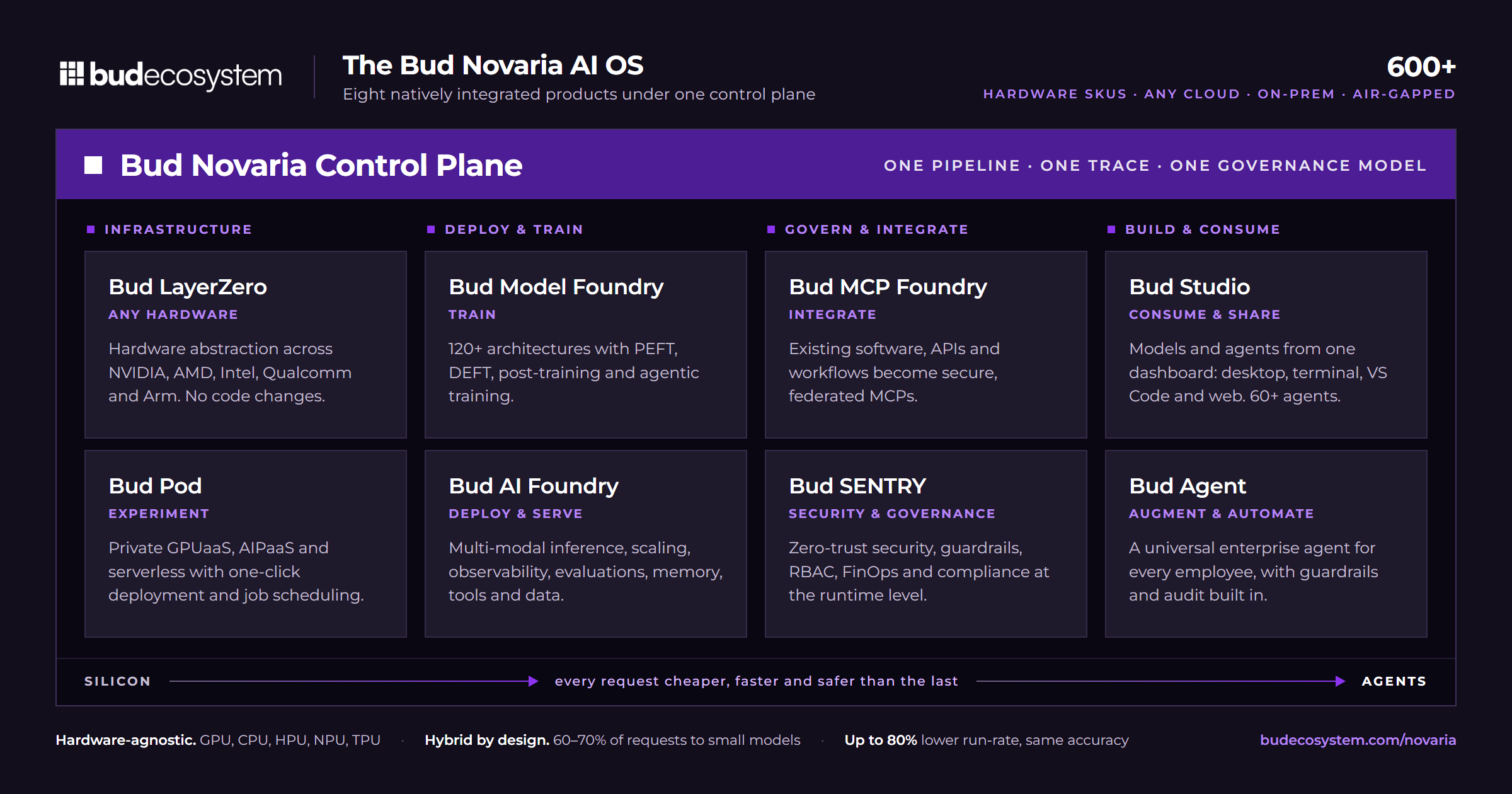
Bud Ecosystem delivers a single, opinionated, end-to-end platform with purpose-built role-based UIs for every enterprise persona — from super admins and model engineers down to business users.

3

Validated Cost Savings

Customer data shows Bud delivers 76–91% lower total cost of ownership compared to GPT-4o across RAG, SQL, translation, and summarization use cases, with up to 82% lower monthly AI spend in production deployments.

4

Hardware Freedom

Bud runs on commodity GPUs and CPUs from AMD, Intel, and Qualcomm—not just NVIDIA—with 600+ supported hardware configurations. In fact, 90% of enterprise AI workloads run efficiently at scale on Intel Xeon processors.

Purpose-Built for Every Enterprise Persona

Unlike NVIDIA's developer-only approach, Bud serves every role in your organization

Super Admin / Platform Operator
Full cluster management, FinOps, governance & compliance controls, infrastructure monitoring, DevOps and evaluation team dashboards. Complete operational visibility across all compute, models, and cost centres.
Admin / Developer (Model Engineer)
OpenAI-like developer dashboard for model deployment, agent building, project management, API management, fine-tuning, evaluation, and observability. Launch and manage deployments without infrastructure expertise.
Internal Developer (API Consumer)
OpenAI-compatible API access, integration tools, SDK access, and shareable agent/project endpoints. Seamlessly integrate Bud-hosted models into any application with zero rewrites.
Business User (Any Employee)
Bud Studio: desktop app, terminal, VS Code extension, and web UI. Universal personal assistant, 60+ pre-built agents, agent sharing & collaboration. The last-mile AI adoption surface for the entire enterprise.
Autonomous Agent Developer
Clawd Bot (Bud's Claude Code / GPT Codex alternative): agentic coding system on par with frontier coding agents, powered by private models. Terminal system for command-line AI access.
NVIDIA Approach: Developer APIs only — no end-user interfaces provided
Bud Approach: Purpose-built UIs for every persona from platform operators to business users

The Numbers Speak for Themselves

Validated benchmarks from enterprise deployments

76-91%
Lower TCO vs GPT-4o
Across RAG, NL-to-SQL, translation, and summarization use cases
82%
Cost Reduction
Case study: $220K/month → $40K/month with 3.3× faster response times
600+
Hardware Targets
CPUs, AMD GPUs, Intel Xeon/Gaudi/Arc, Qualcomm NPUs, TPUs — not just NVIDIA
<10ms
Guardrail Latency
Bud Sentinel vs. NVIDIA's ~500ms. Trained on 4.5M+ labeled samples

The NVIDIA Container Assembly Model

Understanding the hidden engineering tax

NVIDIA's enterprise AI platform is explicitly a collection of separately packaged Docker containers — each a discrete microservice that teams must individually deploy, configure, and wire together.

8+ Separate containers to assemble
4-6 Months typical deployment time
~4×10⁸ vLLM configuration permutations

NVIDIA Components Required:

  • NIM: Each model is its own Docker container requiring NVIDIA Container Toolkit, CUDA drivers 580+, NGC API key
  • NeMo Guardrails: Separate container adding ~0.5 seconds latency; requires Colang configuration
  • NeMo Retriever: RAG pipeline microservice deployed independently
  • NeMo Agent Toolkit: Open-source Python library requiring separate integration
  • NeMo Customizer/Evaluator: Additional containers for fine-tuning and evaluation

Bud: All-in-One Platform

NVIDIA Requires: NIM container (per model)
Bud Runtime — unified
NVIDIA Requires: NeMo Guardrails + Colang
Bud Sentinel — <10ms, 160+ guards
NVIDIA Requires: NeMo Retriever + Vector DB
Knowledge Layer — 200+ sources
NVIDIA Requires: NeMo Agent Toolkit + LangChain
Bud Agent Builder — no-code UI
NVIDIA Requires: Manual Kubernetes + third-party
AI FinOps — budgeting, rate limits
NVIDIA Requires: Not provided — APIs only
Bud Studio — desktop, VS Code, web
NVIDIA Requires: Manual LangChain integration
MCP Foundry — 400+ tools, no-code

Platform Architecture & Deployment

Detailed capability comparison across critical enterprise dimensions

Capability NVIDIA AI Enterprise Bud Ecosystem
Hardware Requirements NVIDIA GPUs Only

Exclusively NVIDIA GPU (H100, A100, B200/Blackwell). Requires NVIDIA-certified systems. Blackwell sold out through 2026–2027.

600+ Configurations

Hardware-agnostic: CPUs, GPUs (NVIDIA, AMD, Qualcomm, Intel), TPUs, NPUs. Runs on commodity hardware — no premium chip dependency.

Deployment Environments Limited Options

Cloud (AWS, Azure, GCP, OCI), DGX/on-prem data centers with NVIDIA-certified hardware. Kubernetes/Helm.

12+ Clouds + Edge

12+ clouds, private data centers, edge, air-gapped environments. Kubernetes-native. Zero-config sovereign deployment.

Inference Stack NVIDIA-Optimized

TensorRT-LLM, vLLM, SGLang — all NVIDIA-optimized. Best-in-class throughput on NVIDIA GPUs (2.6× speedup on H100).

Universal Engine

Bud Runtime: universal engine supporting LLMs, STT, OCR, diffusion. 0.3×–4× auto-tuned speedup. Heterogeneous routing across hardware classes.

Model Support 100+ Models

Llama 4, Gemma3, Mistral, DeepSeek-R1, Qwen3, NVIDIA Nemotron. NVIDIA-optimized containers.

120+ Architectures

Hardware-neutral support for all open models + custom fine-tuned models. 120+ architectures for training (SFT, DEFT, agentic). SOTA domain models included.

API Compatibility OpenAI Compatible

OpenAI-compatible REST APIs. Industry-standard; easy integration into LangChain, LlamaIndex, Deepset.

200+ Providers

OpenAI-compatible; supports 200+ model providers. AI Gateway with <1 ms overhead at 10K+ QPS.

Sovereign / Air-Gap Limited

Possible on-prem with NVIDIA DGX, but requires NVIDIA hardware procurement and enterprise license. Not designed for true air-gap scenarios.

Native Support

Native sovereign deployment: private data centers, air-gapped, disconnected environments. Purpose-built for data-sensitive sectors (defense, banking, government).

CPU Inference Not Supported

Requires GPU for all workloads. No CPU-native inference capability.

Fully Optimized

90% of enterprise AI tasks (OCR, TTS, STT, embeddings, actions) run natively on Intel Xeons at scale — no GPU required.

Security, Governance & Compliance

Enterprise-grade security capabilities comparison

Capability NVIDIA AI Enterprise Bud Ecosystem
Guardrails NeMo Guardrails

Topic control, content safety, security. Enterprise-grade but adds ~500ms measurable latency.

Bud Sentinel

<10 ms guardrail latency (near-zero overhead). 300+ probes. Trained on 4.5M+ labeled samples — world's largest open guardrail dataset.

Zero-Trust Security Basic RBAC

RBAC at software level. Relies on underlying cloud/on-prem security stack. No built-in confidential computing.

End-to-End

Zero-trust model governance end-to-end. Confidential computing. Model weight & infra security. Enterprise RBAC, FinOps controls.

Compliance & Audit Platform Dependent

Depends on deployment platform (cloud provider compliance). NVIDIA AI Enterprise SLA.

Built-in

Compliance-ready evaluation metrics. Rate limits & compliance monitoring. Built-in audit logs across all tiers.

Data Sovereignty Expensive

Data can flow through NVIDIA cloud APIs or partner clouds. Full sovereignty requires NVIDIA-certified on-prem DGX stack (expensive).

By Design

Sovereign-by-design: all data stays on-premise or in chosen cloud. No data egress to Bud infrastructure required.

Model Supply Chain Security Basic

Container validation and NVIDIA NGC catalog trust. No specific supply chain attack protection published.

Protected

Bud Runtime includes protections against LLM supply chain attacks via model downloads from untrusted sources.

Training & Model Customization

Model development and fine-tuning capabilities comparison

Capability NVIDIA AI Enterprise Bud Ecosystem
Training Frameworks NeMo 2.0

NeMo Framework 2.0 with Megatron Core. NeMo AutoModel (HuggingFace integration). Blackwell GPU support. Distributed training on EKS, Azure, GCP.

Model Foundry

120+ architectures. SFT, DEFT, post-training, agentic training. Low-compute, memory & bandwidth optimized. Runs on NVIDIA, AMD, Qualcomm, Intel hardware.

Fine-Tuning Methods LoRA via NeMo

LoRA adapters via NeMo Customizer and NIM multi-LLM containers. HuggingFace model support.

Multiple Methods

SFT, DEFT, LoRA, post-training techniques. Designed for accuracy-preserving low-resource fine-tuning.

Data Management Separate Tools

NeMo Data Designer + NeMo Curator for data curation, synthetic data generation, data flywheel.

Integrated Pipeline

Training pipeline with data curation tools. LLM 'windtunnel' experimentor for automated training configuration.

Evaluation NeMo Evaluator

Skill-based evaluations, regression testing. Data flywheel with continuous improvement loop.

140+ Benchmarks

LLM Evaluation Framework 2.0: 100+ datasets, reproducible metrics, compliance-ready audit scores. Red teaming included.

Experimentation Platform DGX Cloud

NIM Agent Blueprints as reference workflows; DGX Cloud-based training.

Bud Pod

Private GPUaaS, AIPaaS, serverless. One-click deployment, job scheduling, pipelining for researchers.

Agentic AI & Orchestration

Agent development and enterprise system integration

Capability NVIDIA AI Enterprise Bud Ecosystem
Agent Framework NeMo Agent Toolkit

Open-source Python: profiling, evaluation, optimization for production agent systems. Compatible with LangChain, LlamaIndex, OpenTelemetry.

Bud Agent Runtime

MCP orchestration (400+ MCPs), agent PaaS, composable agent networks, built-in guardrails, artifact sharing.

MCP / Tool Integration No Native MCP

No native MCP Foundry. Relies on external integrations (LangChain, etc.) for tool connectivity.

MCP Foundry

Converts any enterprise software, API, or workflow into MCP — no coding needed. 400+ pre-integrated MCPs. GenAI-ready from day one.

Agent Blueprints / Templates NIM Blueprints

Digital humans, multi-modal RAG, drug discovery, PDF ingestion. 1-click via NVIDIA Launchables.

60+ Prebuilt Agents

Bud Studio: 60+ prebuilt agents for enterprise use cases. Natural-language lifecycle management via Bud Agent.

End-User Interface Developer APIs Only

No consumer-facing studio. Developers interface via APIs and Jupyter-style tooling.

Bud Studio

Desktop app, terminal, VS Code extension, web UI. Empowers non-technical end-users — PA & intern for every employee.

Multi-Agent Coordination Basic Support

NeMo Agent Toolkit supports cross-agent coordination metrics. Blueprints demonstrate multi-NIM workflows.

Composable Networks

Composable agent networks: built-in multi-agent orchestration, secure deployment, inter-agent guardrails.

Observability, FinOps & Operations

Enterprise monitoring, cost control, and operational efficiency

Capability NVIDIA AI Enterprise Bud Ecosystem
Observability & Monitoring Third-Party Required

NeMo Agent Toolkit: granular metrics on tool usage, computational costs. OpenTelemetry compatible. Requires third-party tools (Fiddler, Arize, W&B).

Native Cockpit

Real-time inference monitoring, failure detection, auto-healing (restarts services, redirects traffic, spins new instances). Built-in analytics and reporting.

FinOps / Cost Controls Manual Tuning

Per-GPU subscription model. Cost optimization requires manual tuning. No unified FinOps layer.

Integrated FinOps

Predictable spend tracking, rate limits, cost forecasting, chargeback reporting. AI Gateway cuts costs by up to 40%.

Auto-Scaling Manual Config

Kubernetes-based scaling on NVIDIA-certified infra. Manual configuration required for complex scenarios.

Zero-Config Scaling

Bud Scaler: SLO-aware auto-scaling across heterogeneous hardware and clouds. Distributed KV caching; disaggregated compute.

Self-Healing Infrastructure Basic Restart

Container restart via Kubernetes. No AI-aware self-healing logic.

Autonomous Recovery

Bud Runtime: autonomous failure detection with automatic service restart, traffic redirection, and instance provisioning.

Natural Language Operations Not Available

No NLU operations interface.

Bud Agent

Manages deployments, runs optimizations, executes evaluations in natural language — turning weeks of MLOps into guided workflows.

Cost & Commercial Model

Understanding the true total cost of ownership

NVIDIA AI Enterprise

Licensing Per-GPU subscription tied to hardware. Annual/3-year/5-year terms. Opaque pricing.
Hardware CapEx High: requires NVIDIA H100/A100/Blackwell GPUs ($30,000–$40,000+ per GPU). Blackwell sold out through 2026–2027.
Cloud Costs H100 cloud at ~$2–$3/GPU-hour. Hidden operational costs: MLOps engineers, CUDA expertise.
Expertise Deep MLOps, CUDA, GPU scheduling expertise required. Scarce talent pool. High hiring overhead.
Vendor Lock-In Strong NVIDIA hardware and software ecosystem lock-in. CUDA moat creates switching costs.

Bud Ecosystem

Licensing Platform licensing independent of hardware vendor. No GPU vendor subscription fees. Unified per-deployment pricing.
Hardware CapEx Low: runs on commodity hardware, existing CPU/GPU clusters, widely available GPUs. No premium chip procurement.
TCO Savings 6–8× lower TCO versus traditional cloud. Heterogeneous routing offloads workloads to CPUs, reducing GPU costs.
Expertise Zero-config deployment. Natural language operations via Bud Agent. No CUDA expertise required.
Vendor Lock-In Hardware-agnostic by design. No vendor lock-in: runs on any cloud, any hardware, any open model.

Key Advantages Over NVIDIA AI Enterprise

Why enterprises are choosing Bud

Hardware Freedom (600+ Configurations)

Bud runs on CPUs, AMD GPUs, Intel Xeon/Gaudi/Arc, Qualcomm NPUs — not just NVIDIA. 90% of enterprise AI tasks run natively on Intel Xeons at scale with no GPU required. With Blackwell GPUs sold out through 2026–2027 and H100 lead times at 5–6 months, enterprises cannot afford NVIDIA-only strategies.

No Container Assembly Tax

NVIDIA requires assembling separate Docker containers for every capability: NIM, NeMo Guardrails, NeMo Retriever, NeMo Agent Toolkit, NeMo Customizer, NeMo Evaluator. A single vLLM node configuration alone spans ~4×10⁸ permutations. Bud delivers all 12 capabilities in one unified, pre-integrated platform — eliminating 4–12 months of deployment engineering overhead.

Validated 76–91% Lower TCO

TCO case study reports across four enterprise use cases vs. GPT-4o: RAG (87.6% cheaper), NL-to-SQL (76% cheaper), NL-to-Insights (85% cheaper), Translation (90.7% cheaper). AI stylist agent: $220K/month → $40K/month (82% reduction) with 3.3× faster response times and maintained accuracy.

True Sovereignty

NVIDIA enterprise still routes through cloud partners or requires expensive DGX on-prem stacks. Bud is sovereign-by-design: data never leaves the enterprise, supports air-gapped deployments, and is purpose-built for regulated industries — banking, defense, government.

Best-in-Class Guardrails

Bud Sentinel delivers <10 ms guardrail latency (near-zero overhead) trained on 4.5M+ labeled samples — the world's largest open guardrail dataset. NeMo Guardrails adds ~500ms measurable latency and lacks the same scale of adversarial training.

End-User Empowerment

NVIDIA has no consumer-facing studio — it is a developer and infrastructure platform. Bud Studio provides desktop, VS Code, terminal, and web UI interfaces, putting AI in the hands of every employee — not just developers. 60+ prebuilt agents for enterprise use cases.

Competitive Scorecard

Head-to-head evaluation across 15 enterprise dimensions

Evaluation Dimension NVIDIA Bud Leader
Hardware Flexibility 4/10 10/10 Bud Ecosystem
Raw Inference Performance (NVIDIA HW) 10/10 7/10 NVIDIA
Total Cost of Ownership 4/10 9/10 Bud Ecosystem
Data Sovereignty & Air-Gap 5/10 10/10 Bud Ecosystem
Security & Guardrails 7/10 10/10 Bud Ecosystem
Agentic AI & MCP Integration 6/10 9/10 Bud Ecosystem
End-User Studio / UX 3/10 9/10 Bud Ecosystem
Training & Model Customization 9/10 8/10 NVIDIA
Observability & FinOps 5/10 9/10 Bud Ecosystem
Vendor Independence 2/10 10/10 Bud Ecosystem
Ease of Deployment (No-MLOps) 5/10 9/10 Bud Ecosystem
Enterprise Ecosystem & Partnerships 10/10 6/10 NVIDIA
Domain-Specific Model Library 9/10 7/10 NVIDIA
Multi-Cloud / Multi-Region Support 7/10 10/10 Bud Ecosystem
Open-Source Commitment 6/10 8/10 Bud Ecosystem
11 Categories where Bud leads
4 Categories where NVIDIA leads

Where NVIDIA AI Enterprise Excels

A balanced analysis requires acknowledging NVIDIA's genuine advantages in specific contexts

Raw Inference Performance on NVIDIA Hardware

2.6× throughput vs. off-the-shelf H100 deployment. For organizations already owning NVIDIA GPU fleets, NIM delivers unmatched optimization.

Ecosystem Breadth & Industry Momentum

AWS, Azure, GCP, Oracle, Dell, HPE, Lenovo, 100+ ISVs. Every major cloud and OEM is NVIDIA-certified. Massive developer community (28M+ developers).

Specialized Domain Models

NVIDIA Nemotron Ultra (reasoning), BioNeMo (life sciences), Cosmos (physical AI/robotics), Riva (speech). Unique models with NVIDIA IP advantage.

Frontier Training Scale

NeMo 2.0 with Megatron Core is the dominant framework for training frontier-scale models. Used by Amazon, Shell, AT&T for custom LLM development.

Enterprise Support Network

SLA-backed support with NVIDIA AI experts. Validated software through rigorous NVIDIA certification. Partnerships with Accenture, Deloitte, Quantiphi for SI services.

Agentic Blueprint Library

NIM Agent Blueprints for customer service, drug discovery, multimodal RAG, digital humans — battle-tested reference implementations deployed at scale.

Ideal Use Case Matrix

Which platform is right for your enterprise scenario?

Government / Defense (Air-Gapped)

NVIDIA: Not designed for this Bud: Purpose-built sovereign stack

Public Sector Banks / BFSI

NVIDIA: Possible but high cost & complexity Bud: Sovereign, compliant, low TCO

SME / Mid-market without GPU infra

NVIDIA: Prohibitive hardware cost & expertise Bud: CPU/commodity GPU deployment possible

Cost-Sensitive AI Scaling (FinOps)

NVIDIA: Per-GPU subscriptions scale poorly Bud: Integrated FinOps, 6–8× lower TCO

Research Org with NVIDIA GPU Fleet

NVIDIA: Best-in-class performance optimization Bud: Runs on same fleet + heterogeneous HW

Frontier LLM Training at Scale

NVIDIA: NeMo Megatron-Core gold standard Bud: 120+ architectures, multi-hardware

The 7-Layer Bud AI Foundry Architecture

Designed to replace 100+ fragmented tools that enterprises currently manage manually

Bud Runtime
Model Layer
  • Hardware & engine agnostic model runtime
  • Zero-config deployment across 120+ architectures
  • Automated quantization, kernel optimization
  • CPU-native endpoints for 90% of enterprise tasks
Bud Scaler
Orchestration Layer
  • Zero-config scaling for models, tools, components
  • Multi-tenancy; multi-LoRA serving
  • Card isolation serving 10s of adapters
  • Serverless functions; virtual MCPs
Bud AI Gateway
Agentic Layer
  • Intelligent, self-learning AI Gateway
  • Multi-modal support, MCP integration
  • End-to-end agent builder
  • Internet-scale agent runtime
Bud Sentinel
Security & Governance
  • Zero-trust security for all operations
  • Bud Evals with 140+ benchmarks
  • 160+ Guardrails
  • AI FinOps with auto cost optimization
Knowledge Layer
Data & RAG
  • 200+ data source support
  • Synthetic data services
  • S3-compatible object storage
  • Vector DB deployment
MCP Foundry
Tool Integration
  • 400+ pre-integrated MCPs
  • Convert any API to MCP — no coding
  • Enterprise system integration
  • GenAI-ready from day one

Ready to Evaluate Bud for Your Enterprise?

Get a personalized assessment comparing TCO, deployment timelines, and capabilities for your specific use case.

For most enterprise AI initiatives — particularly in regulated sectors — Bud Ecosystem represents the more complete, cost-effective, and strategically sound choice.