Enterprise AI Platform Comparison

Nutanix AI vs.
Bud Foundry

A comprehensive comparison of enterprise AI platforms across infrastructure, inference, orchestration, security, agents, and service capabilities.

In a Nutshell,

Nutanix AI is an enterprise AI infrastructure platform focused on turnkey GenAI deployment with deep NVIDIA integration. Bud Foundry is a comprehensive enterprise Generative AI platform for RAG, multi-agent systems, governance, high-performance inference, and full AI application lifecycle with broad hardware support.

1

Hardware Flexibility

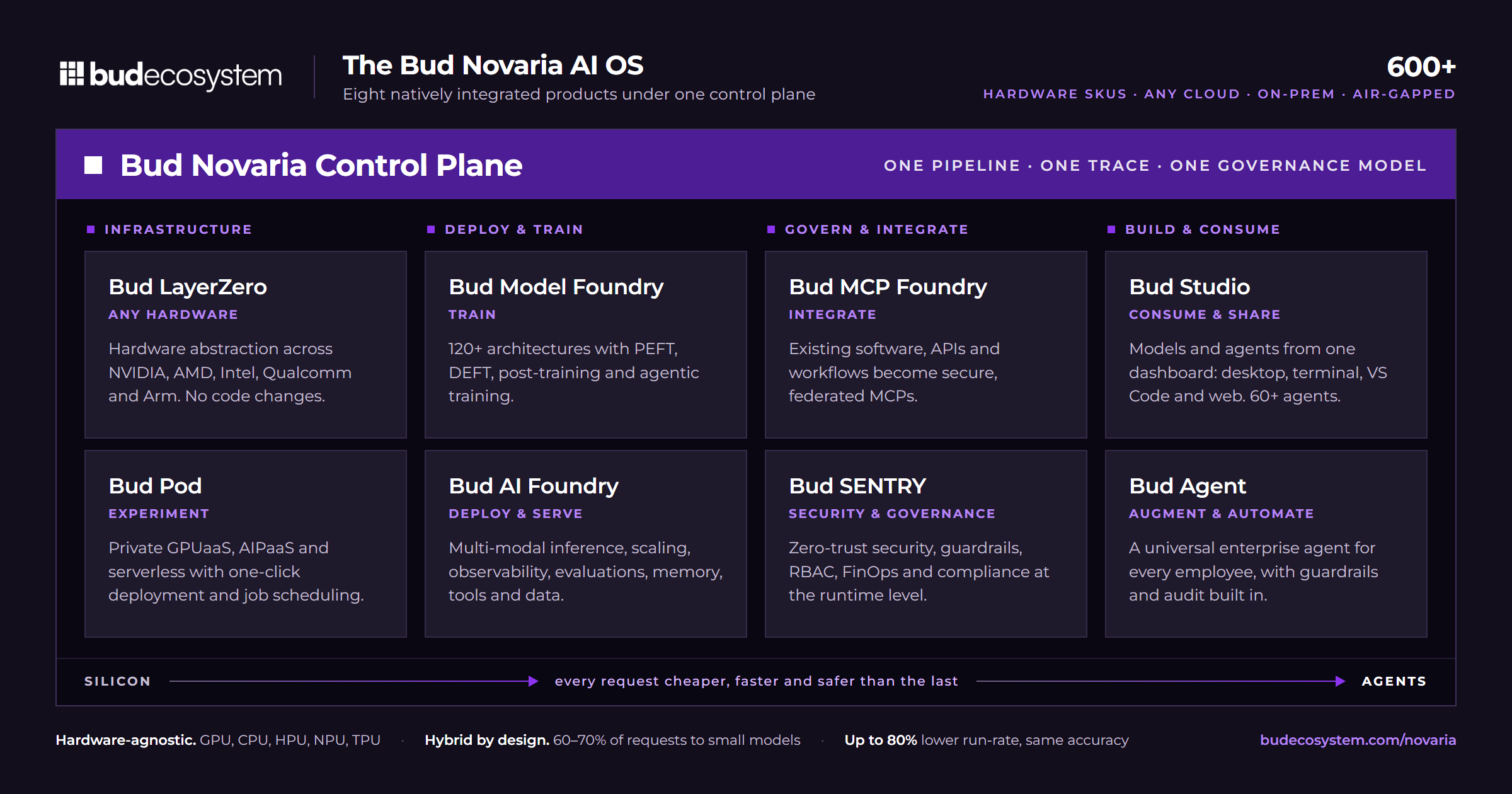
Nutanix supports NVIDIA GPUs only (L40S, L40, L4, H100, H200, A100). Bud supports 600+ hardware SKUs including NVIDIA, AMD, Intel, Gaudi, ARM, NPUs, CPUs, and TPUs.

2

Performance Advantage

Bud delivers 3.2x vs SGLang, 3.6x vs vLLM on DeepSeek 671B, 1.7x vs vLLM on M-LLM, and ~6x better embedding performance.

3

Modality Support

Nutanix: Text, Embeddings, Vision, Image Generation. No Audio/TTS/STT. Bud supports 8 modalities including Audio, Documents, Actions, Video, and Omni models.

4

Agent & Tools Ecosystem

Nutanix has no native A2A, MCP, or AG-UI protocol support. Bud provides 1000+ MCP tools, multi-agent runtime, 200+ pre-built agents, and full protocol support.

Key Capability Differences

Critical features where platforms diverge significantly

600+
Hardware SKUs (Bud)
vs NVIDIA-only support in Nutanix AI
3.6x
Faster than vLLM
Bud performance on DeepSeek 671B
26+
Guardrails (Bud)
vs no native guardrails in Nutanix
1000+
MCP Tools (Bud)
vs no native MCP support in Nutanix

General Comparison

Core platform capabilities and architecture differences

Category Nutanix AI Bud Foundry
Core Focus

Enterprise AI infrastructure platform for turnkey GenAI deployment, LLM inference, and RAG applications with focus on data sovereignty, air-gapped environments, and hybrid multicloud consistency. Built on Nutanix Cloud Platform (NCP) with deep NVIDIA integration.

Enterprise Generative AI platform for RAG, multi-agent systems, governance, high-performance inference, and full AI application lifecycle. Supports GPU-as-a-Service with additional components for basic training/fine-tuning.

Architecture Model

Full-stack software-defined architecture: Nutanix Cloud Infrastructure (NCI) for HCI with GPU nodes, AHV hypervisor (NVIDIA AI Enterprise validated), Nutanix Kubernetes Platform (NKP) for orchestration, Nutanix Unified Storage (NUS) for NFS/S3. Minimum 4-node GPU cluster with 100GbE networking.

Unified GenAI application runtime integrating orchestration, routing, governance, observability, security, and FinOps.

Hardware Flexibility NVIDIA Only

NVIDIA GPUs only (L40S, L40, L4, H100, H200, A100, RTX PRO 6000, Blackwell announced). Intel AMX for CPU-based acceleration on <10B models. AMD GPUs not currently supported despite marketing mentions.

Heterogeneous

Broad heterogeneous hardware support (NVIDIA, AMD, Intel, Gaudi, ARM, NPUs, CPUs), optimized for hybrid/edge/cloud environments.

Compute Optimization Basic

GPU virtualization via MIG (NAI 2.5), vGPU (software-based, up to 64 users/card with live migration), and full passthrough. Time-slicing via round-robin scheduler (480-960 Hz). No automated workload-aware slicing or bin-packing.

Advanced

Advanced GPU/CPU virtualization (time-slicing, spatial slicing etc), dynamic workload scheduling, bin-packing, auto-scaling, and workload-SLO-resource aware routing.

Model Inference Gateway Basic

NAI Gateway (early access in 2.5): Load balancing, rate limiting, API controls, unified endpoints for multi-model routing, API key management, SSL encryption, RBAC. No KV-cache-aware routing or SLO-based routing.

Advanced

High-performance inference engine with sub-millisecond gateway latency, token optimization, caching, concurrency management, and model-level QoS routing.

RAG & Knowledge Pipelines Manual Assembly

Native RAG support via dedicated embedding endpoints, reranker endpoints, PostgreSQL with pgvector (via Nutanix Database Service). NVIDIA NeMo Retriever integration. Sample 'Talk-to-My-Data' app included. Requires manual component assembly.

Native

Native RAG orchestration, knowledge indexing, semantic retrieval, 200+ data connectors.

Agent Framework Limited

Agentic AI via NVIDIA NIM/NeMo microservices (NAI 2.5). Tool calling with one-click enablement, function calling for external APIs. NVIDIA AI Blueprints for templates. No native A2A, MCP, or AG-UI protocol support (only third-party experimental mcp-nutanix).

Comprehensive

Multi-agent runtime, contextual coordination, tool integration, workflow execution, and reasoning optimization.

Guardrails & Trust Via NVIDIA

NVIDIA NeMo Guardrails integration: jailbreak protection, prompt injection defense, topic restrictions. Runs locally in containers for air-gapped deployment. Custom programmable rail definitions. No native hallucination detection or red teaming.

Enterprise-grade

Enterprise-grade guardrails (safety, bias, toxicity, compliance), policy enforcement, access control, data governance, zero-trust operational security.

Observability & Telemetry Basic

LLM metrics in NAI 2.5: TTFT, TPOT, tokens/sec, latency percentiles (P50/P95/P99), active/queued requests, GPU utilization. Rsyslog integration for audit logs. No native OpenTelemetry support; third-party integrations available.

Full-stack

Full-stack observability across hardware, inference engine, models, agents, pipelines, users, cost, latency, SLOs, drift, hallucination, and cache behavior.

AI FinOps Basic

Cost governance via Nutanix Cloud Manager. Intel AMX for CPU inference (GPU cost avoidance), MIG/vGPU for GPU sharing. Manual endpoint scaling for right-sizing. No dedicated AI FinOps dashboards with chargeback/showback.

Built-in

Built-in AI FinOps: usage metering, cost tracking, token optimization, budget enforcement, energy insights, workload forecasting, and automated resource right-sizing.

Multi-tenancy Basic

RBAC for model/endpoint access controls, API key management with per-endpoint attribution. Active Directory/SSO integration (LDAP, SAML). No per-tenant quotas, isolated model contexts, or multi-LoRA serving documented.

Deep

Deep multi-tenancy: isolated model contexts, per-tenant quotas, role-based policy controls, multi-LoRA serving, virtual endpoints.

Deployment & Scaling Manual Scaling

On-premises, edge, public cloud (AWS EKS, Azure AKS, GKE), bare metal, air-gapped dark sites with full offline bundle support. Kubernetes-native scaling with HPA, Knative (scale-to-zero). Manual minInstances/maxInstances configuration.

Automated

Multi-environment enterprise deployments (on-prem, hybrid, sovereign cloud, edge), cross-cluster scaling, infrastructure reprovisioning.

Extensibility & Ecosystem Limited

NVIDIA partnership (NIM, NeMo, AI Blueprints, Blackwell), Intel AMX, Hugging Face model library. Partner integrations: DataRobot, Robust Intelligence, AccuKnox. OpenAI-compatible APIs. Limited native extensibility for custom workflows.

Enterprise

Enterprise API/SDK ecosystem for agents, models, guardrails, workflows; integration with data platforms, DevOps, enterprise systems.

GPU as a Service Comparison

Runtime, virtualization, and inference capabilities

Category Nutanix AI Bud Foundry
Runtime NVIDIA Only

NVIDIA GPUs only: L40S, L40, L4, H100, H200, A100, RTX PRO 6000. Blackwell architecture announced. Intel AMX for CPU-based inference on smaller models (<10B parameters). AMD GPUs confirmed NOT supported in FAQ despite marketing mentions. No NPU, TPU, or Gaudi support.

600+ SKUs

Bud Runtime is a truly heterogeneous GenAI model runtime that supports over 600+ hardware SKUs - GPUs, NPUs, HPUs, CPU, and TPUs. Across vendors like Nvidia, AMD, Intel, Huawei, IBM, Google, Tenstorrent, Cambricon, Rebellions NPUs etc. With guaranteed, new customer chip integration.

Virtualization Standard

Three methods: 1) MIG (NAI 2.5) - hardware-level partitioning on A100/L40/H100 with isolated memory/cache, 2) vGPU - software-based sharing up to 64 users/card with live migration support, 3) Full passthrough for maximum performance. Time-slicing via Kubernetes GPU Operator with round-robin scheduling.

Advanced

Truly heterogeneous virtualization for all supported hardware. Multiple virtualization support - Hardware partitioning (MIG), MPS (Nvidia), Hami-core, FCSP (Bud proprietary), Timeslicing. State of the art noisy neighbor reduction with true MIG-like isolation and fairness. Supports workspaces & tenant offloading to extend GPU memory by 40-50% through CPU offloading & prefetching.

Inference Engine 5 Engines

Five engines supported: vLLM (primary, PagedAttention-based), TGI (Hugging Face), NVIDIA NIM (optimized microservices), hf-transformers (native), custom-model-server (user-provided). vLLM is default in deployment UI. No SGLang or MLX support.

Bud Runtime+

Comes with Bud Inference engine - with custom kernels & optimizations for Model Inference acceleration, stability & heterogeneity at scale. Also supports vLLM, SGLang, Triton, MLX, LLaMa.cpp or BYOIE.

Model Support 300+ Models

300+ pre-validated models from NVIDIA NIM (NGC catalog), Hugging Face Hub, and custom uploads. Auto model size detection from Hugging Face imports (NAI 2.5). Pre-configured vCPU, memory, GPU recommendations. Community-based support model.

Automated

Automated kernel support, guaranteed extensions for new model architectures across devices - custom customer models as well.

Inference Scaling Basic

Kubernetes-native scaling: HPA compatibility, Knative autoscaling (scale-to-zero). Manual endpoint scaling with minInstances/maxInstances (NAI 2.5). NAI Gateway provides load balancing. No LLM-specific autoscaling based on KV cache or token metrics.

Automated

Automated topology, SLO & hardware aware scaling, parallelism, SLO guarantees, accuracy etc.

P/D Disaggregation No

Prefill-Decode disaggregation not documented or supported.

Yes

Full P/D disaggregation support for optimal resource utilization.

Hardware Aware Placement & Scaling Partial

Hardware validation checks if infrastructure can run models at desired context length. No automated workload-aware placement or SLO-based scaling.

Yes

Full hardware-aware placement and scaling.

Automated Slicing & Cluster Realignment No

MIG slices are manually configured. No automated cluster realignment based on workload.

Yes

Automated slicing and cluster realignment.

Hardware Failure Prediction No

Relies on standard Nutanix infrastructure monitoring. No AI-specific hardware failure prediction.

Yes

Proactive hardware failure prediction.

KV Cache Offloading & Cross-Engine Reuse No

KV cache management handled by underlying inference engines. No cross-engine KV reuse or advanced offloading.

Yes

Full KV cache offloading and cross-engine reuse.

Benchmark & Inference Accuracy Verification No

No native tool. MLPerf Storage benchmarks available for storage performance. No inference accuracy verification or model quality evaluation tools.

Yes

Full benchmark and inference accuracy verification tools.

Inference Engine Comparison

Engine support, modalities, endpoints, and deployment capabilities

Category Nutanix AI Bud Foundry
Inference Engine Support

vLLM (primary), TGI, NVIDIA NIM, hf-transformers, custom-model-server. No SGLang, Triton (standalone), or MLX.

Bud runtime, vLLM (Bud Enterprise version - Less errors, zero configuration, HIPAA, GDPR (PII) Compliance), Triton, SGLang, TGI.

Modality Support Limited

Text Generation (primary), Embeddings (dedicated endpoint), Reranking (/rerank API), Vision/Multimodal (Llama 4 Scout 17B-16E), Image Generation (Stable Diffusion). No Audio (TTS/STT), Document/OCR, or Action models.

8 Modalities

Text, M-LLM (Vision-Text, Audio-Text, Omni), Text to Image (diffusion), Audio (STT, TTS), Embeddings (decoder, encoder, Re-ranker, Classifier, CLIP, CLAP), Documents, Actions (GUI Interaction), Video.

Deployment Semi-automated

'3-click' deployment with pre-validated configurations. Auto model size detection from Hugging Face (NAI 2.5). Hardware validation for context length. Manual endpoint scaling configuration.

Fully Automated

Completely automated & SLO aware deployment.

Middleware

NAI Gateway provides load balancing, rate limiting, SSL. Rsyslog for logging. No native Kafka, custom middleware framework.

Built-in middlewares for Text, Documents, Embeddings (REST, GRPC), Audio (Livekit).

Endpoints REST Only

OpenAI-compatible REST APIs: /chat/completions, /embeddings, /images/generations, /rerank, /models. Provider schema support for OpenAI, Anthropic, GCP patterns. No gRPC, WebRTC, or LiveKit.

Multi-transport

Multi-vendor, multi-transport - REST, gRPC, LiveKit, SSE, WebRTC. Supports 12+ vendor endpoints: OpenAI (Responses, Chat completion, Realtime, guard, batched, slo-based), Anthropic, Gemini etc.

Workload Types Online Only

Online serving (primary). Batch inference possible through API but not optimized. No SLO-based or priority-based request handling documented.

Multiple

Online serving, Batched inferencing, SLO & Priority based requests.

Parallelism/SD/PD Manual

Tensor Parallelism via multi-GPU configuration (1-8+ GPUs per endpoint). Depends on underlying engine (vLLM). No automated parallelism selection or PD disaggregation.

Automated

Automated best setting & deployment, with automated scaling.

KV Cache Aware Routing No

Routing handled by NAI Gateway without KV cache awareness.

Yes
Adapters - LoRA, DoRA Via Engine

Not documented as native NAI feature. Available through vLLM/TGI engine capabilities. No UI-based LoRA management.

Yes

Full LoRA and DoRA support.

Automated Quantization No

Must use pre-quantized models or NIM microservices.

Yes

Automated quantization support.

GPU Optimizer No

MIG/vGPU for resource sharing but no profiler-based optimization or automated GPU allocation.

Yes

Profiler-based GPU optimizer.

Zero Config Deployment Partial

Pre-validated models have optimal configurations. Auto model size detection (NAI 2.5). Still requires infrastructure setup and manual scaling configuration.

Yes

Bud simulator finds out the best engine configurations.

Proprietary Cloud Model Support No

No native integration with cloud AI providers (OpenAI, Anthropic, etc.). Focused on self-hosted inference.

200+ Providers

Integration with 200+ Cloud AI providers like OpenAI, Anthropic etc.

Custom Decoding & Sampling Engine Default

Depends on underlying inference engine (vLLM/TGI defaults). No NAI-native custom decoding methods beyond engine capabilities.

14 Methods

14 different sampling/decoding methods including entropy method for inference time scaling methods.

Performance Comparison

Benchmarked inference performance across modalities

Bud Foundry demonstrates significant performance advantages across all tested modalities and model types.

3.6x
vs vLLM
LLM / LRM (DeepSeek 671B)
3.2x
vs SGLang
LLM / LRM (DeepSeek 671B)
1.7x
vs vLLM
M-LLM (Multimodal)
~6x
Better
Embeddings (BERT, RoBERTA, ModernBERT, CLIP, CLAP)

Nutanix AI Performance Notes

LLM/LRM: vLLM, TGI, NVIDIA NIM. Performance metrics available (TTFT, TPOT, tokens/sec). No comparative inference benchmarks published.
M-LLM: Supported via Llama 4 Scout (17B-16E). No performance baselines published.
Embeddings: Dedicated endpoint. No performance benchmarks or model-specific optimizations documented.
TTS/STT: No support. No dedicated audio endpoints or models.
Document/OCR: Partial support via RAG pipelines. No native OCR models.
Action Models: No support. No GUI interaction or action model capabilities.
Omni Models: No. Limited to text, vision, embeddings, image generation modalities.

Orchestration Comparison

Scaling, caching, and cluster management capabilities

Category Nutanix AI Bud Foundry
RayClusterFleet (Multi-LoRA) No

No Ray integration. Multi-LoRA not documented as native feature.

Yes

Enables multi-LoRA-per-pod deployments, significantly improving scalability and resource efficiency.

LLM-Specific Autoscale No

Uses standard Kubernetes HPA/Knative. No KV cache or inference-aware autoscaling.

Yes

Real-time, second-level scaling leveraging KV cache utilization and inference-aware metrics to dynamically optimize resource allocation.

GPU Optimizer No

MIG/vGPU for static allocation. No dynamic profiler-based optimization.

Yes

Profiler-based optimizer which optimizes heterogeneous serving, dynamically adjusting allocations to maximize cost-efficiency while maintaining service guarantee.

Accelerator Diagnostics No

Standard Nutanix infrastructure monitoring only. No AI-specific accelerator diagnostics.

Yes

Automated failure detection and mock-up testing to improve fault resilience.

Request Router Partial

NAI Gateway provides rate limiting and load balancing. No documented fairness policies or TPM/RPM controls.

Yes

Central request dispatcher enforcing fairness policies, rate control (TPM/RPM), and workload isolation.

Distributed KV Cache Runtime No

KV cache managed by individual inference engines. No distributed runtime.

Yes

Scalable, low-latency cache access across nodes. Enables KV cache reuse, reducing redundant computation and improving token generation efficiency.

LLM Specific CRDs No

Standard Kubernetes resources. No LLM-specific CRDs or P/D disaggregation.

Yes

Specialized container lifecycle management for P/D disaggregation, including multi-mode support (TP, PP, single GPU, and P/D disaggregation), and custom resources for P/D orchestration.

Scaling Methodologies Basic

HPA (Horizontal Pod Autoscaler), Knative autoscaling (scale-to-zero). Manual minInstances/maxInstances configuration (NAI 2.5). No KPA or advanced optimizer-based scaling.

Advanced

HPA, KPA (KNative Auto Scaler), APA (Advanced Pod Autoscaler), Optimizer-based Autoscaling: SLO & Request aware autoscaling. All with reactive and proactive auto-scaling.

Cluster Observability Standard

Nutanix Prism Central for infrastructure visibility. Kubernetes resource monitoring, GPU usage statistics, endpoint health in NAI dashboard.

Yes

Full cluster observability with LLM-specific metrics.

OTEL Support No Native

No native OpenTelemetry support. Third-party integrations available (Datadog, Dynatrace, ScienceLogic). Rsyslog for log aggregation.

Yes

Native OpenTelemetry support.

Hot Cluster Updates Partial

Nutanix Lifecycle Manager (LCM) provides full-stack updates. Rolling updates for Kubernetes workloads. No documented hot updates for running inference endpoints.

Yes

Full hot cluster updates support.

Security & Governance Comparison

Model security, firejailing, and zero-trust capabilities

Category Nutanix AI Bud Foundry
Model Scan No

No native capability. Partner integration with Robust Intelligence for model validation. No built-in scanning.

Yes

Protects from model serialization attacks, weight poisoning, data theft, data poisoning etc.

Model Weight FireJailing No

Models stored in Nutanix Unified Storage with standard encryption. No firejail isolation.

Yes

Model weights in secure firejail pre-inferencing for zero-trust infrastructure security.

Inference Time Security Monitoring No

NeMo Guardrails provides input/output filtering but not runtime security monitoring.

Yes

Inference time monitoring to monitor and purge unauthorized access, execution or calls.

FireJailed Object Storage No

Standard encryption at rest (FIPS 140-2 Level 1/2). No firejail for storage.

Yes

Ensuring that model weights and model artifacts at rest are strictly guardrailed from any unauthorized access, executions etc.

Non-Weight Artifact Scanning No

Relies on trusted sources (NGC, Hugging Face). No artifact scanning.

Yes

Scanning other artifacts from public model repos, code repo etc.

Zero Trust Model Lifecycle Partial

AccuKnox integration for Zero Trust CNAPP. Forward proxy for secure downloads (NAI 2.5). Not comprehensive model lifecycle.

Yes

Bud SENTRY framework provides end-to-end model lifecycle management - through downloads, at rest, or while during execution and back.

Model Output & Input Guardrails

Guardrail capabilities, performance, and customization

Category Nutanix AI Bud Foundry
Private LLM Guardrails No

No native guardrails.

Yes

Bud Guard supports 26 different guardrails including prompt injections, toxicity, model drift etc. Ensures 100% airgapped and safe AI deployments.

Guardrail Integrations No

No external guardrail provider integrations.

Yes

Azure AI Foundry guards, AWS guardrails, Palo Alto network, Protect AI etc.

Guardrail Performance No

No native guardrails to measure.

<10ms

Less than 10ms latency with Bud Guard.

Supported Guardrails No

No native guardrails.

Comprehensive

26+ Bud guards, 200+ Secret rules, 40+ PII Protection, 6 different guard providers (Cloud models if required).

Custom Guardrails No

No custom guardrail capability.

Yes

Through natural language, Bag of words, RegEx, Bud symbolic AI, Custom policies.

Guard Types No

No guard types.

Multiple

LLM, MLLM, TTS, MCPs, Retrieval, Tools.

Architecture No

No guardrail architecture.

3-Layered

1) Bud Guard - Performant L1 guard layer <10ms, 2) Encoder based models - LlaMa guard, Prompt guard, 3) LLM based guardrails - GPT-OSS 20B / Qwen Guard etc.

Hardware Requirement N/A

No native guardrails.

CPU Only

Bud guards are GPU-free models that are CPU native.

Model Governance & Safety Controls

Red teaming, evaluations, and compliance capabilities

Category Nutanix AI Bud Foundry
Red Teaming No

Not documented.

Yes

Over 12+ safety evaluations, based on OWASP guidelines.

Model Evaluations No

No native evaluation framework.

120+ Evals

120+ Evals across many different domains, task types. Like HumanEval for coding, ARC-AGI etc.

Evaluation Metrics No

Relies on external tools.

16+ Metrics

16+ different metric types. Like F1, ROGUE, PPL, Gen, LLM-as-a-Judge etc.

Active Hallucination Detection No

Not documented.

Yes

Multi-layered hallucination detection built right into the inference engine.

AI & Sovereign AI Compliance Partial

FIPS, HIPAA, PCI-DSS compliance. No AI-specific sovereign compliance framework.

Yes

Add custom policy rules for Sovereign AI compliances - Across models, tools, Agents & data.

Agents, Prompts & Tools

Agent runtime, tooling, and protocol support

Category Nutanix AI Bud Foundry
Agent & Tools Runtime No

No native agent runtime.

Yes

Internet scale agent & tools runtime built on top of Dapr for distributed & scale agent & tools execution with autoscaling.

Agent Builder No

No agent builder.

Yes

Build end-to-end agents easily through code or through drag & drop.

Tools/MCPs No

No native MCP support.

1000+

Over 1000+ MCP tools, with MCP creation from documentation/OpenAPI/Swagger spec. Inbuilt tools like Calculator, Clock, websearch etc.

Data Integration No

No data connectors.

200+

200+ data connectors to easily create RAG or data intensive agents.

Structured Input/Output No

No structured output support.

Yes

Structured output through JSON/TOON.

Agent Observability No

No agent observability.

Yes

Agent & tools observability at scale for debugging, development & SLO definitions.

Protocol Support No

No A2A, MCP, or AG-UI support.

Yes

Supports A2A, MCP, AG-UI protocols.

Agent Endpoints No

No agent endpoints.

Yes

openai/responses, openai/chat/completions, gRPC etc.

Prompt Caching No

No prompt caching.

Yes

Cache agent, inference & prompt caching to reduce inference cost by ~30%.

Prompt Compression No

No native prompt compression.

Yes

Compress input prompts to reduce the inference or input cost with cloud model.

Playground Yes

NAI Labs (NAI 2.5) provides playground with conversational chatbot, RAG sample apps, image upload testing.

Yes

Supports Bud playground and Gradio.

Prebuilt Agents/Usecases No

No prebuilt agents.

200+

Over 200+ Pre-built agents & usecases with SLOs.

Model/Token/Platform as a Service

Service publishing, dashboards, and enterprise capabilities

Category Nutanix AI Bud Foundry
Model As A Service No

No model publishing capability.

Yes

Ability to publish models with custom pricing, quota, rate limits etc. End users can create API keys and consume the models for their apps/agents.

End User Dashboard No

No end user dashboard.

Yes

OpenAI-like end user dashboard to track token usage, view models, generate API keys, keep track of logs, observability etc.

Client Tools No

No client tools.

Yes

OpenAI-like chat tool, Claude Code-like terminal based coding tool, Cursor-like VS code extension.

MaaS Management System No

No MaaS management.

Yes

Management publishing, FinOps, user management, API key management.

RAG as a Service Manual Assembly

Requires assembly: NAI endpoints + NDB (PostgreSQL/pgvector) + sample app. Not turnkey RAG-as-a-Service.

Yes

Private team/individual RAG for every employees or teams within the enterprise.

Agent As A Service No

No Agent-as-a-Service capability.

Yes

Build & share agents across the entire enterprise.

Ready to Transform Your AI Infrastructure?

Get a personalized assessment comparing platform capabilities, deployment requirements, and ROI potential for your specific enterprise AI workloads.

For enterprises requiring heterogeneous hardware support, advanced guardrails, multi-agent capabilities, and comprehensive AI FinOps - Bud Foundry is the clear choice.