 White Paper · 2026
Bud AI Foundry
The Sovereign Control Plane for the Generative-AI Lifecycle
From model onboarding, automated governance, and cost-optimal hardware sizing — through multi-cloud deployment — to a sub-millisecond inference gateway with intelligent routing, safety, observability, and billing. One platform. Self-hostable. Air-gap capable.

What this paper covers.
- SummaryExecutive Summary
- —The core differentiator and who this paper is for03
- Ch. 01Introduction
- 1What Bud AI Foundry is07
- 2The six cooperating planes09
- 3The golden path11
- Ch. 02Value Proposition
- 4For enterprises, CSPs & OEMs, and engineers14
- 5Headline benefits and unique selling propositions18
- Ch. 03The Components
- 6The component stack — eighteen products20
- 7Inside Bud Agent Runtime31
- Ch. 04The Compounding Structure
- 8Why the whole exceeds the sum & the capability matrix34
- Ch. 05Transforming the AI Journey
- 9Seven causal insights, by stakeholder39
- Ch. 06Conclusion46
The model is the easy part.
Most organizations adopting generative AI confront the same hidden truth: the model is the easy part. The hard part is everything around it.
Proving a model is legally safe to use, scanning it for supply-chain threats, sizing the cheapest hardware that meets a latency target, deploying it across clouds and on-premises, routing each request to the right model, enforcing safety and spend limits on every call, and producing an audit trail a regulator will accept. Done conventionally, this is a six-to-ten-tool, multi-team, multi-week integration project that must be repeated for every model and every cluster.
Bud AI Foundry collapses that entire project into a single, self-hostable control panel. It is the control plane and the data plane for private and sovereign generative AI: a model registry with computed governance, a hardware-sizing optimizer, a multi-cloud cluster and deployment engine, a high-performance inference gateway compatible with the most widely used AI APIs, an intelligent semantic router, an agent and tooling runtime, an evaluation harness, and a unified safety, billing, audit, and observability stack — with the dashboards over all of it.
Bud's value is not any single feature. It is that the features are wired into closed feedback loops and shared control points, so the combination produces capabilities none of the parts has alone: an unbypassable policy plane on every request, governance that is computed rather than asserted, a self-calibrating cost economy, and a complete AI lifecycle that runs entirely inside the customer's own perimeter.
The defining capability is a fully automated journey from "a model exists somewhere" to "a governed, cost-optimal, observable, standards-compatible endpoint" — a pipeline that no single point tool provides. Equally important is the default deployment posture: client-hosted and air-gap-capable. The entire stack, including the AI models that power Bud's own governance and assistant features, can run inside a bank, a hospital, a government agency, or a defense network that cannot send data to an external AI service.
Who this whitepaper is for
This document is written for three audiences whose interests converge on Bud AI Foundry.
Enterprises
that need to run AI across a heterogeneous mix of accelerators and clouds, with strict governance, predictable cost, and a complete audit trail — without surrendering data to a third-party SaaS.
Cloud Service Providers & OEMs
that want to offer a white-labelable, multi-tenant AI platform to their own customers, monetizing GPU capacity with built-in metering, chargeback, and isolation.
Sovereign & regulated institutions
for whom data residency is non-negotiable, and for whom "self-host the model but SaaS everything else" is not an acceptable architecture.
The sections that follow establish the platform's value proposition for each audience, then descend into the component-by-component technical architecture — each framed by the problem it solves, how it solves it, its unique strengths, and the benefits it delivers — before closing with how the compounded structure produces value far greater than the sum of its parts.
Introduction
What Bud AI Foundry is, the architecture that makes it cohere, and the automated lifecycle at its heart.
What Bud AI Foundry is.
Bud AI Foundry is a microservices platform that turns the statement "we have GPUs and clouds, and we want to run AI models for our organization" into a managed, governed, observable product.
It is built as a set of cooperating services orchestrated on Kubernetes, combining a high-performance data plane with a rich control plane. Stated plainly, Bud AI Foundry is all of the following, in one platform:
- A model registry with computed governance — automated license analysis and supply-chain security scanning, not a passive catalog.
- A hardware-sizing optimizer that finds the cheapest configuration meeting your service-level objectives across CPUs, GPUs, and dedicated AI accelerators.
- A multi-cloud cluster and model-deployment engine spanning public clouds and on-premises infrastructure.
- A sub-millisecond inference gateway that speaks the most widely adopted AI APIs and fronts a large set of providers plus self-hosted engines.
- An intelligent semantic router that chooses the right model per request for quality, cost, safety, and latency.
- A prompts, agents, and tools runtime with sandboxed code execution and document understanding.
- An evaluation harness, plus a unified safety, billing, audit, and observability stack — and the dashboards over all of it.
What Bud AI Foundry is not
By default, Bud is not a public AI software-as-a-service. Its default posture is client-hosted: the whole stack — including the AI models that power its own assistant and governance features — can run inside the customer's perimeter, and is capable of fully air-gapped operation. This is a deliberate architectural commitment, and it is the single largest reason regulated and sovereign institutions can adopt Bud where they cannot adopt cloud AI platforms.
Throughout this whitepaper, capabilities are described as they are actually built, grounded in the platform's source rather than aspiration. Bud's engineering culture treats the code as the source of truth, and this document follows that discipline.
The six cooperating planes.
At a high level, the platform separates cleanly into a central control plane — the brain — and a per-cluster data plane — the hot path through which every inference request flows.
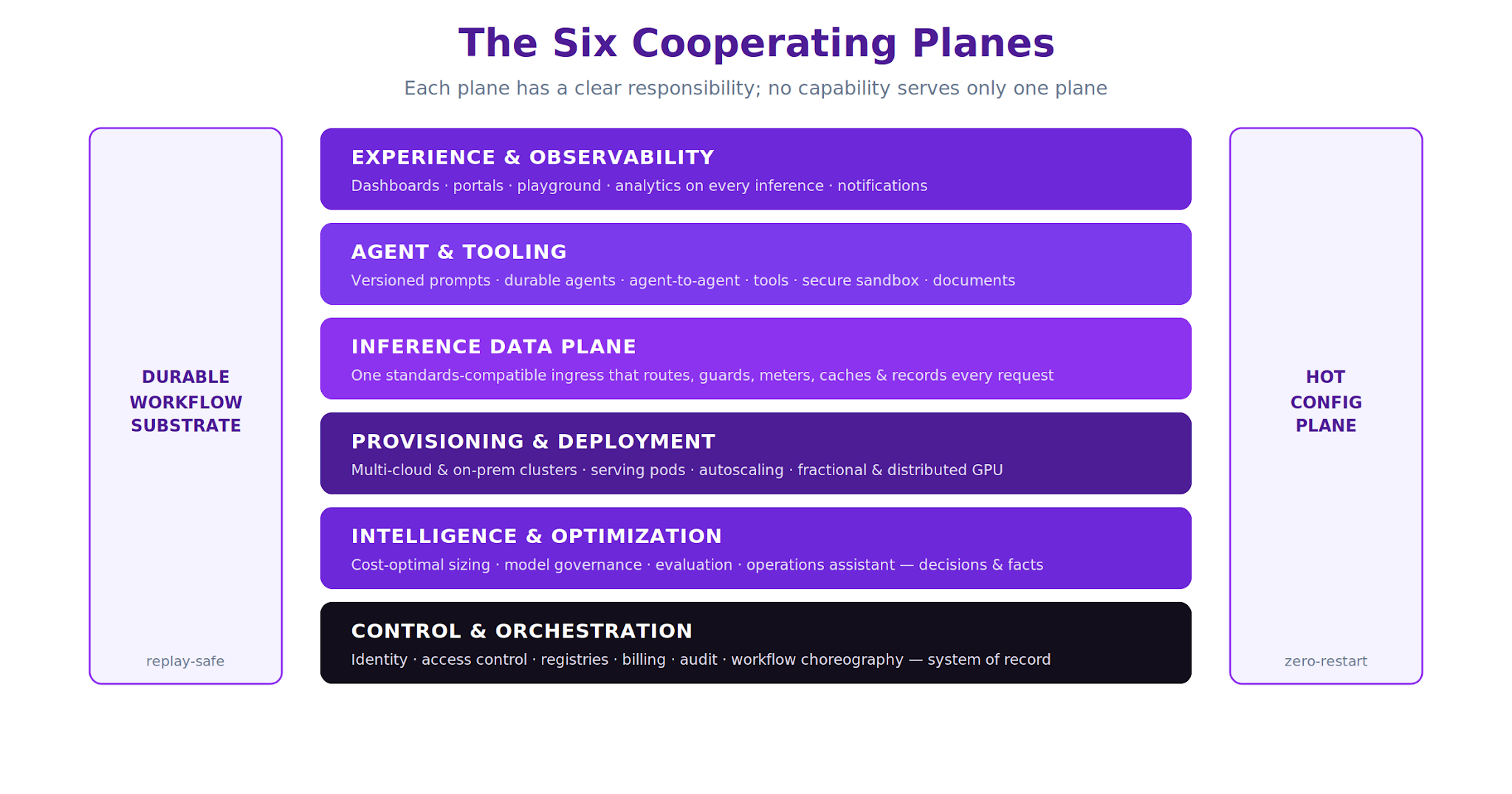
Connecting them are two coordination substrates: a durable, replay-safe workflow mesh for long-running orchestration, and a configuration plane that lets control-plane changes propagate into the running data plane with zero restart.
When an operator adds a model, rotates a key, publishes a router, sets a quota, or adds a safety rule, the change is written once to the configuration plane and hot-swapped into the live data plane in milliseconds — fleet-wide, with no redeploy. This single property underpins much of what makes Bud's governance instant and universal.
Rather than a loose collection of services, Bud is best understood as six cooperating planes. Each has a clear responsibility, and the deliberate separation between them is what lets the platform scale, stay secure, and remain comprehensible.
| Plane | Responsibility |
|---|---|
| 1 · Control & Orchestration | Identity, role-based access control, projects and workspaces, the registries (models, endpoints, clusters, routers, guardrails, prompts), and the choreography of every multi-service workflow. The system of record. |
| 2 · Intelligence & Optimization | The decision-making brains: cost-optimal sizing, model knowledge and governance, quality measurement and evaluation, and conversational operations analysis. These produce decisions and facts, not infrastructure. |
| 3 · Provisioning & Deployment | Turns decisions into running infrastructure: clusters across clouds and on-premises, model serving pods, autoscalers, fractional-GPU sharing, and distributed inference. |
| 4 · Inference Data Plane | The per-request hot path: one standards-compatible ingress that routes, guards, meters, caches, and records every inference. |
| 5 · Agent & Tooling | Higher-order capabilities composed on top of inference: versioned prompts, agent-to-agent interaction, tool connectors, sandboxed code execution, and document understanding. |
| 6 · Observability & Experience | Closing the loop: analytics on every inference, notifications, and the dashboards, portals, and playground that users actually touch. |
The defining design principle is that no capability serves only one plane. The gateway is at once a developer convenience, a scaling primitive, a security enforcement point, and a governance ledger. This multi-dimensional density — every capability simultaneously contributing to developer experience, scalability, security, and governance — is the foundation on which the platform's emergent benefits are built.
The golden path.
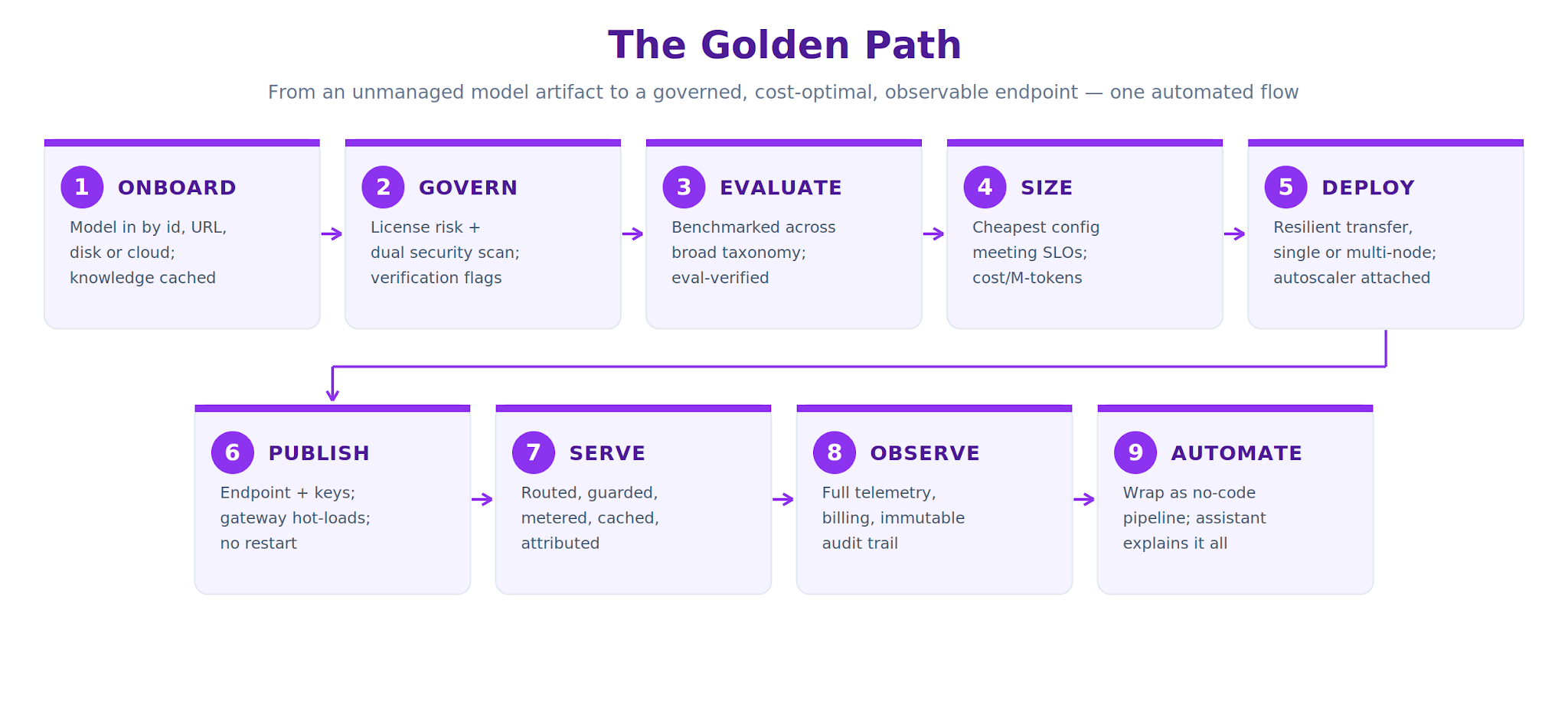
The platform's signature workflow is the fully automated journey from an unmanaged model artifact to a governed, cost-optimal, observable, standards-compatible endpoint. To the operator, it is a single guided wizard with one progress bar.
Each step is owned by a different part of the platform; together they form a pipeline that replaces a security engineer, a legal reviewer, an ML engineer, and a platform team working per-model and per-cluster over weeks.
Onboard
The operator supplies a model — by registry identifier, URL, local path, or cloud reference. Metadata is extracted and resolved against a fleet-wide knowledge cache, so a popular model is analyzed once and reused everywhere.
Govern
Automated license analysis classifies the license, computes the net business risk of each clause, and produces a commercial-use verdict. In parallel, a sandboxed dual security scan checks for unsafe serialization payloads and malware.
Evaluate (optional)
The model is benchmarked across a large catalog of curated datasets spanning a broad capability taxonomy, producing trait scores, leaderboard positions, and an evaluation-verified flag.
Size
The sizing engine predicts serving performance across CPU, GPU, and accelerator targets, then searches for the cheapest configuration that meets your SLOs — attaching a cost-per-million-tokens figure to every recommendation.
Deploy
The deployment engine transfers the model resiliently, renders the serving configuration, and deploys it — single node or distributed multi-node — then verifies health and attaches an intelligent autoscaler.
Publish
An endpoint and API keys are created; the gateway hot-loads the configuration and the model is immediately live behind a standards-compatible API — with no restart.
Serve
Each client request flows through the gateway and, where configured, the semantic router: it is routed, safety-scanned, quota-metered, geo-tagged, cached, and rate-limited — all on the same request.
Observe
Every inference emits telemetry into a high-performance analytics warehouse, feeding dashboards, usage-based billing, and an immutable audit trail.
Automate
Any of the above can be wrapped as a scheduled or event-driven no-code automation, and an operations assistant answers questions about the running system in natural language.
Each step is a coordinated service call or a configuration write, and each emits progress events that the control plane aggregates. An operator watching the dashboard sees a single progress bar spanning the whole pipeline. This connective tissue — durable workflows for orchestration and a hot configuration plane for propagation — is the core of how Bud's features are wired together rather than merely co-located.
Value Proposition
Why Bud AI Foundry matters — to enterprises, to cloud service providers and OEMs, and to the engineers who build on it.
The value proposition for enterprises.
For an enterprise, the central problem with generative AI is not capability — it is control. Capability is increasingly commoditized; control over cost, compliance, data, and operational risk is what determines whether an AI program succeeds or quietly stalls.
Consolidation: one platform instead of a toolchain
A team adopting Bud gets, in one platform, the capabilities they would otherwise assemble from a dozen separate vendors and open-source projects — a multi-provider gateway, a model registry with license and security scanning, cost-optimal sizing, multi-cloud provisioning and serving, an observability warehouse, a prompts-and-agents platform, evaluation, guardrails, intelligent routing, usage-based billing, multi-tenancy, and an immutable audit trail. Consolidation eliminates the integration surface where most AI programs lose months.
Governance that is enforced, not asserted
In most organizations, "is this model safe to use commercially, free of malicious payloads, and good enough?" is answered by a slide deck. In Bud, it is a query against machine-checked platform state. A model cannot be deployed ungoverned: it passes through security scanning, license analysis, and optional evaluation — each turning a compliance artifact into a verified fact behind a tamper-evident audit trail.
Cost as a controllable quantity
The most common failure mode of an internal AI program is runaway, unattributable spend. Bud makes cost a measured, budgeted, charged-back, and auto-optimized quantity at every layer: every sizing recommendation carries a cost-per-million-tokens figure; deployments auto-place on the cheapest viable hardware, including fractional-GPU slices and scale-to-zero; each project gets a budget enforced at the gateway; and usage is metered and charged back per project.
Data sovereignty by default
Because the entire platform is client-hosted by default and capable of air-gapped operation, the enterprise's data never has to leave its perimeter — not for inference, not for governance, not even for the operations assistant. For regulated industries, this removes the single largest blocker to AI adoption.
Bud AI Foundry is the platform an enterprise adopts when it has decided that AI is strategic enough to own — its cost, its compliance, its data, and its operations — rather than rent. It replaces a fragile, multi-team integration project with a single governed control plane that runs inside the enterprise's own infrastructure.
The value proposition for CSPs and OEMs.
Cloud service providers and OEMs have compute capacity — GPU fleets, accelerator hardware, regional data centers — and need to turn it into a differentiated, monetizable AI product for their own customers. Bud is, in effect, the AI platform layer they would otherwise have to build.
A white-labelable platform
Bud is designed to be resold or brand-customized without code changes. The login experience, the dashboards, and the notification templates are all brand-customizable through configuration overlays rather than source forks — so an integrator can ship their own AI platform, under their own brand, on top of Bud.
Multi-tenancy that holds end to end
Isolation is enforced at every layer: per-tenant identity clients, per-service data isolation, namespace isolation per deployment, and row-level security tying every analytics record and cost line back to the project that generated it. A tenant can only ever see inferences for the projects their keys are bound to — an invariant that holds unbroken from the browser session to the individual analytics row.
Built-in metering, quotas, and chargeback
A CSP needs to bill. Bud provides usage-based billing with per-project plans, quotas enforced directly at the gateway, alerting at configurable thresholds, billing-cycle awareness, and chargeback analytics dimensioned by project, endpoint, model, and key. The monetization machinery is part of the platform, not a bolt-on.
Maximizing hardware return
For a provider, idle silicon is lost revenue. Bud turns heterogeneous, partially-idle hardware into a cost and density advantage: fractional-GPU time-slicing packs multiple models onto one accelerator, scale-to-zero reclaims idle capacity, distributed inference serves models too large for one node, and the sizing engine places each model on the cheapest viable target across the whole fleet.
Bud lets a provider stand up a branded, multi-tenant, fully-metered AI cloud on their own hardware — with isolation, governance, and chargeback built in — instead of spending years building the platform layer that sits between raw GPUs and a sellable product.
The technical value proposition.
For the engineers who build on and operate Bud, the value proposition is concrete and measured. It rests on a small number of strong architectural decisions whose consequences compound.
Near-zero switching cost
The gateway is a drop-in front door for the most widely used AI APIs. A team already calling a major provider repoints one base URL and keeps its existing code and SDKs. Because the same gateway fronts both hosted providers and self-hosted engines, a customer can start on cloud passthrough and migrate to their own GPUs without changing a line of client code.
A genuinely elastic, AI-aware data plane
The data plane scales on signals that matter for AI workloads — gateway tail latency and in-flight request depth — not crude CPU proxies. It combines paged-attention memory management, continuous batching, tensor and pipeline parallelism, fractional-GPU sharing, distributed multi-node inference, and an autoscaler with scale-to-zero, predictive, and cost-aware policies.
Sub-millisecond gateway overhead
The gateway is engineered in a systems language for minimal per-request overhead: a high-performance allocator, fully asynchronous and lock-free hot paths, configuration tables hot-swapped wholesale, and fire-and-forget telemetry that never blocks the response path — while still enforcing auth, rate limits, quotas, safety, and full analytics on every call.
Analytics at scale, with no app code on the hot path
Every inference becomes a durable, queryable record in a denormalized analytics warehouse with cascading time-based rollups. All aggregation happens inside the warehouse, so dashboards render in sub-second time even across billions of rows.
One-command install and reproducibility
The entire platform — application services and all stateful backends — installs with a single command, each backend managed by a battle-tested operator. The reference environment is fully declarative and reproducible; procurement, proof-of-concept, and production all start from the same source of truth.
Bud gives engineers a platform that is trivial to try, elastic and fast in production, observable at scale, and reproducible from a single command — while the contract-first design means new backend capabilities automatically surface in the no-code interfaces without hand-written glue.
Headline benefits at a glance.
A handful of numbers capture the shape of the platform.
The unique selling propositions
Several capabilities, taken together, distinguish Bud AI Foundry from any assembled toolchain or single-category product.
The automated golden path
An end-to-end, one-flow pipeline from unmanaged model to governed, cost-optimal, observable endpoint — owned by four cooperating brains for governance, sizing, deployment, and serving. No single point tool provides this.
The unbypassable policy plane
Because every inference traverses one gateway whose behavior is defined by a hot configuration plane, routing, safety, cost, identity, and telemetry are enforced simultaneously on every request. You cannot send an inference that escapes them.
Computed governance
License risk, security scans, evaluation scores, and an immutable hash-chained audit trail turn compliance from a document into enforced, queryable platform state.
Sovereign full-lifecycle AI
Not just self-hosted models — the entire lifecycle, including the governance and assistant AI, runs inside the customer's perimeter with no required external dependency.
Cost as a first-class surface
Cost-per-million-tokens on every option, fractional-GPU placement, scale-to-zero, gateway-enforced budgets, and per-project chargeback make spend a steerable quantity end to end.
Contract-first, auto-generated no-code UX
Backend capabilities are defined once in typed, test-locked contracts that automatically generate the no-code visual builders — so engine and interface evolve together with no hand-maintained glue.
The market is not missing inference engines. It is missing a sovereign control plane that wires governance, cost, safety, and observability into every request and every model.
The Components
Each major component — the problem it solves, how it solves it, what makes it distinctive, and the benefits it delivers.
The component stack.
Bud AI Foundry is composed of a set of purpose-built components. For every one, four questions are answered in order: what problem it solves, how it solves it, what makes it unique, and what benefits it delivers.
The components are presented in the order an operator encounters them along the golden path, followed by the cross-cutting services.
| Component | One-line role |
|---|---|
| Bud Control Plane | The orchestration brain: identity, access control, registries, billing, audit, and workflow choreography. |
| Bud Model Registry | Computed model governance: automated license analysis and sandboxed security scanning. |
| Bud Sizing Engine | Cost-optimal hardware sizing across CPU, GPU, and accelerators, with a cost figure on every option. |
| Bud Cluster Engine | Multi-cloud and on-premises provisioning and resilient model deployment. |
| Bud Runtime | A multi-modal, heterogeneous inferencing system with automated quantization. |
| Bud Serve | Bud Runtime plus modality middleware — complete document, audio, and other modality services. |
| Bud Scaler | The AI-aware autoscaling and distributed-inference control plane. |
| Bud Gateway | The sub-millisecond, standards-compatible inference data plane and policy enforcement point. |
| Bud Semantic Router | The neural-symbolic router that selects the right model per request. |
| Bud Agent Runtime | A durable, massively-concurrent agent platform with governed agent-to-agent collaboration. |
| Bud Secure Sandbox | Hardened, isolated code execution as a governed tool. |
| Bud Document Engine | Vision-language document understanding and extraction. |
| Bud Sentinel & Sentry | Unified security and policy: infrastructure, model-weight, guardrails, and custom policies. |
| Bud Eval | Standardized model evaluation across a broad capability taxonomy. |
| Bud Pipelines | No-code, event-driven lifecycle automation. |
| Bud Metrics | Full-stack observability and tracing on a high-performance analytics and audit warehouse. |
| Bud Notify | Multi-channel notifications and live trace streaming. |
| Bud Assistant | A conversational operations assistant served by the customer's own model. |
Bud Control Plane
System of recordThe orchestration brain and system of record for the entire platform.
An AI platform spanning many services needs a single authoritative brain — one that knows every user, what they may do, which models, clusters, and routers exist, and how to coordinate a workflow touching half a dozen services without losing track of it. Without this, every service becomes an island and the platform fragments.
The control plane is the unified API and system of record across more than two dozen resource domains. It centralizes identity through standards-based SSO with a secure server-side flow in which the browser never holds access tokens, and authorization runs through a database-backed policy decision point nothing can bypass. It never proxies inference; instead it configures the data plane by writing to the hot configuration plane. Long-running, multi-service operations are choreographed as durable, replay-safe workflows that survive restarts, with progress events aggregated into one progress bar.
- A single control plane spanning identity, access control, registries, billing, lifecycle gates, and workflow orchestration — not a dashboard bolted onto separate tools.
- A database-backed policy decision point that is the sole source of authorization truth, with permission expansion and cached effective scopes.
- An immutable, tamper-evident audit trail with hash-chaining, integrity verification, and audit-ready export.
- A configuration-by-writing model: the control plane changes the data plane's behavior without ever sitting on the request path.
- One coherent surface to manage the entire AI lifecycle, instead of many admin consoles.
- Strong, centralized security and access control that no service can circumvent.
- A complete, regulator-ready evidence base for every administrative action.
- Reliable orchestration that does not lose state when infrastructure misbehaves.
Bud Model Registry
Computed governanceComputed model governance — turning a model artifact into a verified, compliant, well-understood asset.
Before a model can be trusted in production, three expensive questions must be answered for every model, every time: Is it legally safe to use commercially? Is it free of malicious payloads hidden in its weights? And what, precisely, is it? Done by hand, this is a recurring tax — a legal reviewer, a security engineer, and an ML engineer — that stalls adoption.
A workflow-driven extraction automates all three. For licensing, it sources the text, classifies it into one of ten license types, answers a structured battery of yes/no questions, and computes the net business risk of each clause. For security, the files are scanned inside a network-isolated sandbox by two complementary scanners — unsafe-serialization detection plus an antivirus pass — hardened for multi-gigabyte weight shards. Rich metadata feeds sizing and the catalog, and the license analysis can run on the customer's own in-tenant model so license text never leaves the perimeter.
- Automated license analysis that computes the net business risk of every clause, not just a license name.
- A large pre-analyzed license corpus, including AI-model-specific licenses, that keeps classifications consistent fleet-wide.
- Dual supply-chain scanning inside a network-isolated sandbox, hardened for multi-gigabyte model weights.
- An in-tenant analysis option that keeps sensitive license and governance data inside the customer's deployment.
- A shared, fleet-wide knowledge cache — a popular model is analyzed once and reused everywhere.
- Legal and security review becomes a single automated workflow, instead of weeks of expert effort.
- A defensible, queryable record of why each model was deemed safe and compliant.
- Supply-chain threats are caught before a model ever reaches a cluster.
- Governance data stays inside the perimeter for the most sensitive deployments.
Bud Sizing Engine
Cost-optimal sizingThe sizing brain — the cheapest hardware that meets your SLOs, with a price on every option.
The single hardest, most expensive judgment in self-hosted generative AI is capacity planning: which accelerators, how many, what parallelism, what batch size, will the model fit in memory, and what will it cost? Answered by hand it is iterative and error-prone — the most common reason deployments stall. Answered wrongly it wastes money or misses latency targets.
The engine predicts serving performance and recommends the lowest-cost configuration meeting your targets — choosing serving engine, device type, tensor and pipeline parallelism, replicas, concurrency, adapter slots, and quantization — then emits the concrete deployment parameters. It offers a fast heuristic path and a deeper evolutionary optimizer. Every recommendation carries a cost-per-million-tokens figure, it reads live cluster and fractional-GPU metrics on every run, and it suppresses configurations that failed real deployments so they are never recommended again.
- A cost-per-million-tokens figure on every single recommendation — financial planning built into capacity planning.
- A tunable accuracy-versus-speed trade-off: instant heuristics for interactive use, deeper optimization when it matters.
- First-class support for fractional GPUs, CPUs, and dedicated accelerators, turning heterogeneous silicon into a cost advantage.
- A feedback loop that calibrates recommendations to the customer's actual hardware and improves with use.
- Multi-node parallelism planning that automatically sizes models too large for a single accelerator.
- Capacity planning becomes a one-click, objective-driven, cost-ranked recommendation instead of expert guesswork.
- Infrastructure spend is visible and optimized before a single GPU is committed.
- Whatever silicon an organization already owns can be used to its fullest.
- The most expensive judgment in self-hosted AI becomes an automated, self-correcting output.
Bud Cluster Engine
Provision & deployMulti-cloud and on-premises provisioning, and resilient model deployment.
Standing up the infrastructure to serve a model is a multi-day platform-engineering task per cluster: provision Kubernetes, install GPU drivers and device plugins, a serving runtime, an autoscaler, and metrics, then hand-write serving manifests — and repeat for every cloud and every cluster. Moving tens of gigabytes of weights reliably is its own failure-prone problem.
The cluster engine takes the sizing engine's configuration and deploys it to public clouds or on-premises Kubernetes from one wizard, auto-installing the entire serving stack: hardware detection, GPU operators, fractional-GPU time-slicing, accelerator device plugins, the autoscaling and distributed-inference control plane, and metrics exporters. A resume-capable downloader survives interruption and eviction; for very large models it renders a distributed multi-node topology automatically. Tenant credentials are encrypted at rest and decrypted only inside isolated workflow activities, each deployment in its own namespace.
- One wizard that provisions a cluster, installs the complete GPU serving stack, and deploys the model — across clouds and on-premises alike.
- Resilient, resume-capable model transfer with deterministic, replay-safe workflows that survive pod eviction and infrastructure chaos.
- Automatic distributed multi-node inference for very large models, and high-density adapter sharing on a single base model.
- Encrypted-at-rest tenant credentials decrypted only inside isolated workflow activities, with per-deployment namespace isolation.
- Fractional-GPU time-slicing on the scheduling hot path, increasing density and lowering per-model cost.
- A multi-day platform-engineering task per cluster collapses to a single guided flow.
- Deployments survive the kinds of infrastructure failures that derail manual processes.
- Models of any size — from small CPU-served models to multi-node giants — are handled by one engine.
- Strong credential security and tenant isolation are built into every deployment.
Bud Runtime
Multi-modal inferenceA multi-modal, heterogeneous inferencing system serving every modality across every kind of silicon.
Serving modern AI efficiently is hard on two fronts. Naive serving wastes memory, batches poorly, and leaves accelerators underutilized — and fleets are heterogeneous mixes of datacenter GPUs, dedicated accelerators, and CPUs. Meanwhile real applications need language, vision, image generation, speech in both directions, embeddings, documents, and actions — and stitching a separate serving system per modality multiplies the operational burden.
Bud Runtime serves the full range of modalities through one system. On performance it uses paged, non-contiguous memory management, continuous batching, prefix caching, tensor and pipeline parallelism, and a broad range of quantization formats — across datacenter GPUs, dedicated accelerators, and CPUs. These capabilities form the search space the sizing engine optimizes over. It also performs automated quantization, compressing a model for the target hardware while preserving accuracy, with the quantized footprint fed directly into cost-optimal sizing.
- A single inferencing system spanning every modality — not a separate stack per modality.
- Serving across datacenter GPUs, dedicated AI accelerators, and CPUs, so heterogeneous hardware serves one catalog.
- Paged memory management and continuous batching that maximize utilization and minimize fragmentation.
- Automated quantization that compresses models for the target hardware while preserving accuracy, fed into sizing.
- One serving system covers every modality an application needs, eliminating per-modality integration.
- High throughput and utilization, which directly lower the cost per token.
- Freedom to serve the same models on whatever silicon is available or cheapest.
- Models are compressed and configured automatically rather than hand-tuned.
Bud Serve
Modality servicesBud Runtime plus the middleware that turns raw model serving into complete modality services.
A raw inference engine produces model outputs, but a usable modality service needs more. Serving documents end to end requires parsing, layout analysis, and extraction around the vision-language model; real-time audio requires session handling, streaming, and media transport around the speech models. Without this middleware, every team rebuilds the same plumbing per modality.
Bud Serve is Bud Runtime combined with modality-specific middleware that makes each modality a complete, ready-to-use service. Around documents it adds parsing and extraction; around audio it adds the real-time session and media-transport layer; and the pattern extends to other modalities. An application consumes a finished capability rather than a bare model endpoint — and all middleware-mediated model calls still route through the gateway.
- A single offering pairing the multi-modal runtime with the middleware each modality needs.
- Document services with built-in parsing, layout analysis, and extraction around the vision-language model.
- Real-time audio services with session handling, streaming, and media transport around the speech models.
- All middleware-mediated model calls still route through the gateway, inheriting governance and cost tracking.
- Applications consume finished modality services instead of rebuilding plumbing per modality.
- Document and audio workloads work end to end out of the box.
- The surrounding middleware inherits the same governance as the models themselves.
- Time-to-value for multi-modal applications drops sharply.
Bud Scaler
AI-aware autoscalingThe AI-aware autoscaling and distributed-inference control plane.
Generic autoscaling does not understand AI workloads. Scaling on CPU utilization is a poor proxy for an inference service whose real pressure shows up as queue depth and accelerator-cache saturation. And serving a model larger than a single node requires coordinating a distributed cluster, which generic orchestration does not provide.
Bud Scaler is the inference-aware control plane layered onto the cluster. It autoscales on real engine metrics — accelerator-cache usage, queue depth — recomputed on a tight interval, and advertises a rich policy surface: scale-to-zero, accelerator-aware thresholds, cost-aware scaling with spot-instance preference, predictive look-ahead, scheduled hints, and multi-cluster federation. For large models it orchestrates distributed multi-node inference; high-density adapter serving lets many fine-tunes share one base model.
- Autoscaling on signals that matter for inference — queue depth and accelerator-cache saturation — not CPU proxies.
- A rich policy surface: scale-to-zero, cost-aware, predictive, scheduled, and multi-cluster-federated scaling.
- Orchestration of distributed multi-node inference for models too large for a single accelerator.
- High-density serving of many fine-tuned adapters on a shared base model.
- The inference tier elastically tracks real demand, neither over- nor under-provisioned.
- Idle endpoints cost nothing, and cost-aware policies keep spend within budget.
- Very large models are served reliably across nodes.
- Accelerator density is maximized through adapter sharing.
Bud Gateway
Policy data planeThe sub-millisecond, standards-compatible inference data plane and single policy-enforcement point.
Every organization serving AI needs a front door — one place to send every request, that speaks a standard API, fronts many backends, fails over gracefully, and enforces security, cost, and safety. Built ad hoc, it becomes a patchwork of a proxy here, a rate limiter there, a safety filter you can forget to wire up — inconsistent enforcement and a request path nobody fully controls.
Bud Gateway is a single, high-performance ingress engineered in a systems language for minimal overhead. It speaks the most widely adopted AI APIs across the full surface and fronts hosted providers alongside self-hosted engines through one model abstraction, with ordered failover and fallback chains. Its entire behavior is defined by the hot configuration plane, so on a single request it authenticates the key, applies guardrails, enforces rate limits and cost quotas, applies firewall rules, attaches geo context, serves from cache, and records analytics — all co-located on the hot path.
- A drop-in front door for the most widely used AI APIs across many providers and self-hosted engines.
- Sub-millisecond per-request overhead while still enforcing auth, limits, quotas, safety, and full analytics.
- A single, unbypassable enforcement point: no inference can escape routing, safety, metering, attribution, and audit.
- Zero-restart configuration: models, keys, routers, quotas, and safety rules hot-swap in milliseconds.
- Per-key model and prompt allowlists, re-validated even against router-chosen models; secrets decrypted only in memory.
- Adopting Bud is a base-URL change; migrating off a hyperscaler is a configuration change, not a rewrite.
- Resilience — failover and fallback — that teams would otherwise hand-build.
- Security, cost, and safety policy that is structural rather than wired up per model.
- A complete, consistent record of every request for analytics, billing, and audit.
Bud Semantic Router
Per-request routingThe neural-symbolic router that selects the right model per request for quality, cost, safety, and latency.
Pinning every request to a single model is wasteful and risky: a simple query does not need an expensive frontier model, a request bearing sensitive data may need to stay on-premises, and a degraded backend should be routed around. Hardcoding these choices in application code is brittle, invisible, and impossible to govern.
The router turns "which model should serve this request?" into a declarative, measured, optimizable policy. It is a three-layer neural-symbolic system: a first layer extracts many signal types — domain, complexity, language, sensitive-data presence, jailbreak indicators, modality, geography — computed lazily and in parallel; a functionally-complete boolean decision engine maps signals to decisions with priority and confidence; and a per-decision chain of selection algorithms runs from static choice through cost-cascade-with-self-verification, similarity, clustering, and adaptive bandits. Shared base models with swappable adapters and compact embeddings let routing run on CPU. The selection layer optimizes quality, the gateway optimizes cost, and a semantic cache short-circuits equivalent queries.
- A genuinely rich routing system — many signal types, a complete decision engine, many selection algorithms — made no-code-configurable.
- Lazy, parallel signal evaluation so latency tracks the slowest active signal, not the total.
- Per-decision model pools: sensitive requests pinned to on-premises models while routine requests take a cost-cascade.
- Memory efficiency through shared base models with swappable adapters and CPU-capable compact embeddings.
- Two-stage separation: routing optimizes quality, the gateway optimizes cost, a semantic cache eliminates redundant work.
- One endpoint transparently backs onto a fleet of models chosen per request for quality, cost, safety, and latency.
- Significant cost savings by reserving expensive models for the requests that need them.
- Safety and residency policy expressed as routing, not application code.
- Resilience that adapts automatically to backend degradation.
Bud Agent Runtime
Durable agentsA durable, massively-concurrent agent platform: type-safe agents, skills, tools, and governed agent-to-agent collaboration.
Building agentic applications normally means assembling four or five separate things — a prompt-management tool, an agent framework, a tool-connector layer, an interoperability protocol — and then solving the two hardest problems yourself: reliability and safety. Agents are long-running and failure-prone; a crash midway means starting over and double-charging. And an ungoverned agent mesh is the industry's fastest-growing risk surface.
Bud solves both at once by combining a type-safe agent framework with a durable-execution substrate. The framework provides a versioned prompt store, runtime-enforced structured I/O, reusable skills, four classes of tools, and a stateful response API. Underneath, every agent runs on a durable virtual-actor substrate — thousands per core at double-digit-millisecond latency, with stateful scale-to-zero — and every model and tool call is persisted so an agent resumes from checkpoint after failure. Decisively, every model call routes back through the gateway, so agents inherit the same quotas, guardrails, attribution, audit, and cost tracking as raw inference.
- A type-safe agent framework and a durable-execution substrate combined in one runtime.
- A virtual-actor model running thousands of agents per core at double-digit-ms latency, with stateful scale-to-zero.
- Durable execution: every model and tool call is persisted, so agents resume from checkpoint instead of starting over.
- Built-in cryptographic per-agent identity, mutually-encrypted agent-to-agent communication, per-deployment scoping.
- Every model call routes back through the gateway, so agents inherit full quota, safety, audit, and cost governance.
- Seven agentic patterns and a full tool surface — skills, connectors, native tools, agents-as-tools — out of the box.
- Agentic applications are built from managed, durable primitives rather than a fragile assembled framework.
- Long-running agents survive failures and never repeat — or double-charge for — completed work.
- The platform scales from one agent to thousands without re-architecture, paying nothing for idle agents.
- The biggest emerging AI risk — ungoverned agents — is structurally mitigated by identity, encryption, and gateway governance.
- Agent cost and safety are tracked exactly like raw inference; versioned prompts make behavior reproducible.
Inside Bud Agent Runtime.
Because the agent runtime is where Bud's reliability, scale, and safety guarantees for agentic AI actually live, it warrants a closer look. Two foundations make it distinctive: a durable, virtual-actor execution substrate, and a complete, type-safe agent framework on top.
The durable execution substrate
Most agent frameworks treat an agent as an in-memory object: fast to start, but lost the moment a process restarts. Bud instead builds on a graduated, industry-standard distributed-microservices foundation — service discovery, distributed state, pub-sub messaging, secrets, tracing — and layers a virtual-actor model on top, in which every agent is an independently-addressable, lightweight unit of compute and state.
Scale and performance
Thousands of agents per core
The virtual-actor model is lightweight enough that a single core hosts thousands of concurrent agents, making large populations economical.
Double-digit-ms latency
Agent activation and message dispatch operate at double-digit-millisecond latency, so concurrency does not cost responsiveness.
Stateful scale-to-zero
Idle agents are reclaimed while their state is durably retained, then transparently reactivated — you pay for active agents, not idle ones.
Virtual actor model
Each agent is an addressable unit of compute and state, so the platform scales from one to thousands without re-architecture.
Durability and resilience
Durable execution
Every model and tool call is persisted as it happens. After a crash or network drop, an agent resumes from its last checkpoint — preserving work and avoiding duplicate spend.
Two-tier resilience
A fast tier of retries, timeouts, and circuit breakers handles transient failures; a durable tier backed by persistent state handles failures that outlast a process.
An agent that has spent ten minutes and a dozen model calls building toward an answer should never start over because a pod was rescheduled. Durable execution makes long-running, multi-step, tool-using agents safe to run in production — they survive the failures that make naive frameworks unusable at scale, and never silently repeat or double-bill completed work.
Security, collaboration, and observability
Every agent carries its own verifiable cryptographic identity, so agents authenticate one another rather than trusting the network; agent-to-agent traffic is mutually encrypted by default; access is scoped per deployment; and SSO, tokens, and managed secrets are built into the runtime. Agents collaborate through pub-sub messaging and a service-to-service layer, and any agent — including those built on external frameworks — can be exposed as a tool through the standard agent-to-agent interface. Observability is standards-based and exports to the metrics, tracing, dashboarding, and log backends an organization already runs.
The agent framework: types, skills, tools, and patterns
Agents declare inputs and outputs as schemas enforced at runtime, so an agent returns validated, structured data rather than free text. Prompts are versioned and stored, and the same agent can be driven through a stateful response API supporting multi-turn conversation, streaming, and background processing.
- Reusable skills package capabilities defined once and shared across agents.
- Tool connectors expose external systems through a standard connector interface.
- Native tools — including web search and fetch — are available without integration work.
- The secure code sandbox is itself a governed tool for computation inside hardened isolation.
- Agents-as-tools let one agent call another, composing specialized agents into larger systems.
Seven agentic patterns out of the box
| Pattern | What it does |
|---|---|
| Augmented LLM | A single model augmented with tools, retrieval, and memory — the foundational building block. |
| Durable Agent | A long-running agent whose every step is persisted, surviving crashes and resuming from checkpoint. |
| Prompt Chaining | Decomposes a task into a sequence of steps, each feeding the next, for reliability on complex tasks. |
| Evaluator-Optimizer | One agent generates while another evaluates and refines, iterating toward a higher-quality result. |
| Parallelization | Runs independent sub-tasks concurrently and aggregates the results, cutting wall-clock time. |
| Routing | Classifies each request and directs it to the most appropriate agent or model. |
| Orchestrator-Workers | An orchestrator decomposes work, dispatches it to specialized workers, then composes their outputs. |
A type-safe framework gives structure and reuse; a durable virtual-actor substrate gives scale, resilience, and security; routing every model call through the gateway gives governance. An agent built on Bud is, from day one, a production-grade service — concurrent to thousands per core, durable across failures, cryptographically identified, mutually encrypted, fully observable, and governed exactly like raw inference.
Bud Secure Sandbox
Isolated code execHardened, isolated code execution as a governed tool.
Letting an AI system execute code is enormously powerful and enormously dangerous — model-generated code on a host can read secrets, reach internal services, or damage the system. Yet many agentic use cases require exactly this. The problem is isolation strong enough to make it safe.
Bud Secure Sandbox runs model-generated code inside hardened, lightweight isolated micro-environments, never on the host, exposing shell and notebook-style execution as governed tools. Each environment has a configurable network-egress policy — block all egress by default — and resource caps. The environment is fixed upstream by the agent runtime so a model cannot select an arbitrary one, and failed teardowns are handled safely.
- Strong isolation through hardened, lightweight micro-environments rather than host execution.
- Per-environment network-egress policy, defaulting to blocking all egress.
- The execution environment is fixed by the runtime, so a model cannot escape its assigned sandbox.
- Resource caps that bound runtime and prevent runaway execution.
- The power of code execution without the danger of host compromise.
- Network access controlled per environment, defaulting to the safest posture.
- A clear, enforced boundary between what a model can request and what it can reach.
- A secure backend for the most capable agentic use cases.
Bud Document Engine
Doc understandingVision-language document understanding and extraction.
A great deal of enterprise knowledge is locked in documents — contracts, reports, forms, scans — that a text-only model cannot read. Turning these into clean, structured text is a prerequisite for most real document workflows, and integrating a separate extraction service adds yet another moving part.
Bud Document Engine is a stateless vision-language document-understanding service that converts pages into clean structured text. Its per-page model calls route back through the gateway, so it inherits the same governance, attribution, and cost tracking as every other inference, and it serves as the document-context step for the agent runtime.
- Vision-language understanding of documents, not just plain-text extraction.
- Document model calls route through the gateway, inheriting platform governance and cost tracking.
- A stateless service that slots cleanly into agentic document workflows as the context step.
- Knowledge locked in documents becomes usable by AI systems.
- Document processing is governed and metered like any other inference.
- A clean building block for document-centric agents and workflows.
Bud Sentinel & Sentry
Security & policyThe unified security and policy layer — protecting the infrastructure, the model weights, and every request.
AI security is not one problem but three, each usually addressed by a different tool: the infrastructure must be protected, the model weights (a valuable, tamperable asset) must be protected, and every request and response must be governed against unsafe content and policy. Assembling separate products leaves gaps and no single place to define what is allowed.
Sentinel and Sentry form the unified security and policy layer spanning all three: infrastructure security, model-weight integrity against tampering and supply-chain risk, and content guardrails on the request path. Above them sits a policy engine with built-in and custom policies. Because the layer is wired into the gateway's hot path, a new policy is live on every matching request in milliseconds, fleet-wide, with every decision audited.
- One unified layer spanning infrastructure security, model-weight security, and request-level guardrails.
- Model-weight integrity protection that treats the weights as an asset to secure against tampering.
- A policy engine with built-in policies and full support for custom, organization-specific policies.
- Guardrails enforced on the gateway hot path — live fleet-wide in milliseconds, every decision audited.
- Content protection covering unsafe content, sensitive-data exposure, and other risks across modalities.
- A single, coherent security posture across infrastructure, model weights, and requests.
- Model assets are protected from tampering and supply-chain compromise.
- Organizational rules are expressed as enforceable custom policies, not aspirations.
- Safety and policy changes take effect instantly and fleet-wide, with a complete audit trail.
Bud Eval
Model evaluationStandardized, reproducible model evaluation across a broad capability taxonomy.
Choosing a model on vendor claims or intuition is risky. Organizations need standardized, reproducible benchmarks to know whether a model is good enough — and whether a cheaper model would do — but standing up an evaluation harness and running it consistently is its own infrastructure project.
Bud Eval benchmarks across a large catalog of curated datasets spanning a broad taxonomy — reasoning, knowledge, code, language, mathematics, safety, long-context, agentic ability, and more. Each evaluation runs as an isolated job against the model reached through the gateway, feeding trait scores, leaderboards, and the model-promotion gate's evaluation-verified flag. The catalog is a versioned manifest with per-dataset provenance.
- A large catalog of curated datasets spanning a broad, well-defined capability taxonomy.
- Evaluations run against the model exactly as it will be served — through the gateway.
- A versioned evaluation manifest with per-dataset provenance for reproducibility and explainability.
- Results that feed directly into the governed model-promotion gate.
- Model selection becomes data-driven instead of based on vendor claims.
- Quality becomes a gate in the lifecycle, not an afterthought.
- Exactly what a model was tested on is reproducible and auditable.
- Cheaper models can be confidently substituted where they measure up.
Bud Pipelines
No-code automationNo-code, event-driven lifecycle automation.
Once an organization has standardized its model lifecycle, it wants to automate it — onboard, evaluate, deploy, benchmark, notify — on a schedule or in response to events, without writing and maintaining custom orchestration code or staffing it to engineers.
Bud Pipelines is a drag-and-drop visual builder backed by a pluggable library of lifecycle actions plus control flow. Action parameters are typed and include dynamic dropdowns for models, clusters, and credentials, so forms render automatically. Pipelines trigger manually, on a schedule, by webhook, or by a platform event, and each execution stores an immutable snapshot of the pipeline as it ran.
- A no-code visual builder whose forms are generated automatically from typed, self-describing actions.
- Triggers spanning manual, scheduled, webhook, and event-driven execution.
- An immutable per-execution snapshot of the pipeline, giving reproducibility and audit.
- A pluggable action library covering the entire model lifecycle.
- Non-experts and automation alike can drive complex multi-service operations.
- Repeatable lifecycle operations become single, scheduled artifacts.
- Every automated run is auditable and reproducible.
- The platform serves both the deep-config expert and the operations generalist.
Bud Metrics
Observability warehouseFull-stack observability and tracing — from clusters to agents to users — on a high-performance analytics and audit warehouse.
An AI platform that cannot answer "what happened, what did it cost, and who did it?" at scale is operating blind. The question spans clusters, deployments, requests, agents, and the users behind them — yet most stacks observe one or two layers with disconnected tools, and whatever record exists must stay fast into the billions of rows.
Bud Metrics observes every layer — cluster, accelerator, and fractional-GPU metrics; deployment health; every inference; agent activity; and usage attributed to user and project. End-to-end distributed tracing follows a request from the user through the gateway and agents down to the cluster and back. The warehouse is denormalized with cascading time-based rollups, so dashboards render in sub-second time across billions of rows; row-level security scopes each client to its own projects.
- Full-stack observability spanning clusters, accelerators, deployments, requests, agents, and users in one place.
- End-to-end distributed tracing from the user down to the cluster that served the request and back.
- A complete, durable record of every inference — content, cost, geography, blocking, safety, and feedback.
- Sub-second analytics across billions of rows through denormalization and cascading rollups.
- Standards-based export to existing observability backends, plus row-level security per project.
- Operators can trace any request across every layer and understand what happened, where, and at what cost.
- Billing and chargeback rest on a precise, complete usage record attributed to users and projects.
- Compliance has a full per-inference audit trail and cross-layer tracing.
- Analytics stay fast no matter how large the request volume grows.
Bud Notify
NotificationsMulti-channel notifications and live trace streaming.
A platform that runs long operations and enforces policies needs to tell people what happened — a cluster provisioned, a scan failed, a benchmark completed, a budget threshold crossed — across whatever channel each user prefers, and engineers need to watch inference traces live while debugging.
Bud Notify provides multi-channel notifications — in-app, email across many providers, and messaging channels — with templates versioned as code and promoted reproducibly from development to production, and a per-recipient feed that doubles as an auditable record. It also streams inference traces live to the dashboard for real-time debugging.
- Multi-channel notifications with templates versioned and promoted as code.
- A per-recipient notification feed that serves as an audit record.
- Live streaming of inference traces to the dashboard for real-time debugging.
- Branded notification layouts customizable through configuration.
- Users are kept informed across their preferred channels with no custom build.
- There is an auditable record of every notification sent.
- Engineers can watch live traces while diagnosing issues.
- Notification branding supports white-label deployments.
Bud Assistant
Ops assistantA conversational operations assistant served by the customer's own model.
Running heterogeneous GPU infrastructure demands deep operational expertise. Answering "why is this deployment slow?", "what should this workload cost?", or "show me the failing pods" usually means an expert manually inspecting clusters and metrics — and an external AI assistant would mean sending operational data outside the perimeter.
Bud Assistant lets an operator chat with their infrastructure in natural language, served by the platform's own model on the customer's stack — so it works air-gapped with no external dependency. It combines read-only cluster inspection with the metrics warehouse and the sizing engine's reasoning, and returns the exact command it ran alongside each answer. It is read-only by design: destructive operations are refused.
- Natural-language operations, served by the customer's own model — fully air-gap-friendly.
- Read-only by design, with destructive operations refused.
- Full transparency: every answer includes the exact command that produced it.
- Grounded in the same metrics warehouse and sizing reasoning the rest of the platform uses.
- The operational expertise needed to run GPU infrastructure is lowered.
- Incident investigation is faster.
- Operational data never leaves the perimeter.
- Every assistant action is transparent and auditable.
The Compounding Structure
How the components reinforce one another through shared control points and closed loops — producing value greater than the sum of the parts.
Why the whole exceeds the sum.
Most AI platforms are a model server plus a proxy plus a dashboard. Bud's distinguishing property is that its components are wired into closed loops and shared control points, so combining them produces capabilities none of them has alone. Three structural decisions drive almost every compounded benefit.
One configuration plane
that the control plane writes and the data plane reads, so policy and configuration changes are instant and universal — with no redeploy.
One inference hot path
through which every request flows, giving a single place where routing, safety, cost, identity, and telemetry are enforced simultaneously.
One telemetry-to-optimization loop
in which the platform measures its own decisions — real latency, throughput, and cost — and feeds them back into sizing and placement, so it improves as it runs.
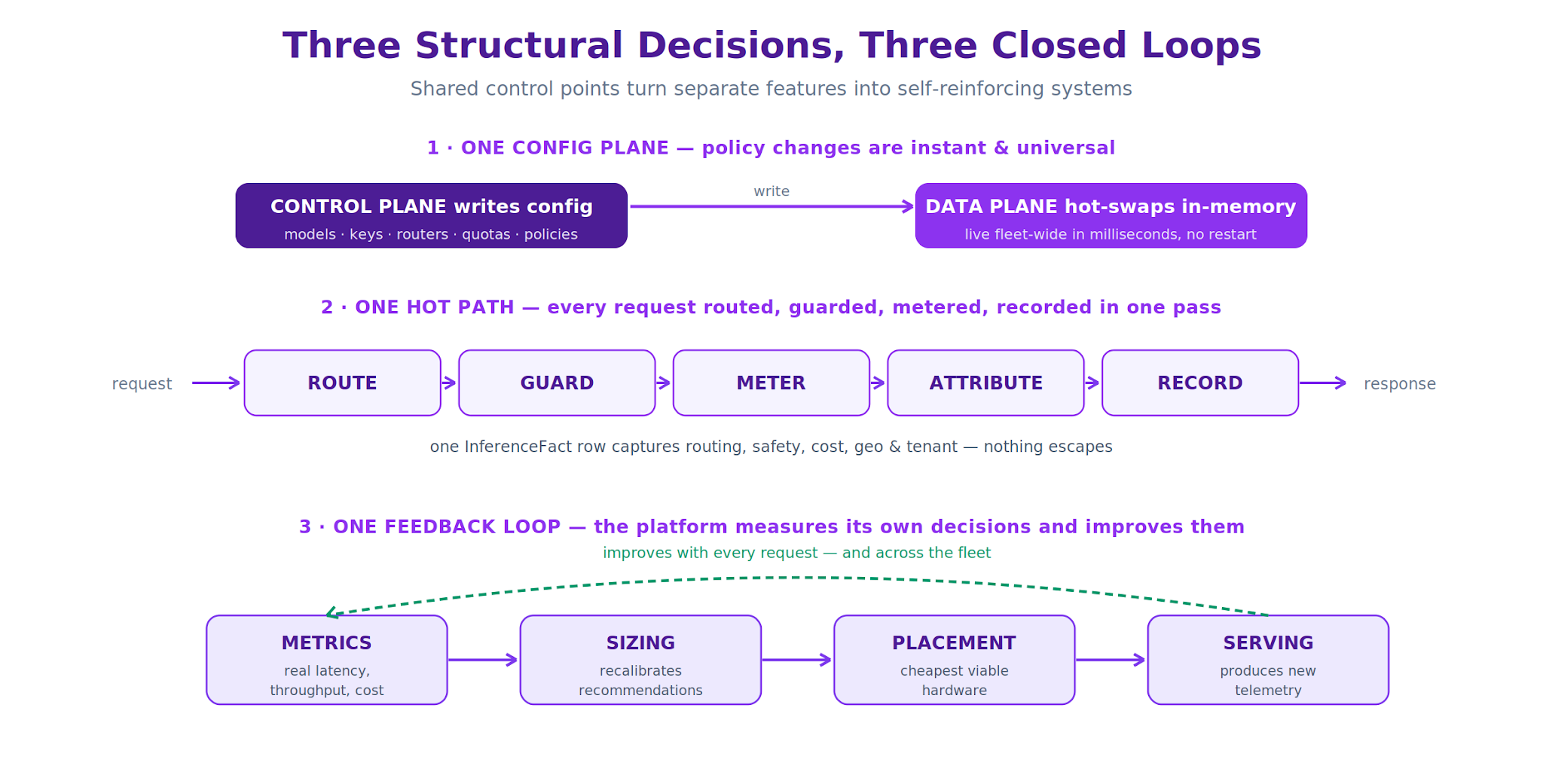
Owning the whole loop — governance, sizing, deployment, serving, routing, safety, cost, and observability, on a self-hostable substrate — produces a platform whose value is structurally greater than any assembled toolchain.
The closed-loop cost economy
Sizing is not a one-shot static estimate. The sizing engine's predictors are calibrated on real benchmark data; the cluster engine pushes live hardware metrics that sizing reads on every run; failed deployments are suppressed so they are never recommended again; and the shared fleet-wide knowledge cache amortizes model knowledge across every Bud install. Cost and performance recommendations are calibrated to the customer's actual hardware and improve with use — and, through the shared cache, across the entire install base.
The unbypassable policy plane
Because every inference traverses the gateway, and the gateway's behavior is defined entirely by the configuration plane the control plane owns, a single control-plane action propagates instantly to every model, tenant, and request. Add a guardrail and content scanning applies immediately; set a quota and over-budget requests are declined instantly; publish a router and intelligent model selection takes over. A security officer's change — block this country, cap this project, scan all of finance — is a configuration write that is live in milliseconds, fleet-wide, with no deployment.
Governance as computed state
The model lifecycle gate — extract, security-scan, license-analyze, evaluate, publish, deploy — turns each compliance artifact into a machine-checked fact stored as platform state, behind a tamper-evident audit trail. "Is this model legally safe to use commercially, free of malicious payloads, and good enough?" stops being a slide deck and becomes a query against verified state.
Agentic AI that inherits governance for free
An agent can call tools, call other agents, execute code in a hardened sandbox, and read documents — and because every model call it makes routes back through the gateway, all of it is automatically subject to the same quotas, guardrails, rate limits, attribution, audit, and cost tracking as raw inference. The industry's fastest-growing risk — ungoverned agentic systems with tool, code, and network access — is met structurally.
The "one plus one equals three" combinations.
The clearest way to see the compounding is to look at what specific combinations produce — outcomes that belong to the whole system, not to any single component.
| Combination | Sum of parts | Emergent outcome |
|---|---|---|
| Sizing + Metrics + failure feedback | Estimate plus logs | Self-calibrating, reality-checked cost and performance sizing |
| Gateway + Router + config plane | Proxy plus router | Instant, fleet-wide, unbypassable policy enforcement on every request |
| Registry license + Eval + audit | Scan plus benchmark | A defensible, machine-checked model-approval gate |
| Gateway quotas + Metrics usage + billing | Rate limit plus dashboard | An internal AI marketplace with budgets and chargeback |
| Identity + access control + tenant attribution | Login plus filter | Multi-tenancy that holds unbroken from browser session to analytics row |
| Agents + gateway + tools + sandbox | Agent plus sandbox | A governed agent mesh where tools, code, and agents inherit safety and audit |
| Sizing + fractional GPU + scale-to-zero | Sizing plus GPU sharing | Fractional-GPU, scale-to-zero cost minimization for small and idle models |
| Durable workflows + resilient transfer | Workflow plus download | Deployments that survive pod eviction and infrastructure chaos |
| Typed contracts + generated interface | Config plus UI | A no-code builder that auto-tracks backend capabilities with no glue |
| Self-hosted everything | On-prem model | Air-gapped full lifecycle, not just inference |
Every capability serves every dimension
Bud is designed so that no capability serves only one concern. Each major capability simultaneously contributes to developer experience, scalability, security, and governance. The density of that contribution is the platform's signature.
| Capability | Dev experience | Scalability | Security | Governance |
|---|---|---|---|---|
| Gateway | Drop-in compat | Stateless scale-out | Hashed keys, firewall | Quotas, attribution, audit |
| Semantic Router | No-code builder | Lazy parallel signals | Safety signals | Per-decision model pools |
| Sizing Engine | Auto cost-optimal | Plans parallelism | — | Cost transparency |
| Cluster Engine | One-click deploy | Autoscale, distributed | Encrypted creds | Cluster SLAs |
| Model Registry | Instant verdict | Cache amortizes | Supply-chain scan | Computed license risk |
| Eval | Click to benchmark | Parallel jobs | — | Quality gate |
| Agent Runtime | No glue code | Background work | Inherited governance | Versioning, audit |
| Secure Sandbox | Code as a tool | Tier concurrency | Hardened isolation | Per-env isolation |
| Metrics | Investigation | Sub-second at scale | Row-level security | Full per-inference audit |
| Control Plane | Unified API | Stateless workers | Access control, audit | Lifecycle gates |
The gateway is at once a developer convenience, a scaling primitive, a security enforcement point, and a governance ledger — and the same is true of every row. This multi-dimensional density is what makes the combination structurally more valuable than a set of single-purpose tools.
Competitive positioning
Bud does not aim to win any single category against the best specialist. Its claim is that owning the whole loop produces something no specialist can: a self-hostable platform that takes any model from unmanaged artifact to governed, cost-optimal, safely-routed, fully-observable, billed inference — and keeps improving its own decisions as it runs.
Versus cloud AI platforms
Bud is self-hostable, multi-cloud, and air-gap-capable, with computed license and security governance and cost optimization that hyperscalers do not expose for arbitrary open models.
Versus inference point tools
Those are serving engines; Bud is the lifecycle, governance, sizing, routing, observability, and billing around them.
Versus gateways and proxies
Bud's gateway adds a hot configuration plane, a neural-symbolic semantic router, budget enforcement, a firewall, safety guardrails, and warehouse-grade analytics — and is wired into deployment and sizing.
Versus standalone routers
Bud's router is a far richer neural-symbolic system with per-decision model pools and many selection algorithms, integrated end to end and no-code-configurable.
Versus observability add-ons
Bud owns the data plane that produces the telemetry, so observability is intrinsic and tied to routing, cost, and governance — not an add-on integrated through a separate SDK.
Transforming the AI Journey
A causal analysis of how the combined stack changes the outcome of an enterprise's GenAI and agentic-AI program.
From features to outcomes.
When an enterprise adopts the whole stack, what causally changes about its AI journey? The analysis below is not a list of benefits restated — it is an argument about cause and effect.
It traces how Bud's specific architectural decisions alter the trajectory, economics, and risk profile of an enterprise GenAI and agentic-AI program.
Conventional AI platforms make each stage of the journey possible. Bud makes the later, harder stages — governance, cost control, production hardening, safe agents — structural properties of the first deployment rather than separate projects undertaken later. The enterprise does not climb the maturity ladder one rung per quarter; it starts near the top.
01The maturity-curve collapse
The conventional enterprise AI journey is a staircase. A team runs a pilot. Months later, governance becomes a fire drill and a separate project. Cost overruns trigger a FinOps initiative. Production hardening is retrofitted. Scale forces a re-platforming. And agentic AI, when it arrives, restarts the whole risk-and-governance conversation. Each stage is a distinct project, each takes a quarter or more.
Bud changes this causally because the later stages are not features bolted on later — they are properties of the shared control points the first deployment already runs through. The first model an enterprise deploys is already governed, already cost-attributed, already observable, already safety-enforced, and already ready for agents. The enterprise does not have to climb; the rungs are already underneath it.
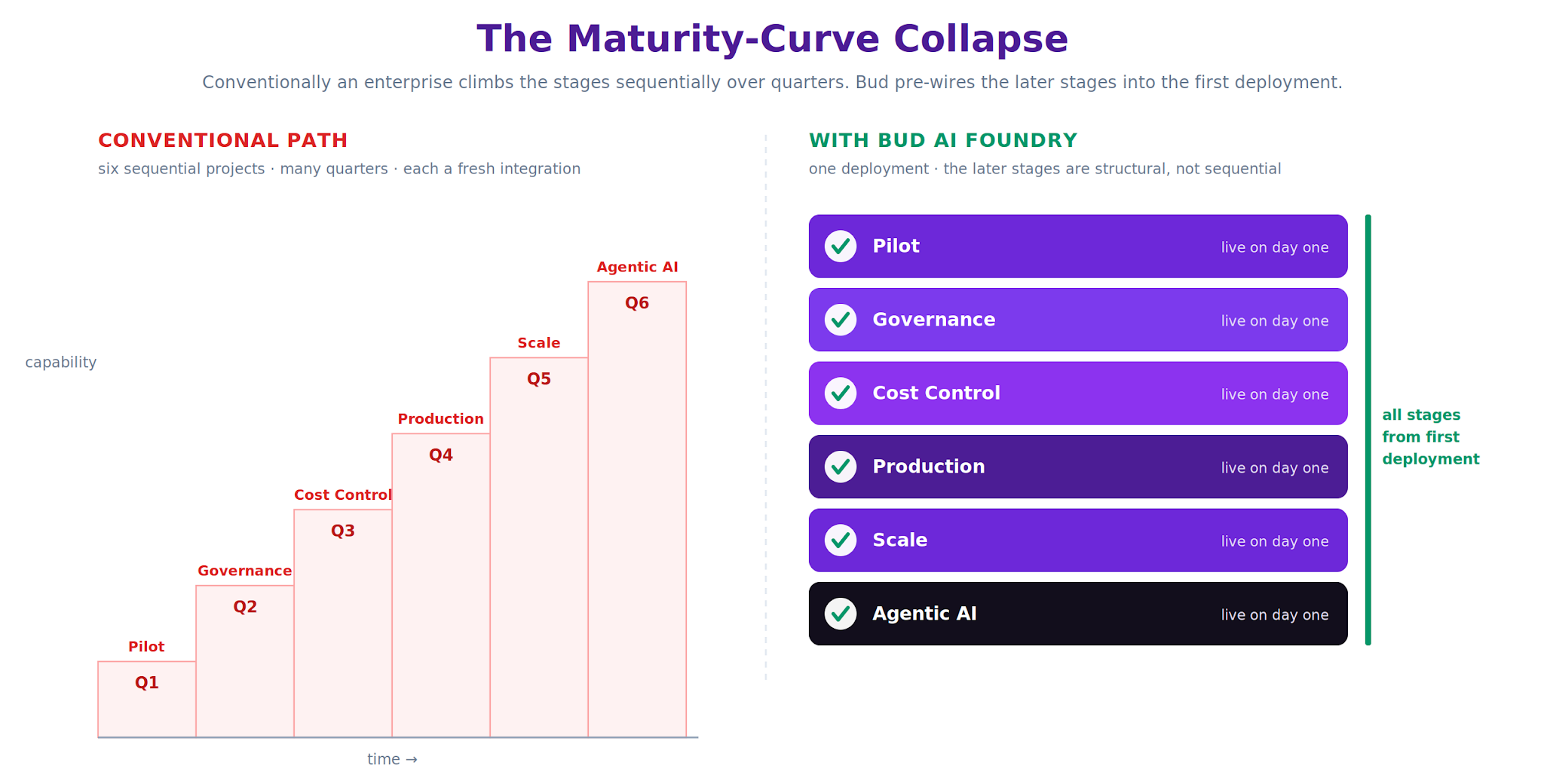
Time-to-production-value is normally gated not by building the first model but by the quarters of governance, cost, and hardening work that follow it. Collapsing that sequence is the single largest causal effect Bud has on an enterprise's AI timeline.
02The marginal model becomes nearly free
In a conventional stack, every new model carries roughly the same cost as the last: a legal review, a security scan, an architecture analysis, a capacity-planning exercise, and the wiring to serve and monitor it. The tenth model costs about what the first did. This is why most enterprises support only a handful of models — each one is a project.
Bud inverts this through four compounding mechanisms: governance is computed and cached, so a known model is reused, not re-analyzed; sizing self-calibrates on accumulated benchmark data; a fleet-wide cache amortizes model knowledge across the install base; and serving is config-driven, so publishing a model is a configuration write rather than an integration. The marginal cost of model N trends toward zero.
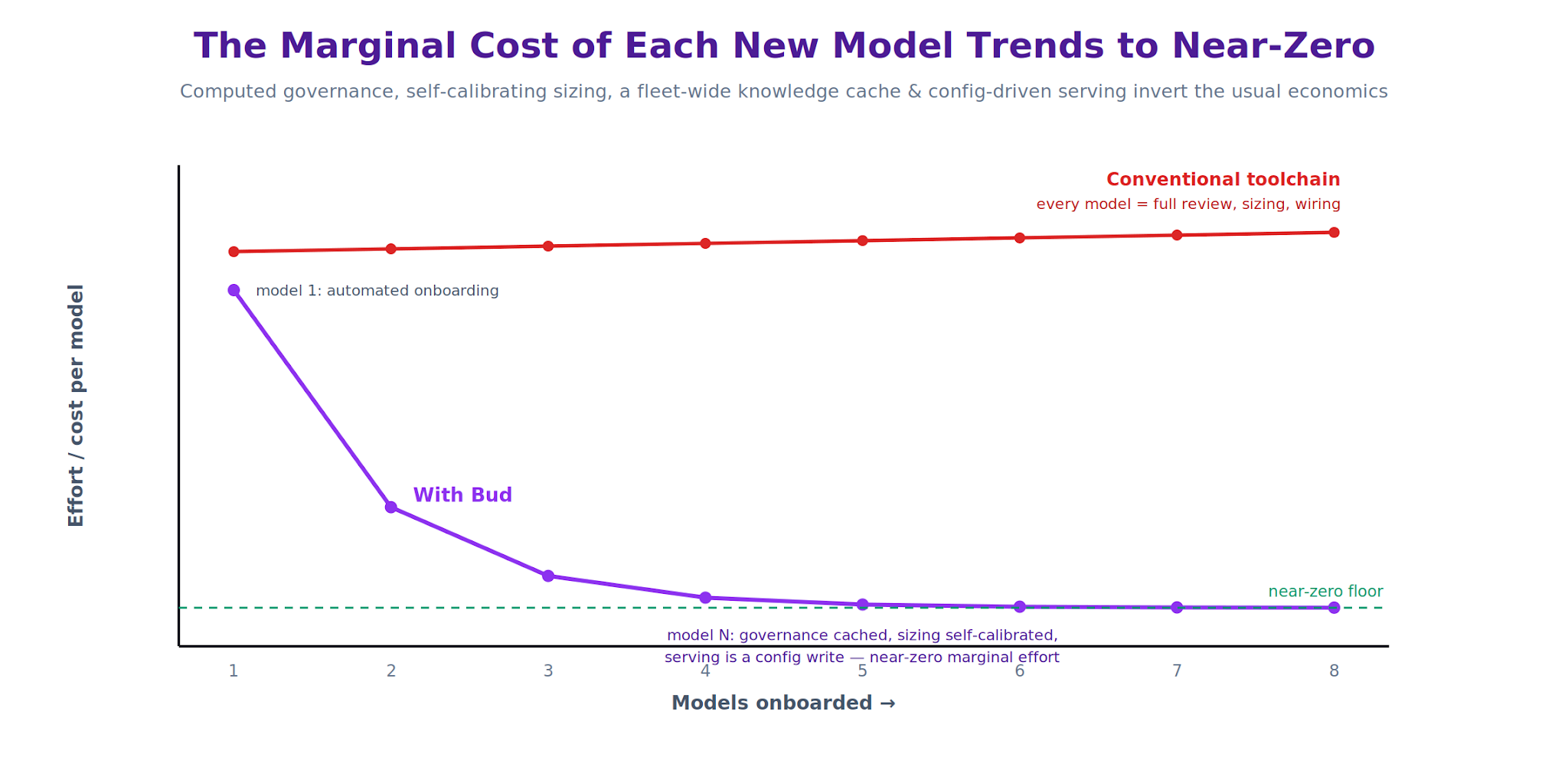
This is not merely a cost saving — it changes enterprise behavior. When adding a model is nearly free, an organization stops rationing models and starts using the right model for each task: a small, cheap model for routine work, a frontier model for hard problems, a specialized model for a niche domain. A near-zero marginal cost per model is the precondition for genuine mixture-of-models in production.
03The self-improving cost economy
Most infrastructure gets more expensive to operate as it grows. Bud runs the other way, because of a closed loop: every inference produces real telemetry — latency, throughput, cost — that feeds the sizing engine, which recalibrates its recommendations, which improve placement, which produces new telemetry. Failed configurations are suppressed, and a fleet-wide cache spreads each lesson across the install base.
The causal consequence is that an enterprise's cost-per-token tends to fall over time without human intervention. Cost optimization stops being a periodic project staffed by experts and becomes a background property of running the platform.
Because the optimization loop and the knowledge cache both compound, the gap between Bud and a static toolchain widens with use. The longer an enterprise runs the platform and the more models it serves, the larger the advantage.
04Agentic AI becomes approvable
The barrier to agentic AI in the enterprise is not capability — capable agent frameworks are widely available. The barrier is approval. An autonomous agent that can call tools, execute code, and reach the network is, to a security officer, an unbounded risk, and the rational response is to forbid it. This is why so many agentic initiatives stall at proof-of-concept: nobody will sign off on production.
Bud changes the risk calculus by making the agent inherit, rather than bypass, the platform's controls. Every model call routes back through the gateway, so it is quota-limited, safety-scanned, attributed, and audited exactly like raw inference. Code runs only inside hardened, network-controlled sandboxes; each agent carries a cryptographic identity and communicates over encrypted channels; every action is durably recorded. The unbounded risk becomes a bounded, observable, governed boundary.
Bud does not make agents more capable; it makes them governable, and governability is what converts an agentic initiative from a forbidden experiment into an approved production system. For most enterprises, that approval — not the agent technology — is the actual blocker Bud removes.
05Compliance becomes an asset, not a tax
In most organizations, AI compliance is a cost center and a brake: a manual, after-the-fact scramble to assemble evidence whenever a regulator, auditor, or customer asks. Because Bud records every inference with full context behind a tamper-evident audit trail, and governance decisions are stored as queryable state rather than documents, the evidence already exists. "Show me every request that touched customer data in this jurisdiction last quarter, and prove the record is untampered" becomes a query, not a project.
Compliance flips from a brake into an enabler. An enterprise that can produce a complete, verifiable audit trail on demand can pass procurement reviews it would otherwise fail, satisfy regulators faster, and enter regulated markets closed to competitors who cannot.
06Sovereignty unlocks the highest-value data
The data where AI delivers the most value — patient records, financial transactions, classified material, proprietary research — is precisely the data that cannot leave the enterprise perimeter. A platform that requires sending data to an external service is therefore structurally barred from the highest-ROI use cases, no matter how capable it is.
Because Bud runs the entire lifecycle inside the customer's perimeter — including the governance and assistant AI — and is capable of fully air-gapped operation, it removes that barrier. The consequence is not incremental: it makes an entire class of otherwise-forbidden, highest-value use cases addressable. For a bank, a hospital, or a government agency, this is often the difference between an AI program that touches only peripheral data and one that reaches the core.
07Decoupling application from model
When an enterprise builds directly against a specific model or provider, it couples its applications to that choice; switching later means rewriting. Bud's single, standards-compatible gateway decouples the application layer from the model layer: applications target one endpoint, and the models, providers, and hardware beneath can change without touching application code.
The causal effects are two. First, there is no lock-in — the enterprise is free to move between providers and onto its own hardware. Second, and more valuable, the enterprise can ride the price-performance curve continuously, swapping in cheaper or better models underneath running applications as the market evolves.
What this means, by stakeholder
These causal effects land differently on each person responsible for an enterprise AI program. The same shared control points produce a distinct, high-value outcome for each role — which is why Bud tends to be a decision multiple stakeholders can agree on rather than a trade-off between them.
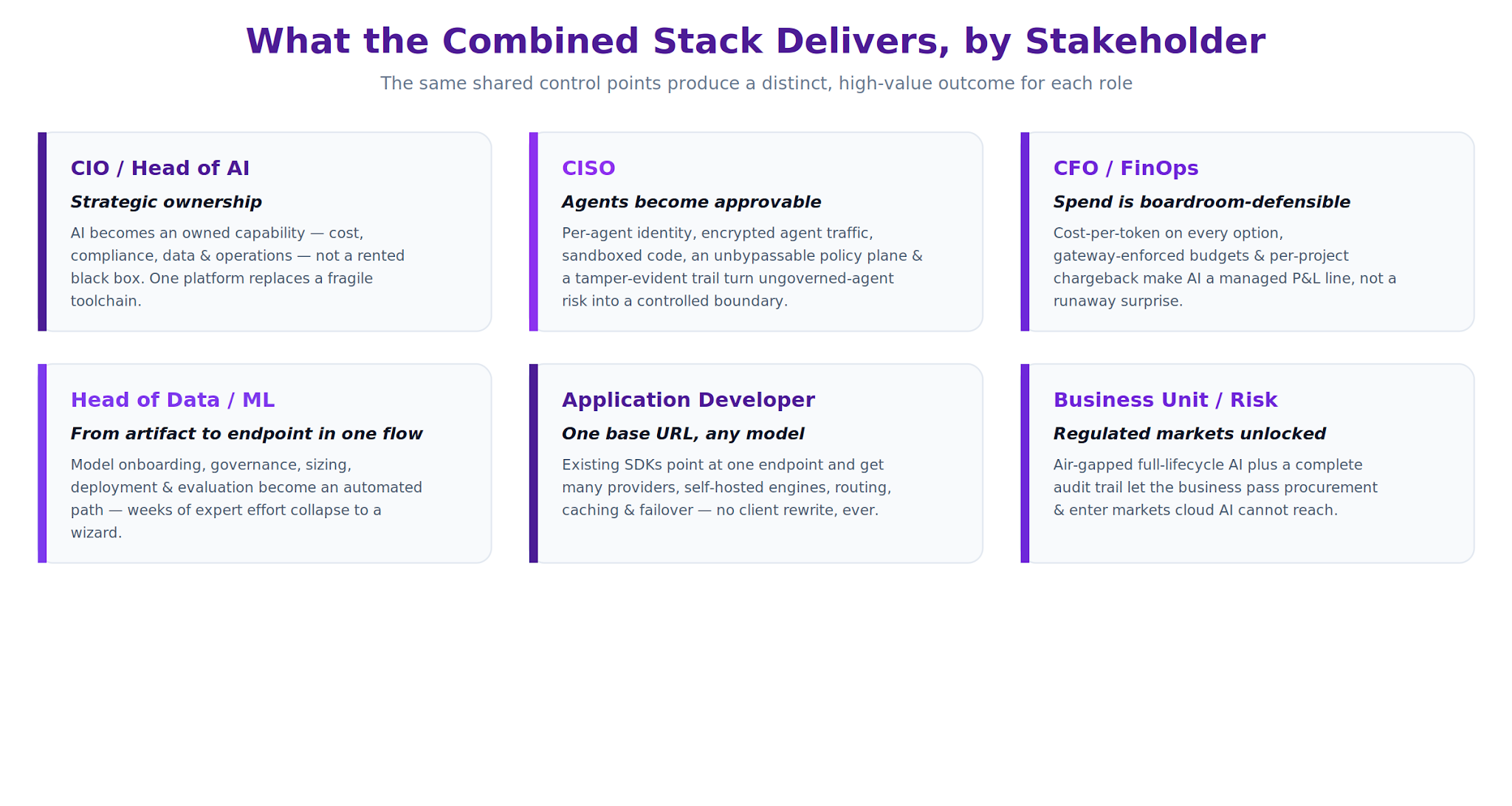
The strategic significance is that Bud is rarely a single-stakeholder purchase. The CISO's need for governable agents, the CFO's need for defensible spend, and the data leader's need for an automated path are usually in tension when met by separate tools. Because Bud meets all of them through the same shared control points, it aligns stakeholders who would otherwise be negotiating against one another — itself a causal accelerant of enterprise adoption.
The combined-stack effect, summarized
Each insight is a consequence of the same root cause: Bud wires governance, cost, safety, and observability into shared control points that every request and every model already passes through.
| Because Bud does this | The mechanism is | The enterprise outcome is |
|---|---|---|
| Pre-wires later stages into the first deployment | Shared control points carry governance, cost, safety, audit | The maturity curve collapses — production posture on day one |
| Computes and caches governance, self-calibrates sizing | Reuse, fleet-wide cache, config-driven serving | The marginal model is nearly free — mixture-of-models becomes practical |
| Measures its own decisions in a closed loop | Telemetry to sizing to placement to telemetry | Cost-per-token falls over time without human effort |
| Makes agents inherit platform governance | Gateway-routed calls, sandboxed code, per-agent identity | Agentic AI becomes approvable, not just possible |
| Records every inference behind a tamper-evident trail | Computed governance state plus immutable audit | Compliance becomes a competitive asset, not a tax |
| Runs the whole lifecycle in-perimeter | Self-hosted models, governance, and assistant; air-gap capable | The highest-value, most-sensitive data becomes addressable |
| Decouples applications from models | One standards-compatible gateway over many backends | No lock-in, and continuous capture of the price-performance curve |
Individually, Bud's components match what specialized tools do. Combined, they change the shape of the enterprise AI journey itself — collapsing its timeline, inverting its per-model economics, making its costs fall with use, making its agents approvable, turning its compliance into an asset, unlocking its most valuable data, and freeing it from lock-in. These are not features; they are changes to the trajectory of the program.
Conclusion
What the platform amounts to, and why owning the whole loop is the differentiator.
Conclusion.
Bud AI Foundry is engineered so that its features reinforce each other through shared control points and closed feedback loops. The combined outcome is a self-hostable platform that takes any model from unmanaged artifact to governed, cost-optimal, safely-routed, fully-observable, billed inference — and keeps improving its own decisions as it runs.
For the enterprise, it is the platform to adopt when AI is strategic enough to own rather than rent — its cost, its compliance, its data, and its operations. For the cloud service provider and OEM, it is the branded, multi-tenant, fully-metered AI cloud they would otherwise spend years building. For the engineer, it is trivial to try, elastic and fast in production, observable at scale, and reproducible from a single command.
The differentiator is not that Bud wins any single category, but that owning the whole loop — governance, sizing, deployment, serving, routing, safety, cost, and observability, on a sovereign, self-hostable substrate — produces a platform whose value is structurally greater than any assembled toolchain, and whose entire lifecycle can run where AI software-as-a-service cannot go.
The market is not missing inference engines. It is missing a sovereign control plane.
Bud AI Foundry wires governance, cost, safety, and observability into every request and every model — a self-hostable platform that owns the whole loop, from an unmanaged artifact to a governed, cost-optimal, observable endpoint, and keeps improving its own decisions as it runs.
About Bud Ecosystem, Inc. — Sovereign AI infrastructure for the enterprise. We are on a mission to democratize generative AI — making it practical, affordable, profitable, and scalable for everyone — innovating the fundamentals of GenAI systems from enterprise AI platforms and run-time environments to model architecture and agent frameworks.Copyright 2026 Bud Ecosystem, Inc. All rights reserved. · budecosystem.com · sales@bud.studio