Bud MCP Foundry

The production layer for enterprise agents.

The MCP protocol is settled. Producing the MCPs that real enterprises need is not. Bud MCP Foundry unifies four tiers of MCP connectivity (remote vendor servers, stdio-bridged tools, AI-generated custom MCPs from your existing docs and APIs, and internal native skills) behind a single governance, observability, and FinOps plane. Weeks of integration work compressed into minutes.

TIER 01 · REMOTE HOSTED (1,000+) Slack · Notion · GitHub Linear · Atlassian · Composio Zapier · Databricks Marketplace TIER 02 · STDIO-BRIDGED Drive · Gmail · Calendar Filesystem · Postgres · Redis Playwright · community MCPs TIER 03 · AI-GENERATED CUSTOM OpenAPI · Postman · PDF docs DOCX · HTML · Markdown Live REST endpoints TIER 04 · INTERNAL NATIVE Composed Skills · Bespoke tools Template prompts · Resources Custom A2A agents BIFROST unified dispatch UNIFIED MCP CATALOG tools/list · tools/call resources/list · prompts/list CONSUMERS Claude · ChatGPT Gemini · Cursor LangChain · CrewAI AutoGen · LangGraph REST / CLI / SDK
The question

Agentic systems are evolving fast.
Is your organisation AI-ready?

Models are capable. Frameworks are mature. Protocols are settled. The bottleneck has moved from the AI to the systems around it. Whether your enterprise can deploy useful agents in 2026 depends entirely on whether your existing tools, data, and workflows are reachable, governable, and observable to them.

400+
Internal systems running in a typical mid-sized bank, most without machine-readable interfaces.
Industry estimate, mid-sized bank
80–200
RPA bots running in parallel that have to be reachable to agents.
Industry estimate, RPA fleet size
40K+
Pages of operational documentation locked outside of agent context.
Industry estimate, ops documentation
30%
Of enterprise vendors expected to ship native MCP servers in 2026; the rest is on you.
Forrester, 2026
Before

400+ systems. 80–200 RPA bots. 40K+ pages of docs. None of it agent-reachable.

After

One catalog. One governance plane. Agents see one surface.

The new bottleneck

Production, not protocol.

A mid-sized bank runs 400+ internal systems, most exposing REST APIs at best, many only through thick-client GUIs, some with no machine-readable interface at all. 80-200 RPA bots. 40,000 pages of operational documentation. None of it is agent-ready.

Forrester predicts 30% of enterprise application vendors will ship native MCP servers in 2026. Gartner expects 40% of enterprise applications to embed AI agents by end of 2026, with MCP as the backbone. The production layer is the deciding factor.

The case

Three things are true about the enterprise AI transformation in 2026.

I.

The protocol question is settled.

MCP is the de facto standard. Every major AI platform supports it. Every major enterprise application vendor is adopting it. Building on anything else is now a technical-debt decision.

II.

The production question is not.

Most enterprises do not have the MCP capabilities their agents need. They don't have them because producing them by hand is uneconomical. They won't have them in time because existing tooling doesn't produce them at scale.

III.

The governance question is about to become acute.

As agent volume grows from thousands to millions of daily tool invocations, enterprises without a coherent governance plane will discover, through audit or incident, that they cannot explain what their agents did, why, with whose permissions, at what cost.

The industry first

Four tiers of MCP connectivity.
One governance plane.

No other MCP platform on the market today unifies all four connectivity modes behind a single governance plane. This is the structural choice that separates Bud MCP Foundry from every other product in the category. Everything else in the platform follows from it.

TIER 01 Remote hosted MCPs (1,000+) Slack Notion GitHub Linear Atlassian TIER 02 Self-hosted stdio-bridged stdio Drive Gmail Filesystem TIER 03 AI-generated custom PDF OpenAPI Postman DOCX TIER 04 Internal natively-managed Skills Tools Prompts A2A BIFROST unified dispatch UNIFIED MCP CATALOG Generic MCP consumer
tools/list · tools/call · resources/list · prompts/list, same calls, any tier.
Tier 01

Remote hosted MCPs (1,000+)

Servers vendors have already built and host remotely. Federated over HTTPS, SSE, or Streamable HTTP. OAuth 2.0 credentials encrypted with Fernet and stored securely. Auth propagates to the upstream server so tools execute with the initiating user's permissions, not a shared service account.

Examples

Composio (850+), Zapier MCP (8,000+), Databricks MCP Marketplace (LSEG, FactSet, Nasdaq, Moody's, S&P Global), Notion, Slack, GitHub, Atlassian, Linear.

What Bud adds
  • Auth credential management with encryption at rest
  • Team-scoped tool visibility
  • Policy enforcement layered over vendor tools
  • FinOps tracking across third-party API spend
  • Cross-catalog semantic search
Tier 02

Self-hosted stdio-bridged MCPs

Many of the most valuable MCP servers don't exist as hosted services. Google publishes Drive, Gmail, Calendar, and Sheets as stdio CLI tools. Official filesystem, PostgreSQL, Redis, SQLite, Playwright MCPs follow the same pattern. Bud auto-bridges stdio to HTTP/SSE.

Examples

Google Drive / Gmail / Calendar / Sheets, Filesystem, PostgreSQL, Redis, SQLite, MySQL, Playwright, community GitHub MCPs.

What Bud adds
  • Stdio to HTTP/SSE protocol translation
  • Subprocess wrapping and keepalive management
  • Horizontal scaling across worker instances
  • Per-MCP health with auto-exclusion
  • Redis-backed distributed session state
Tier 03

AI-generated custom MCPs

The long tail: hundreds of internal systems, legacy applications, industry-specific vendor tools, and custom APIs for which no MCP exists and none will ever be published. Produced automatically from API docs, OpenAPI specs, Postman collections, PDF vendor docs, internal wikis.

Time compression

Custom MCP server development is typically 1-4 weeks per integration per engineer. The Bud pipeline produces governed MCPs in minutes, with no coding required.

What Bud adds
  • Multi-format ingestion (OpenAPI, Postman, PDF, HTML, Markdown)
  • Firecrawl-powered documentation crawling
  • AI-powered enhancement and workflow composition
  • Evaluator QA with confidence scoring
  • Dry-run preview and bulk conflict resolution
Tier 04

Internal natively-managed MCPs

Tools, resources, and prompts the enterprise chooses to manage natively within the Foundry. Registered through the Skills Hub, stored in PostgreSQL, executed by the platform's own service layer.

Used for
  • Bespoke tools built for internal workflows
  • Composed skills that bundle multiple capabilities
  • Template-driven prompts encoding institutional knowledge
  • Shared resources under team-scoped access control
  • Custom A2A agents as first-class capability providers
Unified by Bifrost

All four tiers are routed transparently. Consumers issue standard MCP calls and receive results. Auth, authorization, rate limiting, observability, and audit apply uniformly regardless of tier.

How Bifrost works

Bifrost is the internal routing plane that abstracts multi-protocol, multi-origin MCP server connectivity into a unified dispatch layer. It is what makes the four-tier tool management look like one tier to consumers.

Routes MCP method calls to the correct backend: locally registered, federated, or stdio-bridged.
Normalizes stdio, SSE, and Streamable HTTP into a consistent format.
Handles protocol version negotiation between gateway and each backend server.
Performs capability merge across federated peer Foundries with composite key identity resolution.
Supports qualified naming (gateway.tool) for human-readable references across federation.
Virtual server composition: build cohesive logical groupings of tools, resources, prompts, and A2A agents exposed as a single endpoint.
How it works

Weeks per integration,
compressed to minutes.

Most enterprise systems will never ship a native MCP. The Foundry produces them automatically from what you already have: an OpenAPI spec, a docs URL, a PDF, or a live REST endpoint. Four pipeline stages: ingest, crawl, enhance, evaluate. No SDK to learn. No boilerplate to write.

5a · MCPfication pipeline
TRADITIONAL INTEGRATION Day 0 Day 7 Day 14 Day 21 BUD MCP FOUNDRY Ingest Crawl Enhance Evaluate ~3 WEEKS ~5 MINUTES
01

Ingestion

API documentation URLs, OpenAPI 2.0+, Postman Collections, PDF / HTML / Markdown / DOCX, live REST endpoints, wiki exports from Confluence and SharePoint. Bulk import with skip / update / rename / fail conflict strategies and dry-run preview.

02

Crawler (Firecrawl)

Firecrawl-powered traversal of documentation sites. Handles JavaScript-rendered pages, auto-detects OpenAPI specs linked in docs, classifies auth-related pages, infers base URLs. SSRF-protected URL validation. robots.txt compliance.

03

Enhancer

AI-powered analysis that produces workflow-composed tools with agent-optimized descriptions. Parses unstructured documentation, maps parameters to JSON Schema, composes workflow-level tools from related endpoints rather than naive 1:1 mapping.

04

Evaluator

Validates URLs and schema compliance, deduplicates semantically equivalent endpoints, enriches metadata, assigns confidence scores, flags tools below configurable thresholds for human review. Nothing enters the registry without passing.

What days-to-value looks like

Two weeks. Zero coding.

Week 1
Stakeholder identifies target systems; upload begins.
Day 1–3
Pipeline processes 20–40 MCPs from REST APIs and documentation.
Day 4–7
Evaluator review, human approval, gradual activation.
Day 8–14
Agents using new capabilities in production with full observability from the first invocation.
5b · Effortless creation

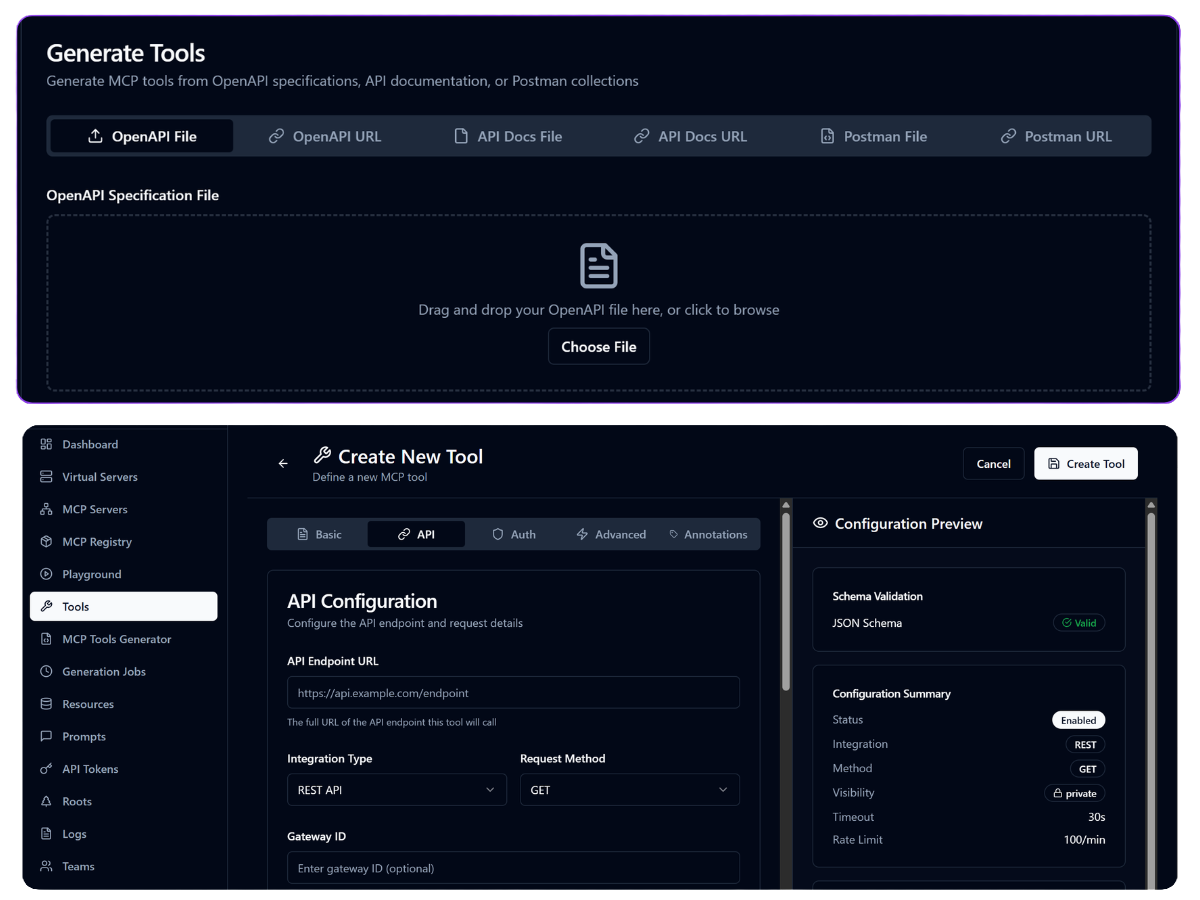
Point the Foundry at what you already have. Approve, ship.

A UI walkthrough of the same pipeline.

01
Drop in your source
Upload a spec, paste a docs URL, or connect a live API.
02
Auto-generate & enhance
Workflow tools and agent-optimized descriptions, with confidence scores.
03
Approve & ship
Click approve and the MCP is live behind Bifrost.
foundry.bud.studio/create
Foundry · Create
Bud MCP Foundry creation screen
OpenAPI ingested 12s · 47 endpoints
Confidence 94% · auto-published
5c · Skills

Compose, then distribute. Skills travel.

Skills are the authoring and distribution layer for composable agent capability. The Hub is where you compose them; the Registry is where they become portable across any MCP-compliant agent.

Skills Hub · authoring

The authoring layer for composable agent skills.

Conceptually similar to how Claude exposes skills via its Skills standard, the Skills Hub lets organizations define self-contained units of capability and make them discoverable and invocable by any MCP-compliant AI agent, regardless of vendor.

Composition
Skill creation by composing tools, resources, and prompts into cohesive, self-contained skill units with JSON Schema validation.
Plugin hook chain
Plugin execution at every lifecycle stage: pre-registration validation, pre-invocation filtering (PII detection, content moderation), post-invocation transformation.
Versioning and events
Naming uniqueness enforcement, version tracking, and change-event publishing to subscriber queues for real-time notification of skill changes.
Skills Registry · distribution

The distribution layer. Skills become portable.

A catalog of predefined, ready-to-use skills covering common enterprise use cases. Your enterprise's procedural expertise, codified in Skills, is no longer tied to Claude or any single vendor. It travels to OpenAI, to on-premises SLMs, to any MCP-compliant agent.

One-click deployment
Pick from the catalog, click deploy, the skill is live. No configuration files, no registration flow.
Snapshot-based versioning
Immutable, reproducible configurations. Each deployed version captured as a snapshot that can be rolled back or exported.
Team-scoped visibility
Share within a team, scope to roles, or publish to the entire platform. Retired skills retain their audit trail.
Govern

One control plane.
Every interaction accounted for.

Every tool invocation, regardless of tier, routes through the same control plane. One audit trail, one policy engine, one place to answer who did what, with whose permission, at what cost. Security, compliance, and observability are built in, not bolted on.

6a · Control plane

Unified observability and governance across every MCP.

01
End-to-end observability
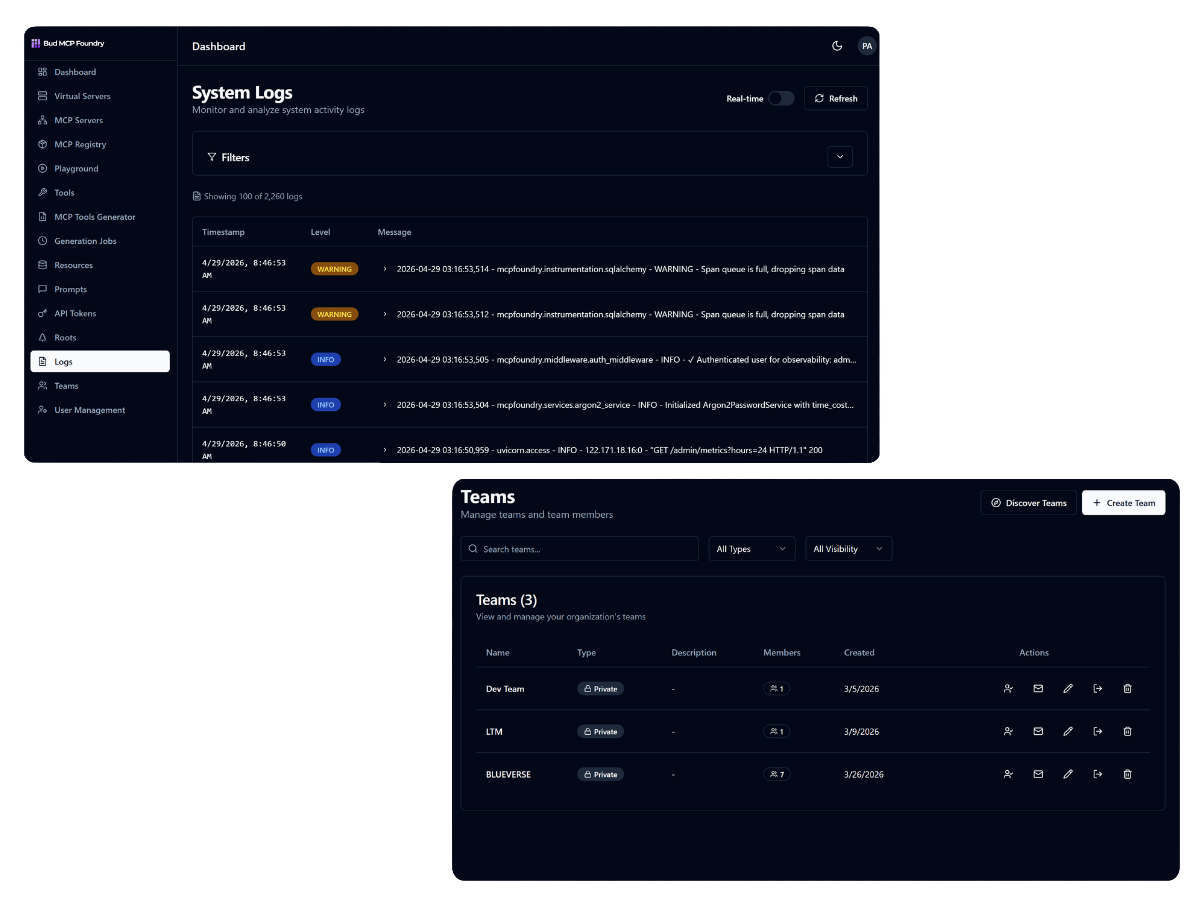
Distributed traces, per-agent and per-tool latency & cost dashboards, structured audit logs with PII redaction, real-time anomaly alerts.
02
Centralized governance
RBAC and token scoping at the gateway, Evaluator-gated promotion, regional data residency, secrets handling enforced uniformly across every tier.
03
Lifecycle & FinOps controls
Versioning, deprecation, and rollback for every published MCP. Quota and budget enforcement per agent, per tenant, per workspace.
6b · Compliance

Built for the controls your security, legal, and compliance teams already require.

RBAC, SSO, fine-grained access policies, immutable audit trails, and ready-to-export compliance reports, available from day one. No bolt-on plugins. No retrofits.

01
RBAC & access control
Role- and attribute-based access at the gateway. Per-tool, per-tenant, per-workspace scoping. SSO via SAML and OIDC; SCIM provisioning for user lifecycle.
02
Compliance & data residency
SOC 2, ISO 27001, GDPR, and HIPAA-aligned controls. Region-pinned data flows. PII and secrets redaction enforced before logs leave the trust boundary.
03
Audit-ready reports
One-click exports for access reviews, tool-usage attestations, and incident investigations. Tamper-evident logs with cryptographic chaining for forensic integrity.
foundry.bud.studio/access
Foundry · Access
Bud MCP Foundry access control screen
RBAC active 1,247 scoped tokens
Audit log tamper-evident chain
SOC 2 ISO 27001 GDPR HIPAA
6c · Security

Defense-in-depth.
No plaintext credentials. Anywhere.

Security is foundational to the platform's design, not an afterthought. Authentication is enforced by default on every API, protocol, and administrative endpoint. Admin surfaces are disabled unless explicitly enabled.

NETWORK APPLICATION DATA OPERATIONAL No plaintext credentials. Anywhere. Enforced at the schema level. Refuses to boot on weak defaults.
01

Network

  • TLS/HTTPS with built-in certificate tooling
  • HSTS with configurable max-age and subdomains
  • Secure WebSocket (WSS) for bidirectional MCP
  • Outbound TLS enforced to upstream MCPs
  • CORS, CSP, X-Frame-Options, Permissions-Policy
02

Application

  • JWT with nine signing algorithms across HMAC / RSA / ECDSA
  • Argon2id password hashing (OWASP-recommended)
  • OAuth 2.0 SSO (Google, Entra ID, Okta, Keycloak, GitHub)
  • PKCE with S256, DCR per RFC 7591
  • Three-scope RBAC, token scoping (IP / time / server)
03

Data

  • AES-256-GCM for tool and resource credentials
  • Fernet for OAuth client secrets and SSO secrets
  • Argon2id hash for user passwords
  • SHA-256 hash for issued API tokens
  • Zero plaintext persistence, enforced at schema level
04

Operational

  • Startup security validation (refuses to boot on weak defaults)
  • Structured audit logging with sensitive-data masking
  • SBOM generation for every release
  • Container image signing and supply-chain verification
  • Automated vulnerability scanning in CI/CD
6d · Observability

Agent-level trails. Enterprise-scale performance.

Agent behavior is non-deterministic. When something goes wrong, the question is never just "what call failed" but "what was the agent trying to do, with what context, and what sequence of calls led here."

LogFire

Dedicated logging for AI agent activity. Per-agent activity trails across tool invocations, skill executions, prompt renderings, and A2A communications. Built for post-incident analysis and compliance reporting at enterprise scale.

OpenTelemetry

W3C Trace Context propagation. Export to OTLP (gRPC/HTTP), Jaeger, Zipkin, or console. Traces stored in the platform's own database when external infrastructure is unavailable.

Prometheus

Metrics on every HTTP endpoint: request counts, duration histograms, size histograms. Per-tool, per-gateway, per-server, per-agent, per-skill, per-prompt counters. Exposed via /metrics/prometheus with GZip.

Health & HA

/health, /ready, /health/security endpoints. Auto-healing with separated enabled/reachable status. Active-active multi-region. PostgreSQL streaming replication. Redis Sentinel/Cluster.

Performance
<50ms
API gateway latency
<500ms
Tool execution (simple)
<100ms
First-byte streaming
10K+
Concurrent connections (min)
100K/min
Request throughput
99.9%
Uptime SLA target

Live performance envelope. SLA-backed in production.

Architecture

Seven layers of clean separation.

Every request traverses the full middleware stack before reaching a backend service. This design enforces consistent security, observability, and policy behavior regardless of which component is accessed.

Layer 01
Consumer
AI agentsClaudeChatGPTGeminiCursorLangChainCrewAIAutoGenLangGraphReact dashboardREST/CLI/SDKfederated peer Foundries
Layer 02
Transport
HTTP/JSON-RPCSSEWebSocketStreamable HTTPstdio (auto-bridged)
Layer 03
API Gateway
ASGI gatewayORJSON/health/ready/health/security
Layer 04
Middleware stack
CORScompressionsecurity headersprotocol validationtoken scopingauthRBACrequest loggingobservability instrumentation
Layer 05
Backend services
FederationGatewayToolTeam ManagementA2AMCP Server
Layer 06
MCP Registry
Tier 1Tier 2Tier 3Tier 4virtual server composition
Layer 07
Data & observability
RedisPostgreSQL 14+ (or MySQL/MariaDB)SQLAlchemy 2.0AlembicLogFireOpenTelemetryPrometheus
Integrations

Production-ready on day one.
The majority of enterprise tooling.

Pre-built, governed MCP integrations authenticated through standard OAuth, governed through the same plugin and policy hooks as custom tools, observable through the same telemetry pipeline.

Microsoft 365

Native M365 surface

Exchange Online, SharePoint, Teams, Entra ID (Azure AD), OneDrive, Microsoft Graph API.
AWS

Cloud infra

S3, Lambda, DynamoDB, CloudWatch, IAM, EC2, RDS.
Azure

Managed services

Azure Storage, Functions, Cosmos DB, Monitor, Virtual Machines, Azure SQL Database.
VMware

On-prem virtualization

vCenter API, VM lifecycle (create / clone / power / delete), resource monitoring, snapshot management.
Third-party MCPs

1,000+ federated

Notion, Slack, Linear, GitHub, GitLab, Bitbucket, Atlassian suite. Composio (850+), Zapier MCP (8,000+). Databricks Marketplace (LSEG, FactSet, Nasdaq, Moody's, S&P).
Stdio (auto-bridged)

Self-hosted MCPs

Google Drive, Gmail, Calendar, Sheets. Filesystem, PostgreSQL, Redis, SQLite, MySQL. Playwright. Community GitHub MCPs.
LLM providers

Vendor-agnostic

OpenAI, Anthropic Claude, Google Gemini, Mistral, Cohere, any OpenAI-compatible endpoint, on-premises SLMs via Bud AI Foundry.
Agent frameworks

First-class support

LangChain / LangGraph, CrewAI, AutoGen / AG2, A2A and ACP protocols, Bud Agent (native), custom framework plugins.
Custom

AI-generated MCPs

Any internal system you own. Produced by the MCPfication pipeline from OpenAPI specs, documentation, PDFs, or live REST endpoints.
Industry applications

Patterns grounded in the constraints specific industries face.

Realizable within 60-180 days depending on scope. The Foundry produces capabilities from heterogeneous existing systems, federates them across regulatory zones, and provides the agent-facing governance plane.

Public sector & government

Sovereign, air-gapped deployments. Citizen-service automation integrating identity, benefits, payments, and document verification. Defence and intelligence. Havaai Buddhi aviation modernization. BharatGen-aligned sovereign AI. Tax and revenue administration.

Healthcare

Clinical documentation support. Pre-authorization automation (2-4 days down to 2-4 hours). Appointment orchestration. Clinical research cohort identification with PII-filtered access.

Manufacturing

Predictive maintenance workflows. Quality investigation tracing across ERP / MES / QMS. Supply chain exception handling with alternative-source evaluation.

Insurance

Claims triage and fraud detection. Commercial lines underwriting augmentation. Bancassurance cross-sell with regulatory suitability.

Telecommunications

NOC first-line alerting with OSS alarm correlation. Customer care tier-1 resolution. B2B circuit provisioning.

Retail

Inventory synchronization and exception handling. Unified commerce customer service. Supplier compliance monitoring. Merchandising decision support.

How it compares

The MCP market has three layers.
No incumbent covers all three.

The MCP gateway market in 2026 is crowded. Bud MCP Foundry's positioning has to be earned, not asserted. Here is the honest picture.

Layer 1

MCP Server Generation

OpenAPI-to-MCP generators: Stainless, Speakeasy Gram, FastMCP, AWS openapi-mcp-server. Mature only for systems with formal OpenAPI specs, which is a minority of enterprise tooling.

Layer 2 · where Bud plays

Gateway & Registry

IBM ContextForge, Kong MCP, Cloudflare MCP Portals, Azure APIM MCP. Solve routing, governance, and observability across an MCP fleet, but do not produce the fleet itself.

Layer 3

Hosting & Catalogs

Composio (850+ managed), Zapier MCP (8,000+ app-level), vendor-direct MCPs published by Notion, Slack, GitHub, Atlassian, Linear, and others.

Same kernel lineage. Different product surface.

Capability
ContextForge
Bud Foundry
JSON-RPC, HTTP, SSE, WebSocket, Streamable HTTP
Gateway federation with DNS-SD auto-discovery
Tool registry with JSON Schema validation and rate limiting
External MCP server connectivity
Plugin extension system with pre/post hooks
Automated MCP creation from API documentation
Firecrawl-powered documentation crawling
AI-powered tool enhancement and evaluation
Multi-format ingestion (OpenAPI, Postman, PDF, HTML, Markdown)
Confidence scoring, dry-run preview, bulk conflict resolution
Predefined Skills Registry with one-click deployment
Snapshot-based skill versioning
Bifrost unified routing plane
Auto-bridge stdio MCPs to HTTP/SSE with horizontal scaling
LogFire AI-agent activity logging
Token scoping (IP / time / server), startup security validation

Bud MCP Foundry inherits the gateway foundations and adds the production layer above them.

Three ways to evaluate

Start where your team is today.

Path 01

Open-source kernel

The underlying ContextForge kernel is open source under Apache 2.0. Evaluation teams can deploy it standalone to validate base gateway behavior before committing to the full platform.

Visit the repo
Path 02

Developer edition

Single-node deployment of the full Foundry, including the MCPfication factory, Skills Hub, Bifrost, and governance plane. For non-production evaluation against the complete platform surface.

Request developer access
Path 03

60-day pilot

A scoped pilot against a specific business function, delivered by Bud or an Accubits engagement team. Produces 50-100 MCP capabilities and a governed agent application on real infrastructure.

Start a pilot engagement

Go deeper.

Whitepaper

The full product specification, security architecture, and compliance matrix for CTOs and enterprise architects.

Request the whitepaper

Documentation

Platform architecture, deployment topologies, integration catalog, and operational guides for engineering teams.

Browse the documentation

Contact

For deployment discussions, partner engagements, or technical evaluation conversations with the Bud team.

Get in touch