Building Human-Centric AI for India's Digital Future
— PM Narendra Modi, India AI Impact Summit 2026MANAV stands for moral and ethical systems – AI should be based on ethical guidance; accountable governance – transparent rules and robust oversight; national sovereignty – whose data, his right; accessible and inclusive – AI should be a multiplier, not a monopoly; and valid and legitimate – AI should be lawful and verifiable.
PM Modi's MANAV vision for AI – unveiled at the India AI Impact Summit 2026 – is a human-centric framework emphasizing fairness, transparency, security, affordability and trustworthiness in AI.
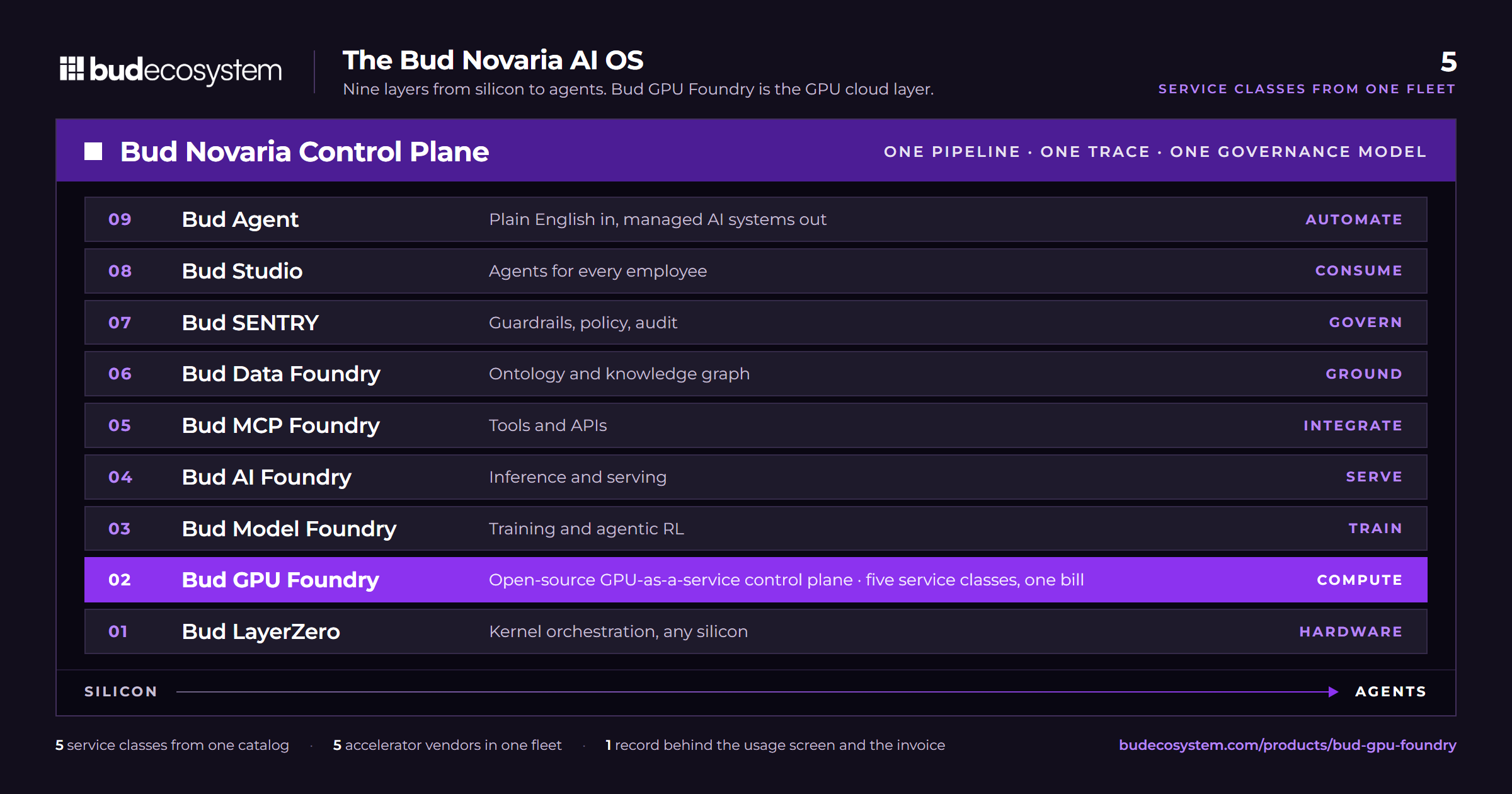
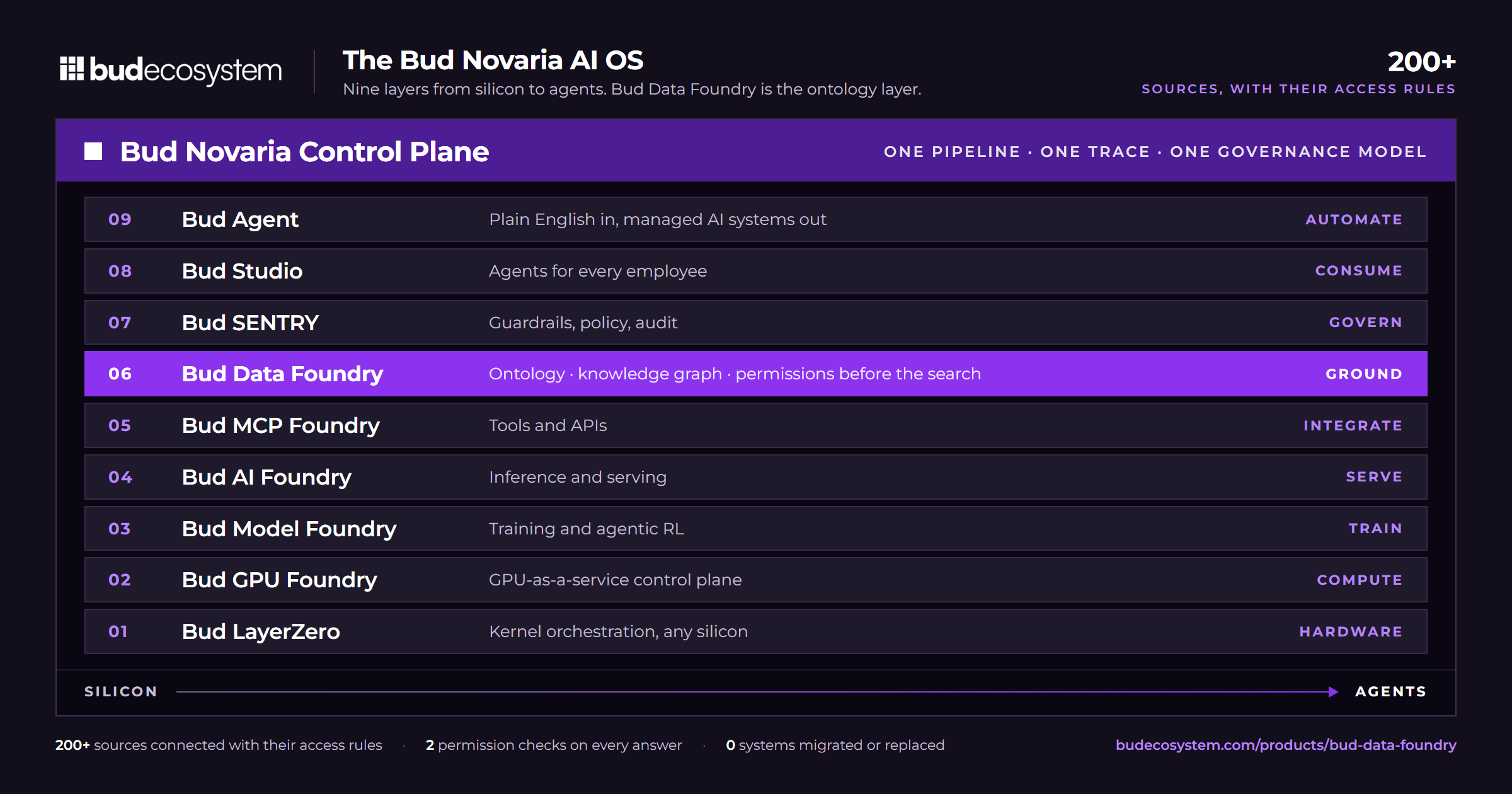
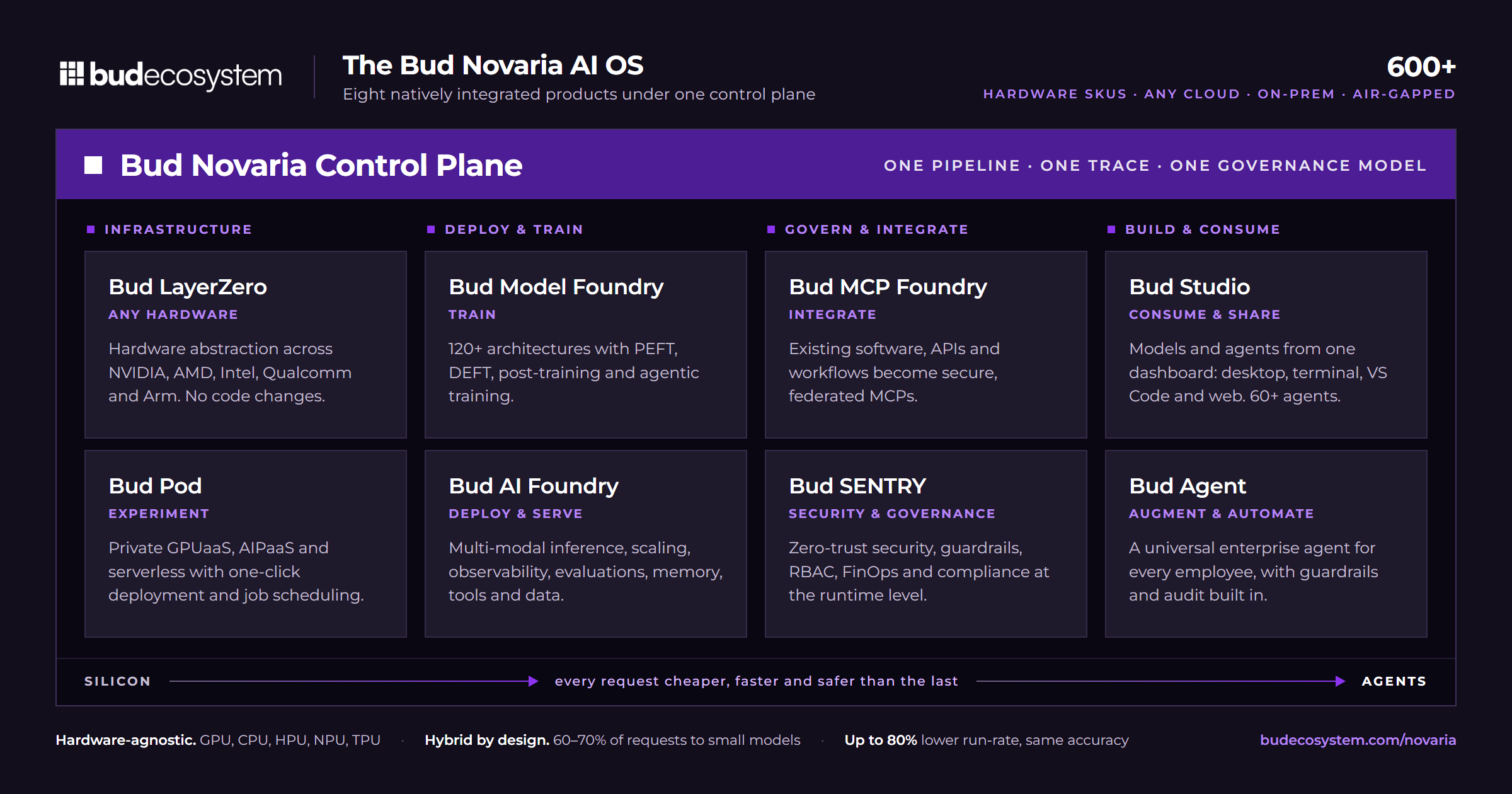
The Bud Ecosystem – an end-to-end enterprise GenAI platform – incorporates features that closely map to each MANAV pillar.
Human-centric, fairness, oversight
Rules, oversight, transparency
Data/tech autonomy, self-reliance
Democratization, broad access
Trust, safety, legal compliance
Our platform features map directly to each MANAV pillar
The 'M' pillar of MANAV establishes that AI systems deployed in India must be guided by human-centric values — fairness, non-discrimination, accountability for harm, and meaningful human oversight at every stage of the AI lifecycle. It recognizes that AI left unchecked can amplify bias, erode trust, and cause systemic societal harm. Moral AI is not a constraint on innovation — it is the foundation that makes AI sustainable and trustworthy at scale.
As GenAI adoption accelerates across public services, healthcare, finance, and education, the consequences of unethical AI outputs compound rapidly. MANAV mandates that any enterprise AI platform must demonstrate measurable ethical guardrails — not as an afterthought, but as a first-class architectural concern.
Bud is designed "to run GenAI safely and responsibly from day one" — ethical compliance is not a bolt-on; it is embedded in the platform's core runtime.
The first 'A' in MANAV addresses the governance infrastructure that must surround AI deployment — who can do what, who is responsible for outcomes, and how every action is recorded and traceable. Accountable governance means that AI systems operate within clearly defined rules, with oversight mechanisms that can reconstruct the full chain of decisions made by both humans and machines.
In enterprise and government settings, AI without governance is a liability. Regulatory bodies, auditors, and boards require demonstrable controls. MANAV places accountability at the heart of sovereign AI — organisations must be able to answer: who authorised this AI action, what did it do, and what was the outcome?
"Granular access control and RBAC enforce least-privilege permissions… Continuous audit logging ensures end-to-end traceability" — governance is operationalised, not just documented.
The 'N' pillar is perhaps the most strategically significant dimension of MANAV for India. It asserts that a nation's AI capability — its data, models, algorithms, and computational infrastructure — must remain within its own sovereign control. True national sovereignty in AI means that no foreign cloud provider, hyperscaler, or proprietary platform should hold unilateral leverage over critical AI infrastructure. It embodies India's principle: "whose data, his right."
Dependence on foreign AI infrastructure introduces geopolitical risk, data sovereignty violations, and technology lock-in that can compromise national security, economic resilience, and citizen privacy. MANAV calls for the development of domestic AI capabilities that can operate independently of global platform dependencies.
"Data, models, and workloads never leave your control… complete data sovereignty" — Bud is architected so that India's AI future is owned by India.
The second 'A' in MANAV recognises that AI must not become the exclusive preserve of well-resourced corporations and elite institutions. Accessibility and inclusion demand that AI capabilities reach small enterprises, public sector bodies, regional governments, rural populations, and citizens across India's extraordinary linguistic and socioeconomic diversity. Democratisation of AI is not just ethical — it is essential for equitable national development.
If GenAI tooling requires expensive proprietary cloud infrastructure, English-only interfaces, and specialist ML teams to operate, it will deepen existing digital divides rather than close them. MANAV's vision of inclusive AI requires platforms that are affordable, multilingual, and usable by non-technical stakeholders — at Gram Panchayat level as much as at enterprise boardroom level.
Bud's founding vision: "democratize GenAI by commoditizing it" — AI should be "a multiplier, not a monopoly." Every Indian organisation, regardless of size or technical maturity, should be able to harness enterprise-grade AI.
The 'V' pillar of MANAV asserts that AI systems must be valid in their technical claims and legitimate in their legal standing. Validity means AI outputs are reliably accurate, verifiable, and safe — not hallucinated, manipulated, or opaque. Legitimacy means AI deployments operate within the bounds of applicable law — domestic regulation, sector-specific compliance requirements, and international standards. Together, validity and legitimacy are what make AI trustworthy enough for consequential decisions.
As AI is deployed in regulated sectors — banking, healthcare, legal systems, public administration — the stakes of invalid or illegitimate AI outputs are severe. Organisations face regulatory sanction, legal liability, and public trust erosion if their AI systems cannot demonstrate that they operated safely, within the law, and with explainable outcomes. MANAV demands that AI systems be provably trustworthy, not merely performant.
"Supports regulatory and industry compliance needs… aligning with White House and EU guidance, GDPR, and SOC2" — Bud makes AI outcomes not just powerful, but provably lawful and legitimate.
The Bud Ecosystem's design – from guardrails and auditability to sovereign deployment and broad accessibility – directly embodies the MANAV principles described by PM Modi. By combining ethical safeguards with built-in governance, local deployment, inclusive access and stringent trust mechanisms, Bud aligns its GenAI stack with India's vision of AI that is both powerful and human-centric.
Sources: Official Indian government releases and news on the MANAV AI vision; Bud Ecosystem documentation and announcements. All claims are supported by cited sources.