Bud GPU Foundry
The GPU-as-a-service control plane. Run the accelerators you already own — NVIDIA, AMD, Intel, Qualcomm and Huawei, across every cluster and site you register — as governed services, from bare metal to tokens, with one catalog, one permission model, one audit trail and one bill. Open source under Apache 2.0.
Silicon to outcomes, as one integrated stack.
Bud GPU Foundry runs the accelerators you already own, across every cluster and site you register, and sells them as governed services — bare metal, virtual machines, Kubernetes, SLURM and serverless containers — to every tenant and segment you serve, from a single node to a whole cluster, in one click. Then it keeps going, into inference, model services and token-based AI consumption on the same stack.
What became of Bud Pod. Bud GPU Foundry succeeds Bud Pod. Pod was the experimentation layer: researchers shared GPUs and went from notebook to production in one click. Bud GPU Foundry keeps that and becomes the GPU-as-a-service control plane for enterprises and service providers — five service classes from one catalog, isolation per tenant, metering that starts when what was bought answers, and AI consumption as a tenant of the same platform.
Layer 02 — the governed fleet under the stack.
Bud GPU Foundry turns the raw capacity LayerZero exposes into a served, multi-tenant fleet. Every layer above trains, serves, grounds, governs and builds on capacity it sells — and Bud AI Foundry runs on it as a tenant, which is how token-billed customers inherit its guarantees.
You pool — accelerators across your data centers, sites and regions become one governed fleet. Register another cluster at runtime and quota, placement, addressing and billing extend to it.
They consume — departments or paying tenants get bare metal, guests, clusters, schedulers and containers from one catalog: quota'd, metered from healthy, and isolated down to the fabric.
The capacity is installed. The platform is what was missing. Accelerators arrive faster than the means to sell them well. A training team wants nodes and a scheduler; a platform team wants Kubernetes; an ISV wants a machine it can image; a research group wants a container and a notebook; a product team wants an endpoint and a token price. Serving each separately leaves several stacks, several bills and no honest answer to who used what. Bud GPU Foundry serves all of them from one fleet, one catalog and one invoice.
Six things one control plane has to get right.
The service classes, the shape resolution, the tenancy, the observed lifecycle, quota and placement, and the step from capacity into AI consumption — each expanded to the specifics an evaluator needs.
Five ways to consume the same fleet, governed by one control plane
A machine, a guest, a cluster, a scheduler or a container. Choose by what your work needs, not by which product your vendor sells. Adding a service class never adds a second billing path, a second permission model or a second audit trail.
| Service class | What you receive | Isolation | Metered on |
|---|---|---|---|
| Bare metal | A physical accelerator host provisioned to an operating system you choose, on your own network and storage, reclaimed with verified erasure. Power on, off, reset, rescue and maintenance state are API calls attributed to a person or token; out-of-band console access never crosses your network. | Sole occupancynobody else resident · returned only after verified erasure, with evidence | node-hours |
| Virtual machine | A hardware-virtualized guest with its own kernel, accelerators passed through at the hardware level, a boot volume, a console and a power-state lifecycle. A stopped guest keeps its boot volume and addresses and stops being metered. Snapshots and private images; confidential execution where the silicon offers it, sold as its own unit. | No shared kernelnever a shared kernel with another tenant · placed by topology, not by count | allocation-seconds |
| Kubernetes | A conformant upstream cluster of your own — three most recent minor releases, highly available control planes with encrypted state — with accelerator node pools drawn from the same catalog, your storage classes and your network. Credentials issued just in time, expiring on their own. | Dedicated control planeper-tenant node pools · no standing kubeconfig to leak | node-hours · per cluster |
| SLURM | Login nodes, named partitions, quality-of-service classes and fair share, with an accounting database and your own accelerators behind them. Keep your job scripts, module trees and workflows; containers run natively inside jobs; a POSIX filesystem with per-user quotas is mounted across every node. | Per-tenant clusteraccounting reconciled to observed allocations · divergence goes to human review | node-hours |
| Serverless container | A workload declared as an image, a command and a shape, placed on the grade the catalog resolved, reachable by shell, terminal or a stable published address. Creation returns a handle; replay is safe by construction; stop is previewed before it happens; leases, schedules and idle thresholds release what is not working. | Per gradewhole node to hardware partition | allocation-seconds · GPU-seconds · VRAM-GB-hours |
Any use case, any environment, one click
Describe the shape your work needs. The platform filters to what your organization may buy, picks exactly one unit by a published rule, tells you which rule chose it, and places the work — on one node, or gang-scheduled across many with the fabric in mind. Resolution is also a read-only call, so a cost model or a procurement script can ask what a shape would buy without launching anything.
When nothing fits, you are told exactly why
| What happened | Reason | What you are told |
|---|---|---|
| No offered unit fits the shape | no_offered_sku | The nearest offered units and what each one lacks: memory, card count, interconnect, grade or model |
| The combination is not in the catalog | off_catalogue | The combination and the catalog version, and nothing else |
| Not sold to your tenant class | profile_refused | The constraint that refused it, without naming units you may not buy |
| The unit exists but is not on sale | not_offered | The grade and the written reason. Never a waitlist for something that is not a capacity problem |
| The grade exceeds your organization's ceiling | above_ceiling | The ceiling. Alternatives the ceiling refuses are never offered as substitutes |
| Your organization's terms permit nothing | terms_exclude_all | A different audience: no edit to the request will help, and the operator must act |
| No quota right now | queued | A queued request with its position in line and a machine-readable reason |
Templates hold a reusable declaration and are copied into the resource at launch, so editing one never changes anything already running. A curated starter library can declare a memory floor, so a request that could never have loaded is refused at declaration rather than at runtime. Every template and image carries a trust tier — official, verified or community.
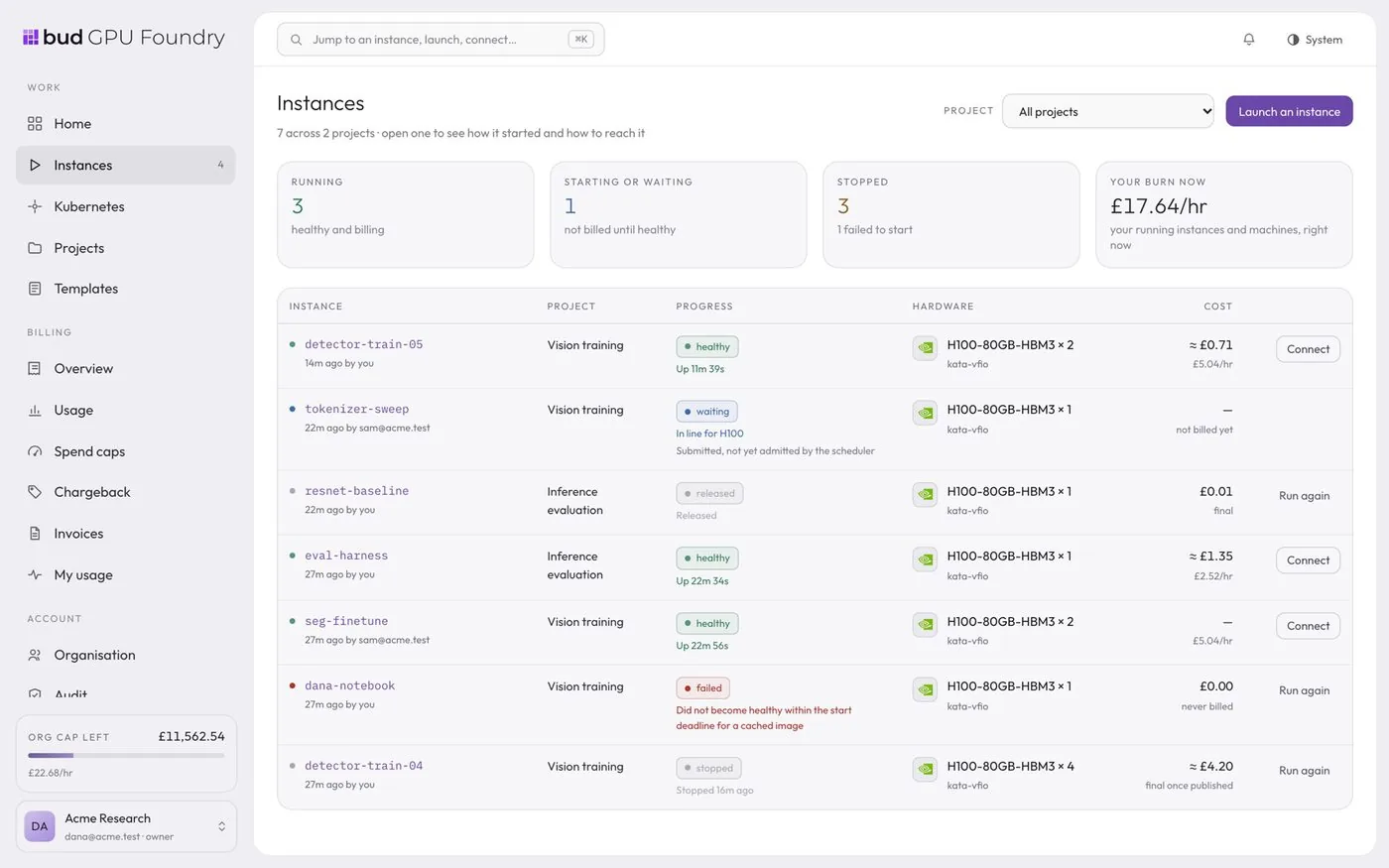
Many tenants and customer segments on one infrastructure, with nothing else shared
Every sellable unit names exactly one service class, one isolation mechanism, one metering basis and the tenant classes it may be sold to. Isolation is a claim about the unit sold, not about the platform in general — and every unit carries one isolation grade, ranked strongest first. An operator states once that an organization may buy nothing weaker than a given grade, and every request in every project is measured against it.
| Grade | What the tenant gets | Rank | Sold to |
|---|---|---|---|
| Bare-metal host | The machine itself, your OS, nobody else resident | rank 0 | both tenant classes |
| Whole node | Every accelerator on a node, yours for the duration | rank 0 | both tenant classes |
| Dedicated GPU in a guest | A whole device passed through to your own kernel | rank 1 | both tenant classes |
| Hardware partition | Dedicated memory and compute paths | rank 2 | both tenant classes |
| Memory-capped slice | A share with a hard memory ceiling | rank 3 | enterprise only |
| Enterprise tenant class | Service-provider tenant class | |
|---|---|---|
| Who the tenants are | Your own business units, departments or subsidiaries, sharing one fleet | Independent customers who are mutually untrusting and may compete with each other |
| Isolation posture | Every grade is available, including the memory-capped slice, because a hostile neighbor is not the threat | Only grades enforced in hardware or by the fabric. Shared-kernel grades are withheld by the platform, not by guidance |
| Billing | Chargeback by project and cost center, against internal budgets | Prepaid balance by default; contract billing in arrears after an identity and credit assessment |
| Enforcement | Quota ceilings and notifications; the eviction ladder exists but is rarely armed | The full ladder for prepaid tenants; contract tenants are never suspended automatically for balance reasons |
| What does not change | The API, the console, the command line, the service classes, the lifecycle, the permission model, the audit trail and the guarantees. A tenant class is a property of the organization and of the unit being sold, not a separate product and not a separate deployment. | |
Resellers and white-label. A reseller organization holds sub-organizations it creates, administers and is billed for. It is granted quota and divides it among its customers in whole instances; consumption aggregates back up the same tree. A reseller administrator has no route to a customer's workloads, sessions or logs — the audit trail records the boundary holding. Brand, logo, color, custom domain and language are properties of an organization, applied to the console, documentation links, invitations and notifications. Rate cards are drafted, compared and published with an effective date, and a published rate never applies retroactively.
Metering starts when what you bought answers. Not a second before.
State is observed from the hardware, never assumed from intent. Three records exist for everything the platform has ever accepted, kept apart on purpose: what was asked for, what was observed, and what was billed. The screen a tenant reads and the invoice they receive come from the same log, so they cannot disagree.
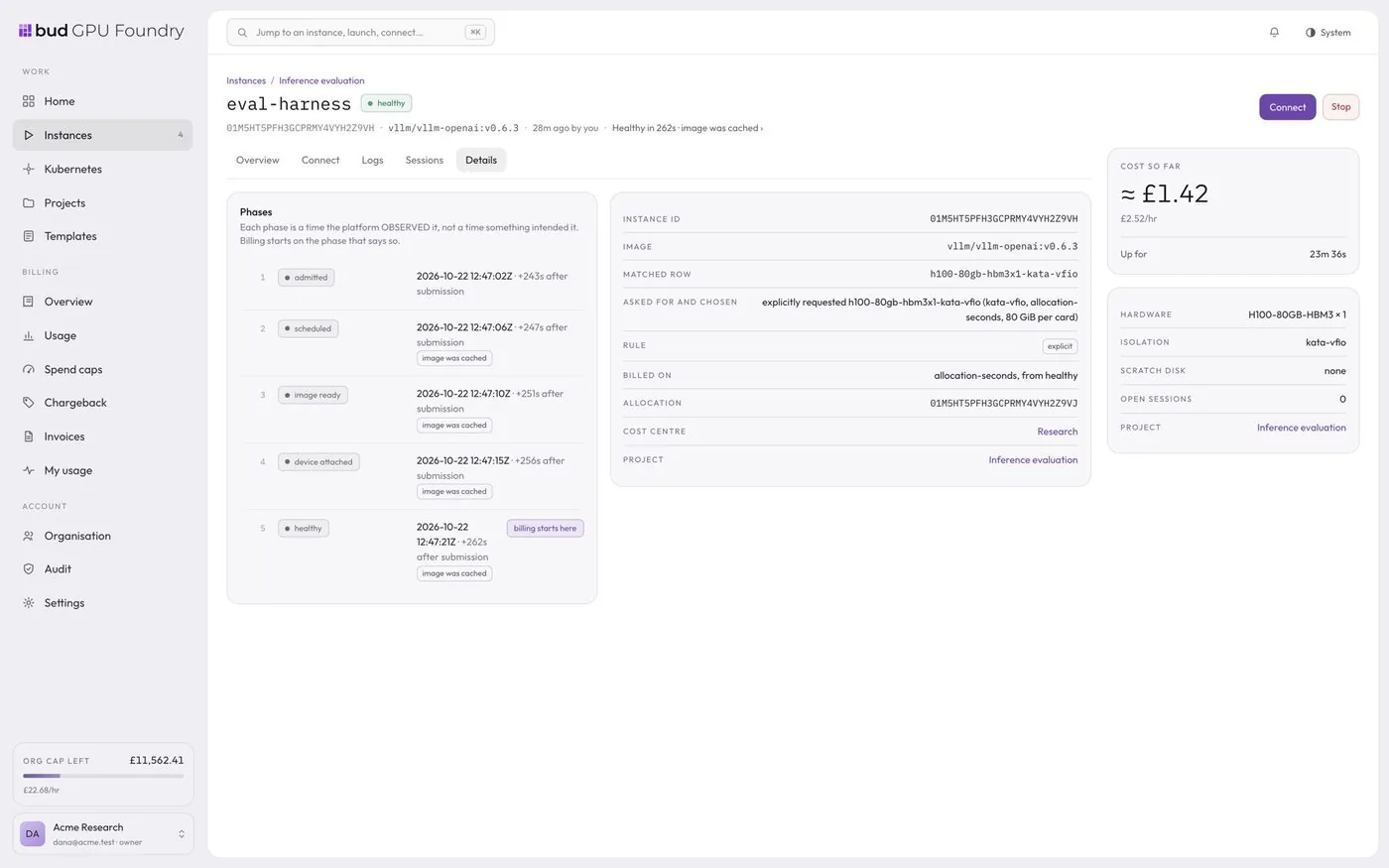
| Reason | What it means | Charged |
|---|---|---|
| start deadline exceeded | It did not reach healthy within the deadline for its start path. Terminated. | nothing |
| image pull failed | The image could not be retrieved: wrong reference, missing credential, or a registry that did not answer. | nothing |
| device never attached | It was scheduled and the accelerator never attached by the mechanism its grade requires. | nothing |
| provisioning failed | A machine, guest, cluster or scheduler did not complete provisioning; the underlying system's own words are carried alongside. | nothing |
| released before healthy | The allocation disappeared before it was ever usable. Recorded as a failure. | nothing |
| backfilled | Reconstructed after the fact from observed timestamps, for capacity that ran without going through the platform's own path. | nothing · counted |
| stopped | Ended because somebody asked it to stop. | up to the stop |
| failed | The workload itself failed, with the cluster's own words carried alongside. | up to the failure |
The log is append-only and keyed on allocation and phase, so a replay is a no-op rather than a second row. A metering event's identity is a pure function of the allocation and its window bounds, so a replay after a broker failure cannot double-charge. Completeness is verified by an independent nightly recomputation rather than asserted.
Scales with demand: quota you can sell, placement you can predict
Quota is the instrument an operator sells with. A grant is an organization's allowance for one unit in one region, in whole instances. Projects draw on it through named shares, idle headroom is borrowable inside the organization — never across organizations — and every placement follows the same published rule.
Network isolation, durable storage, and several ways in through one authorizer
Network. A tenant's network is programmed as part of provisioning them, and it is the same private routed scope whichever service class they bought. Multi-node units receive a dedicated fabric partition; a fabric the platform cannot confirm offers no capacity at all. Platform control surfaces default-deny from every tenant, and the orchestration substrate is not a network a tenant workload can see, let alone authenticate to. Egress is metered per tenant whether or not it is billed.
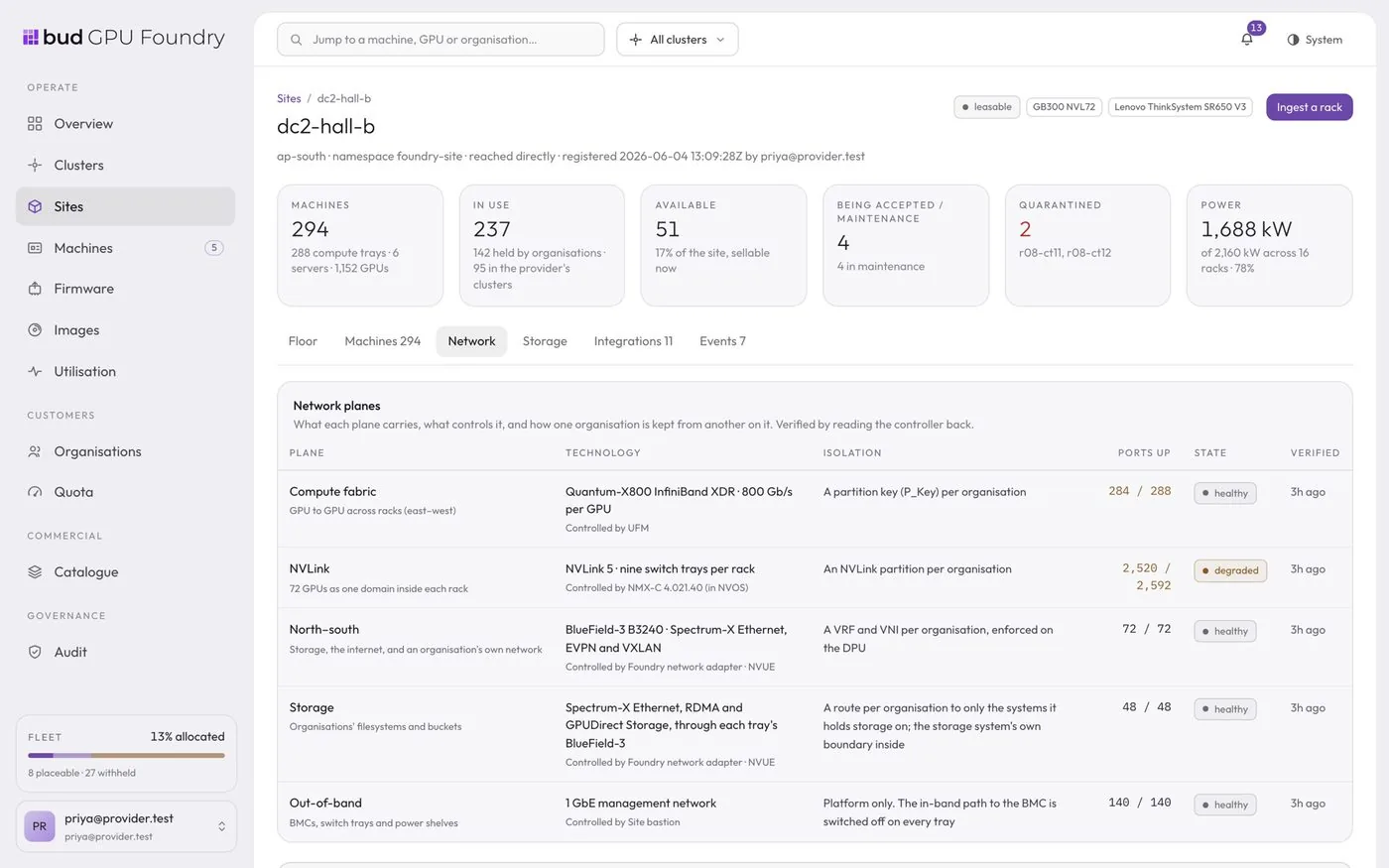
Storage. The platform drives the storage systems you already own — network volumes, a shared POSIX filesystem, boot volumes, S3-compatible object storage, versioned images and declared-ephemeral scratch disk. Each tenant receives its own namespace, access zone and object policy in the backing system; the enforced quota is the number billed; checkpoint writes are acknowledged only once durably stored; and a tenant with a contractual requirement supplies and controls the key protecting its data.
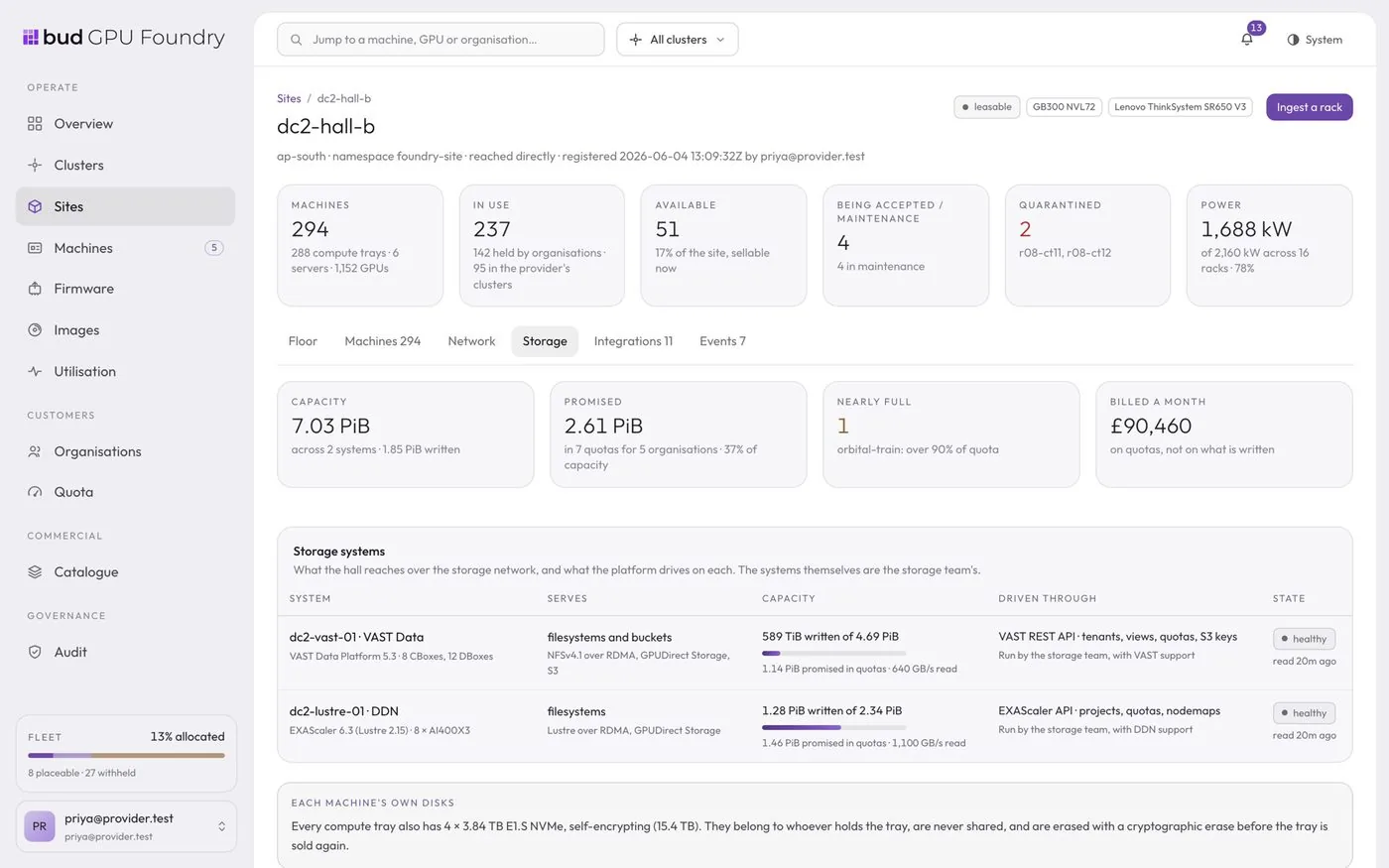
Access. SSH on your own key material or a short-lived certificate, a browser terminal and console on a single-use ticket, managed notebooks, brokered kubectl with credentials issued just in time, and SLURM login over the same gateway. Every session has a beginning, an end, an actor and, where recording is enabled, a replayable transcript. Revocation reaches live connections. Operator staff hold no standing access and cannot attach to a running tenant workload — the break-glass path is cordon and evacuate, refused and audited otherwise.
Billing an enterprise buyer recognizes, and spend caps that act
An allocation window with a provisioning phase priced at zero exists on the first record ever written. Metering, rating, invoices, chargeback, budgets and enforcement all read that one log, which is what makes a disputed charge answerable: a tenant receives a per-window explanation of what was billed and why, including the provisioning windows charged at zero.
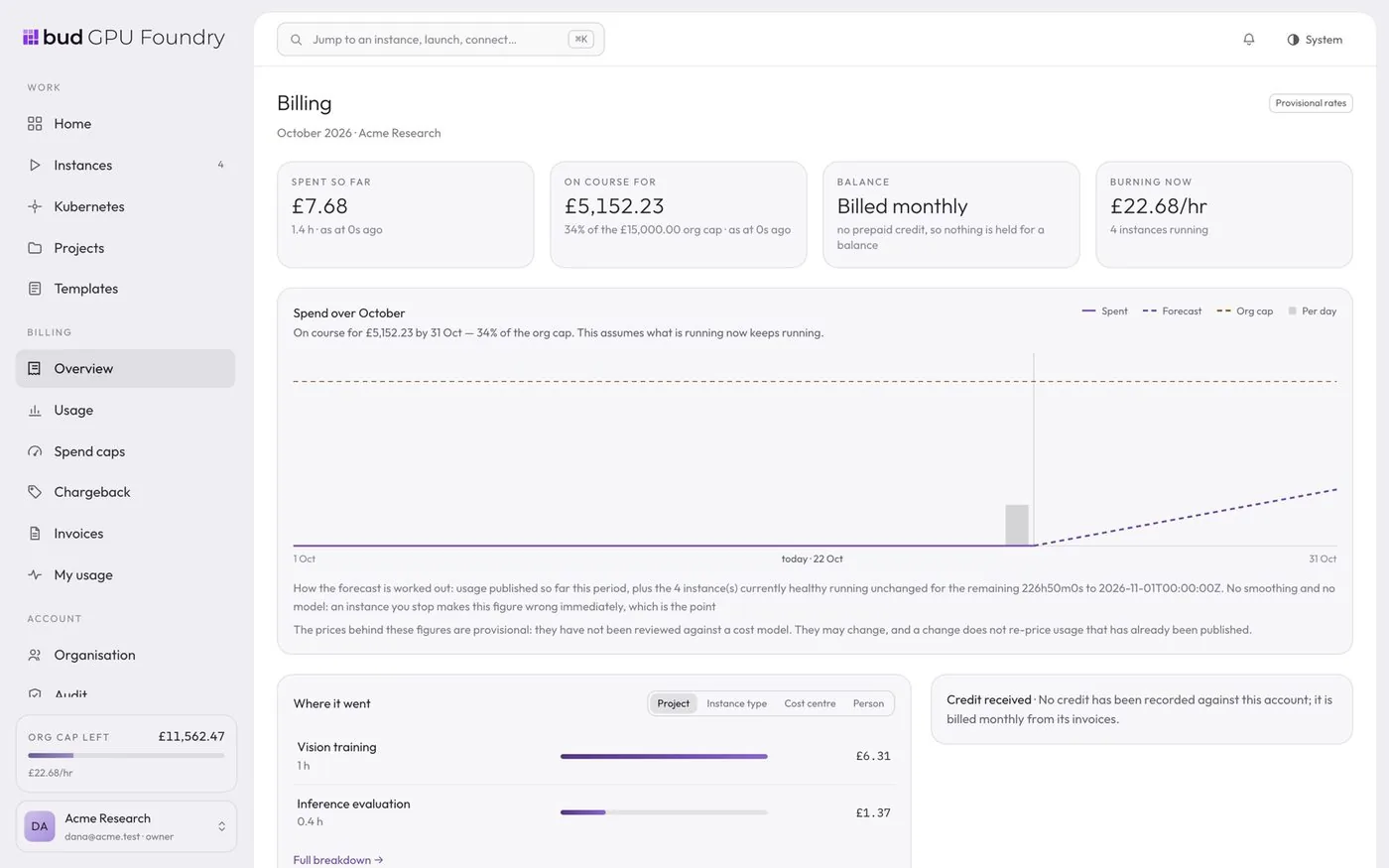
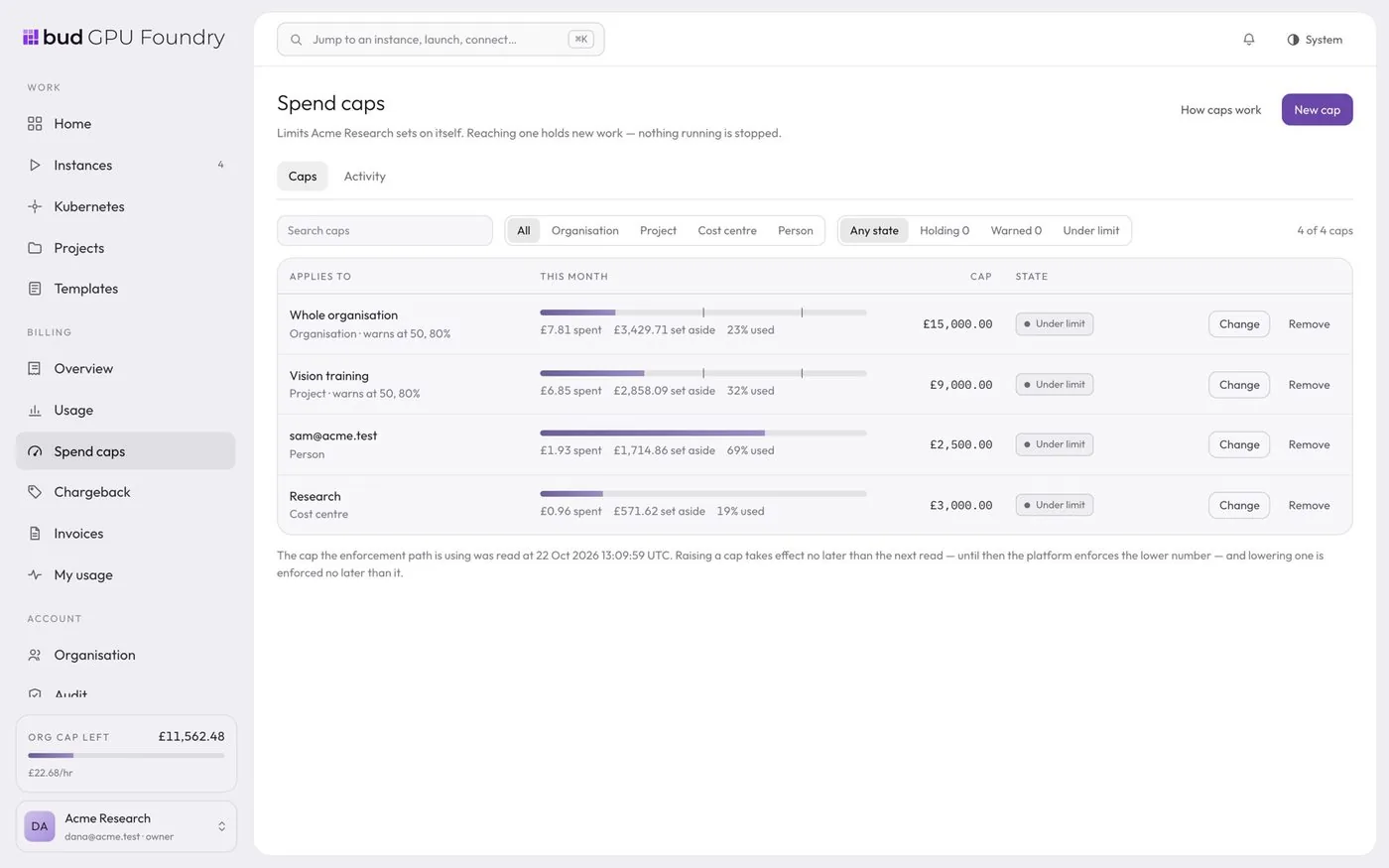
Commercial terms. Every unit's price derives from a cost model covering capacity, power, network, storage and support; achieved margin is reported per unit at least monthly, and nothing is published below its computed floor without a recorded decision. Term commitments are discounted and backed by a reservation ledger that guarantees the capacity exists, and a future-dated reservation returns a confirmed grant or an honest refusal with an alternative date. Interruptible capacity is offered at a published discount, only to work that has declared itself resumable, with notice never shorter than its checkpoint interval. An availability commitment carries a defined measurement, a credit schedule by breach band and published exclusions, with credits computed from platform telemetry and offered without a claim — and the published figure is bounded by the recovery time actually demonstrated in a timed restore drill. Member and cost-center caps refuse new work at submission and never stop work already running.
From capacity to AI consumption: inference, model services and tokens on the same stack
Model catalogs, inference endpoints, serverless models, token metering and agent services are delivered by Bud AI Foundry, which runs on Bud GPU Foundry as a tenant like any other. It receives no private interface and no exemption, so a token-billed customer inherits the isolation, quota and audit trail of the capacity beneath them. The capacity plane does not need to know what a token is; the model plane does not re-implement quota, isolation or metering. What connects them is specified, not assumed.
allocation-seconds · node-hours · capacity-hours — from the phase log, from healthy on. Margin per endpoint is a measurement, not an inference at the end of a quarter.
tokens served — per endpoint, per customer, per model, per agent service — recorded apart from the capacity. Bud AI Foundry's own customers appear as sub-organizations, so a token-billed customer's consumption rolls up through the same tree as everything else.
Where several tenants are served by one model process, no tenant code executes and the isolation claim is made at the request boundary — stated as its own unit in the catalog rather than borrowing a compute grade's claim.
Everything between the accelerator and the invoice is one product.
The ways tenants reach the platform, the control plane, the data plane, the site fabric, and the revenue record that ties them all together. AI services sit on top as a tenant of the same platform, which is how they inherit its guarantees.
Identity, revenue and platform state live in separate domains that are never joined and never reference each other. A failure in one cannot take the others with it.
The API writes what was asked for. The operator writes the substrate. The lifecycle informer alone writes the phase log that metering reads. Nothing else can.
Signed images and versioned charts in a declarative deployment tree, pinned and upgraded together through a staging canary. Which version runs where is reviewable configuration.
Each cluster's region is stated by the operator who onboards it, and every tenant placement happens inside the project's region. Residency is evidence, not a preference.
Work that must have exactly one writer runs under a lease. Work that must scale with demand runs behind a load balancer. Neither is allowed to become the other.
The platform installs into clusters you run. No component needs the public internet to serve a tenant, so an air-gapped site is an ordinary deployment.
Six places in the console, and what each one is for
| Place | What it holds | Who |
|---|---|---|
| Operate | Fleet inventory, clusters, hosts and individual accelerators, with health and the reason anything is not sellable. Networks, address pools, storage systems. | operator |
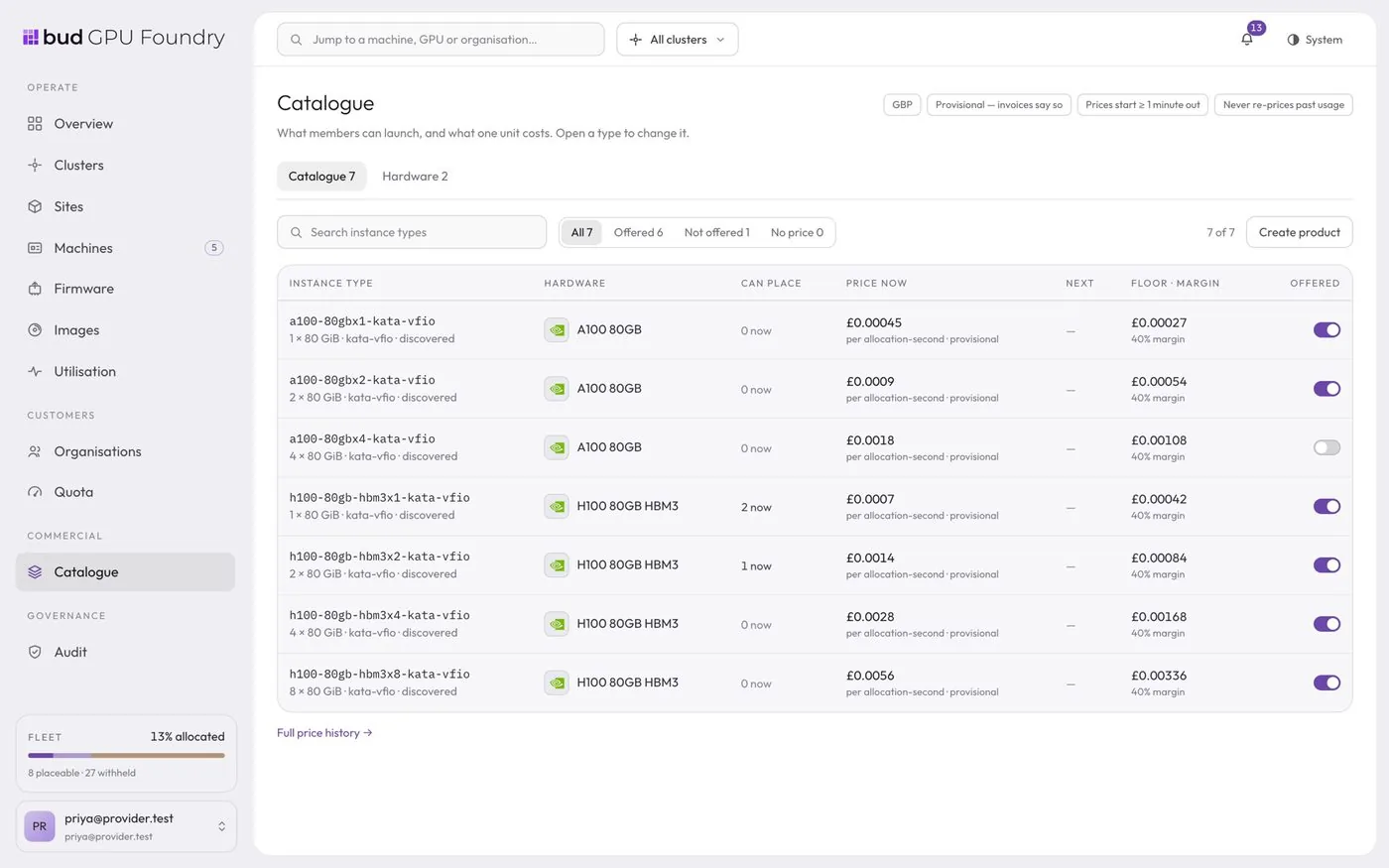
| Sell | The sellable unit set with its reasons, quota granted per organization per region, rate cards, cost floors and margin. | operator |
| Build | Templates, images and the starter library; launch with resolve-before-submit for every service class; queues with a position and a reason. | tenant |
| Watch | Detail for a machine, guest, cluster or workload: phases with the metering marker, live logs, utilization, sessions, the embedded terminal and the stop preview. | both |
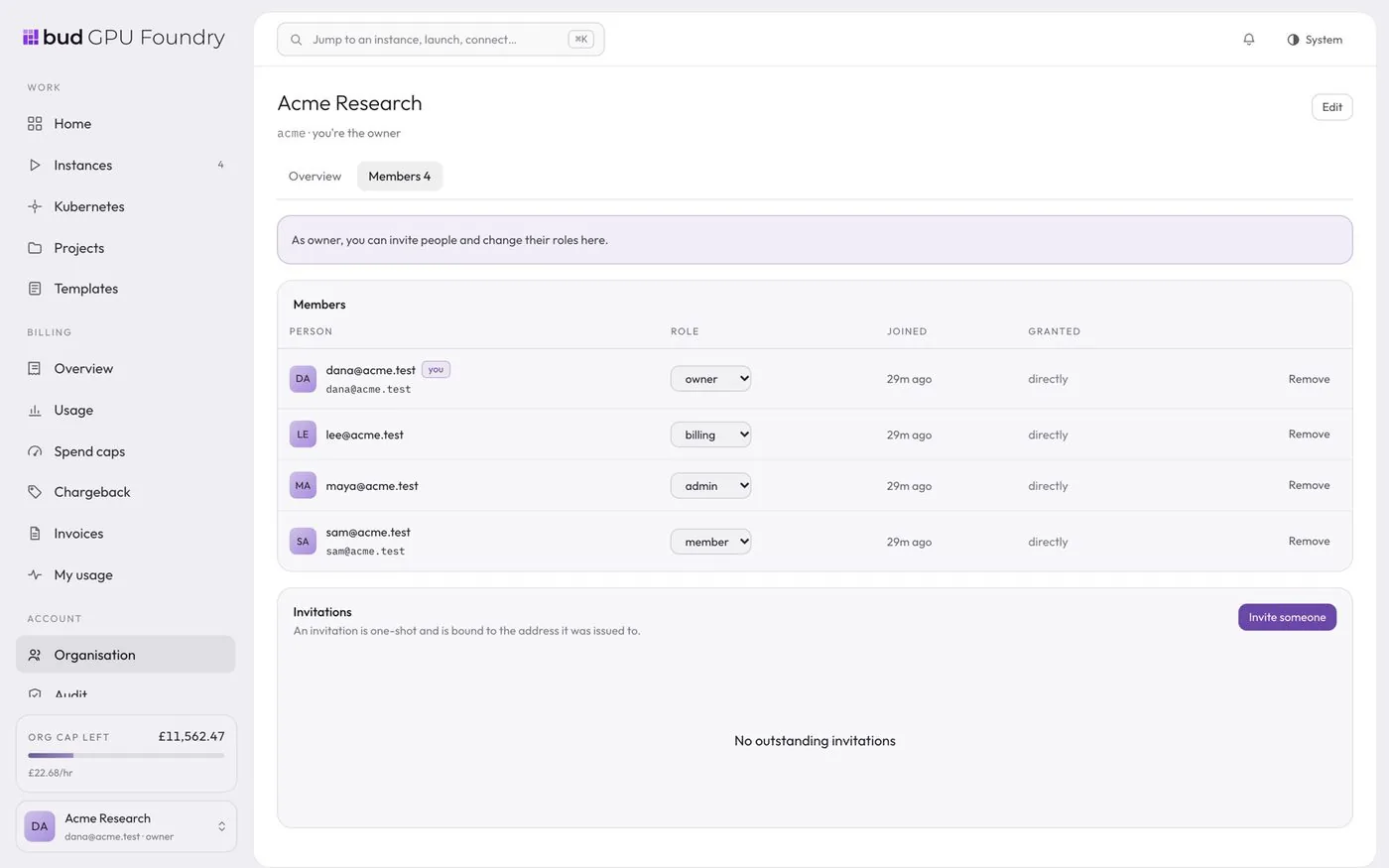
| Govern | Organizations, sub-organizations, projects, people, roles, invitations, domains, tokens, keys and the audit trail. | both |
| Spend | Usage, chargeback by cost center, invoices, budgets and caps, showing the same numbers the invoice will carry. | tenant |
The API is the product; the console, the command line and the SDKs are clients of it, generated from the same published specification. Every operation has a command-line command, the console may call only published endpoints, and no decision lives in a place the command line cannot reach.
Two consoles, one specification
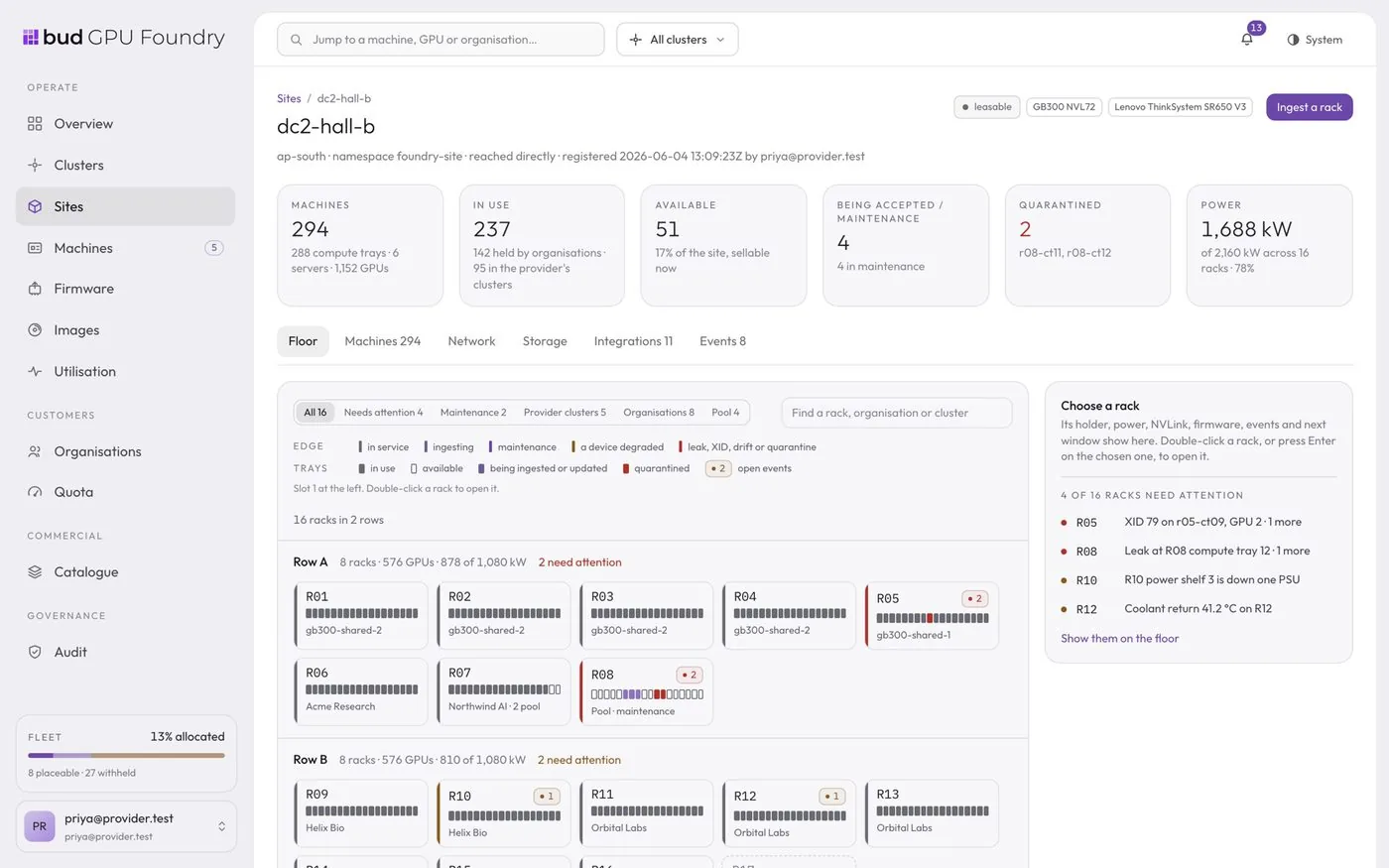
The provider console is where an operator runs sites, clusters, machines, firmware, images, the catalog, quota and organizations. The customer console is where a tenant launches and watches instances, Kubernetes clusters and leases, and reads usage, spend caps, chargeback and invoices. Both are clients of the same published API, and neither can do anything the command line cannot.
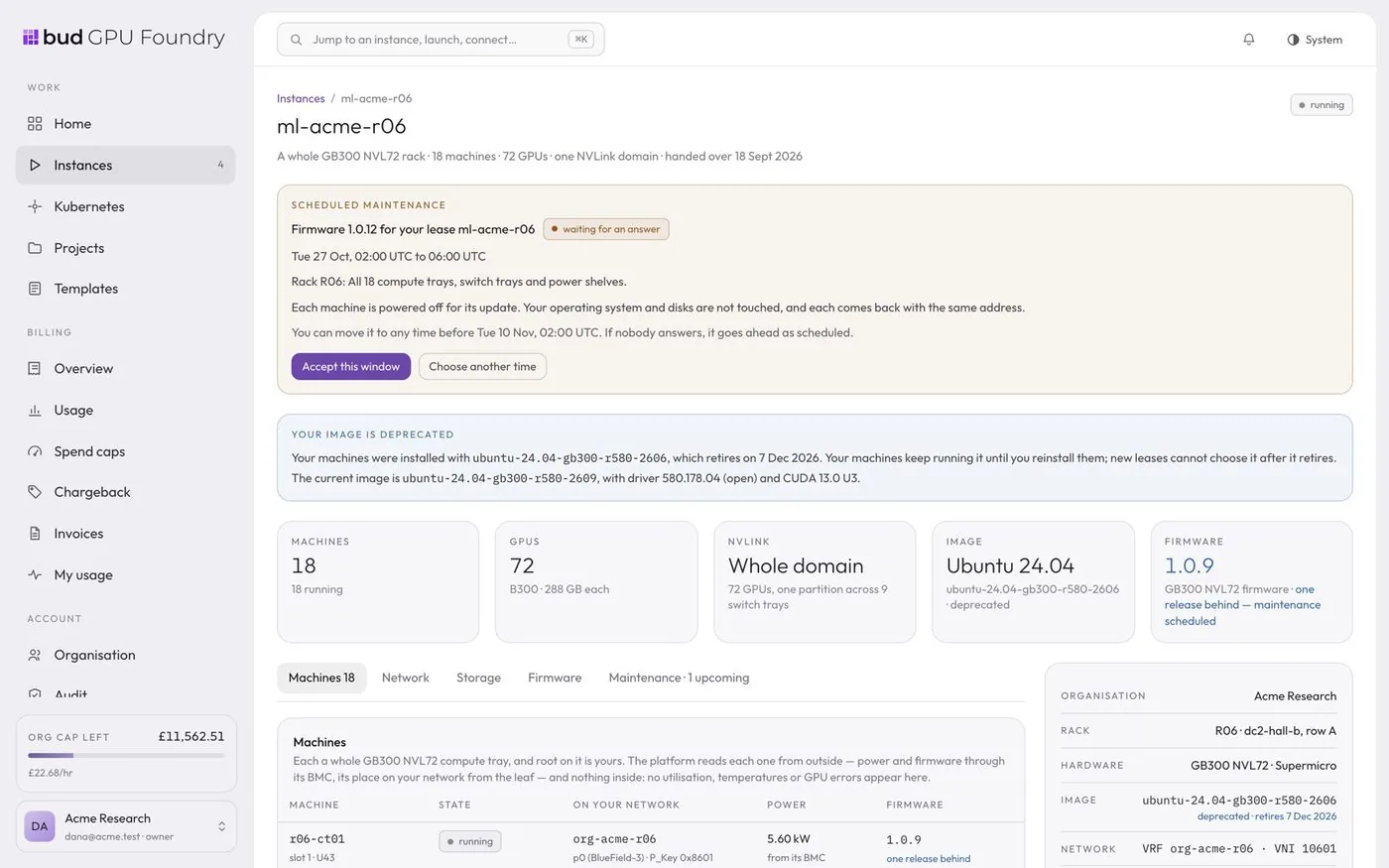
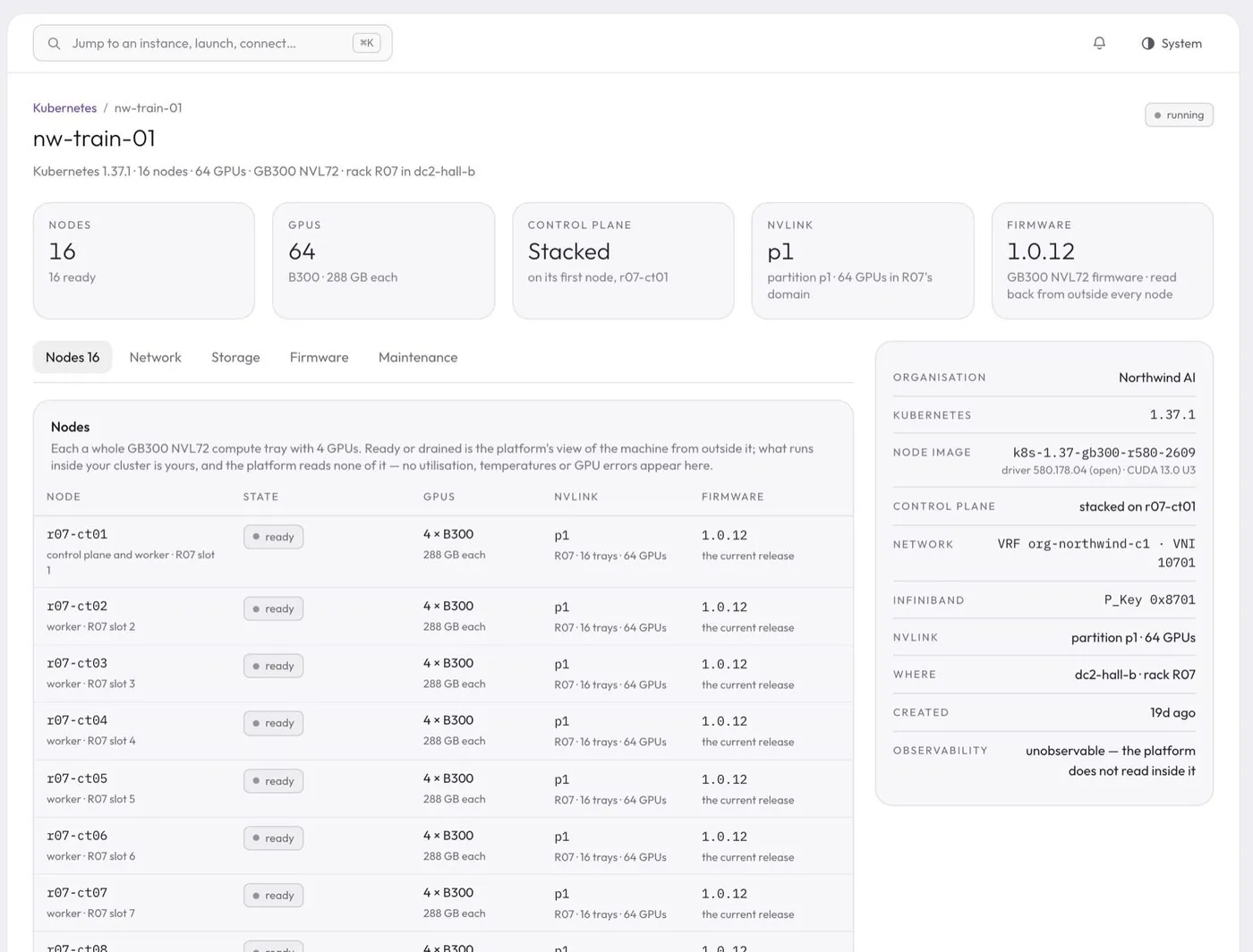
Every rack sold a tray at a time, every machine returned with evidence, and nothing a tenant holds touched unannounced.
Accelerated infrastructure is only as trustworthy as its least-verified firmware and only as current as its oldest image. This is the half of a GPU cloud most platforms leave unspecified: how a rack is enrolled and sold, how a machine comes back, and how the fleet below the tenant is kept current.
Rack-scale systems, sold as bare metal a tray at a time
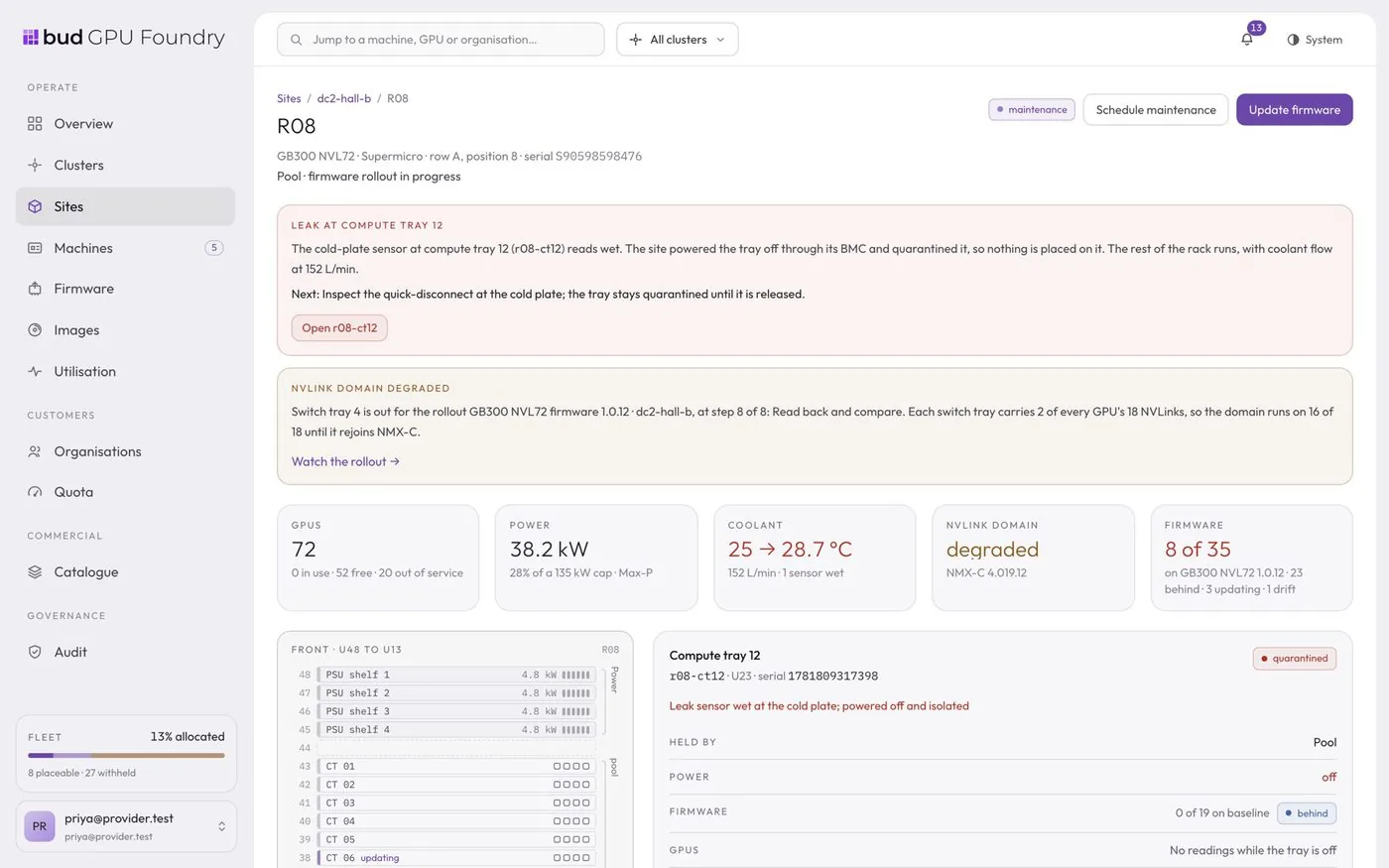
Some accelerated systems are not hosts. A rack-scale system is a set of compute trays sharing one accelerator interconnect domain, its switch trays, its power shelves and its liquid cooling — delivered, powered, cooled, partitioned and updated together. Bud GPU Foundry enrolls and operates the rack as the one unit it is, and sells it through the bare-metal service class in the units a tenant can hold: a tray, several trays, or the whole rack. Nothing about a tray's lease, reclaim or bill changes because it sits in a rack; what changes is that the rack's shared state is taken into account everywhere it matters.
| The rack is the unit of | What that means |
|---|---|
| Delivery | Enrolled whole — compute trays, switch trays, power shelves and cooling inventoried together — and accepted tray by tray, each passing its own acceptance before it can be sold. |
| Power and cooling | Draw, caps and profiles, inlet and return temperatures, coolant flow and leak sensors are recorded against the rack rather than whichever tray reported them. |
| Partition | A tenant's share of the interconnect domain is a partition that excludes every other tenant, made at hand-over and removed at return. A unit of several trays is placed inside one domain, so its trays talk at the bandwidth sold. |
| Firmware | Tray, switch-tray and power-shelf firmware belong to one baseline for the rack's generation, and a rollout is ordered by who holds each tray. |
| Maintenance | Work on a shared component is scheduled against every tray it affects and every tenant holding one, through notified windows. |
| Faults | A coolant leak or power fault takes every machine it affects off sale until resolved. A rack whose cooling, power or interconnect is degraded offers nothing that depends on it, and says which. Every health event is acknowledged and resolved by a named person; a hardware return is tracked as a case against the tray and part. |
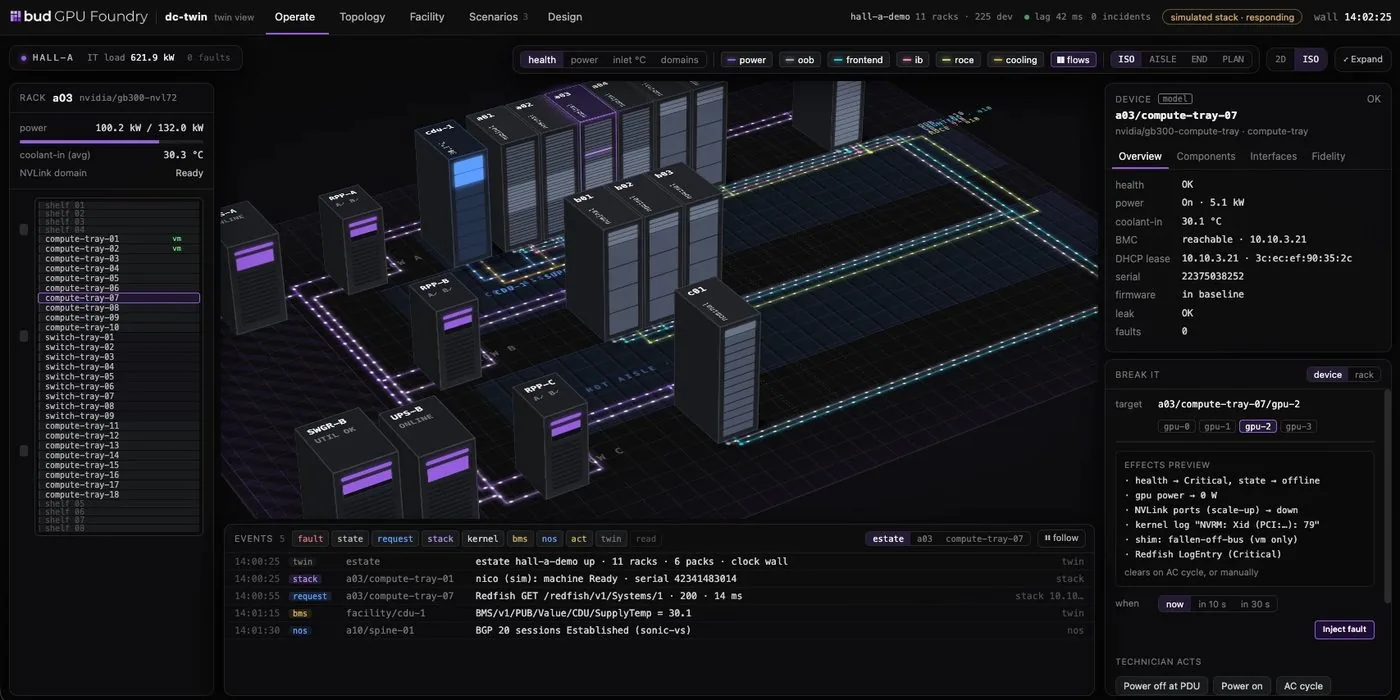
Reclaim: every step, on every return
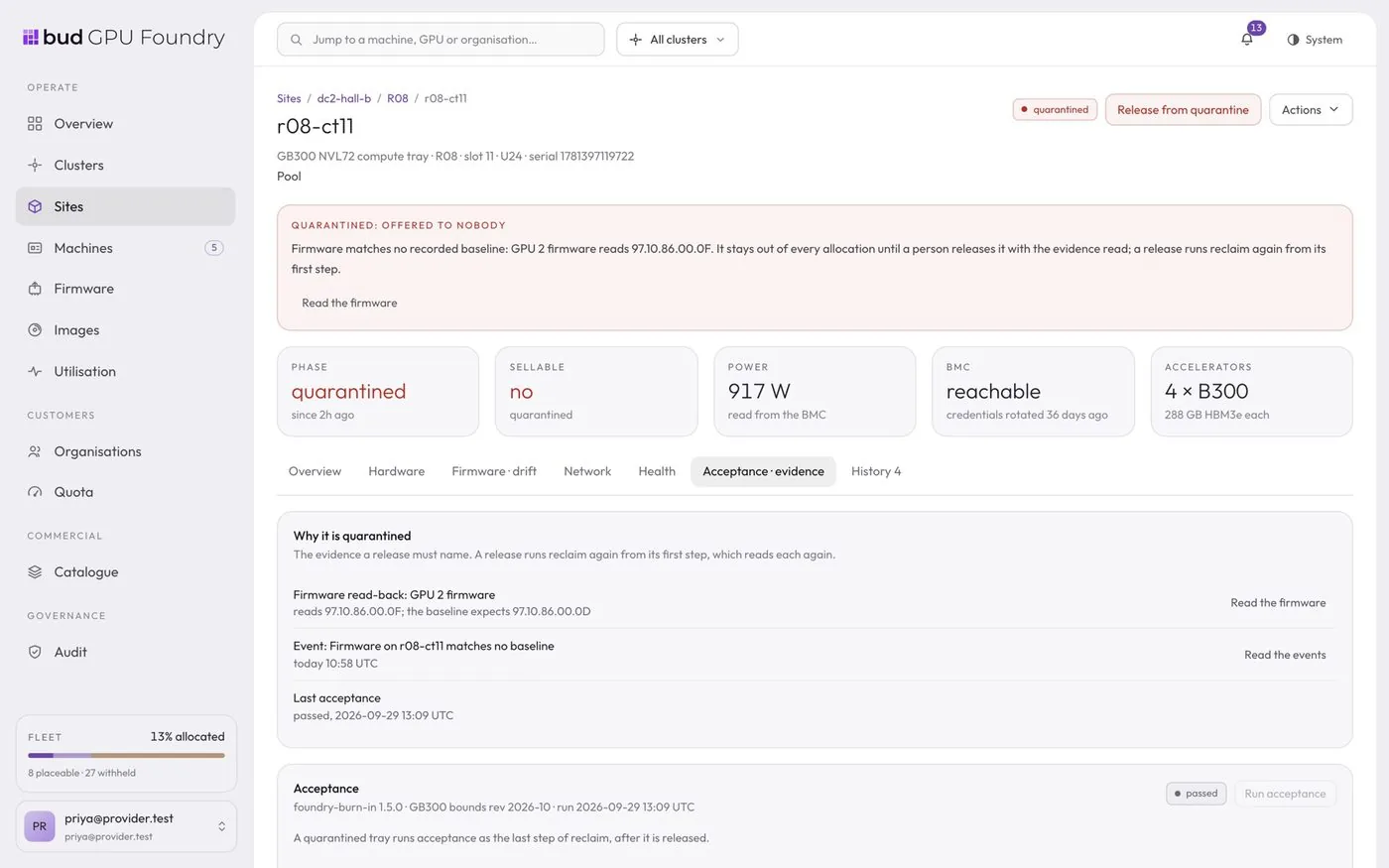
A machine reaches the sellable pool only after its firmware baseline is verified against the recorded standard for its hardware generation and its burn-in suite passes. While a tenant holds it, in-band access to its management controller is disabled, isolation is enforced at the fabric against a tenant with root, and the platform reads it only from outside — power, temperatures, fans, power supplies and the event log — shown to the tenant for the window they held it. When it comes back, reclaim runs every step, every time:
Firmware and images: one baseline per generation, rolled out by who holds what
Each hardware generation has one current baseline naming the package for every component it covers, and every machine is read back against it out of band, per component — so a fleet's firmware is a record rather than a spreadsheet. A package is imported from the vendor's mirror, by upload, or carried by hand into an air-gapped site, and its vendor signature (and measurement manifest, where published) is verified at import; a tampered package is refused at import, not discovered at flash. Each device class has exactly one writer. Devices the platform does not update — fabric switches, storage systems, facility controllers — are read for the record, with who updates them, and never written.
| A component, read back against its baseline | What it means |
|---|---|
| match | At the level its generation's current baseline names. |
| behind | At a level an older baseline names. Due in the next rollout, and never shown in the same color as drift. |
| drift | At a level no baseline names. The machine is quarantined until it is brought back and re-accepted. |
| unreadable | The management controller cannot read the component back. A stated limit, and never a pass. |
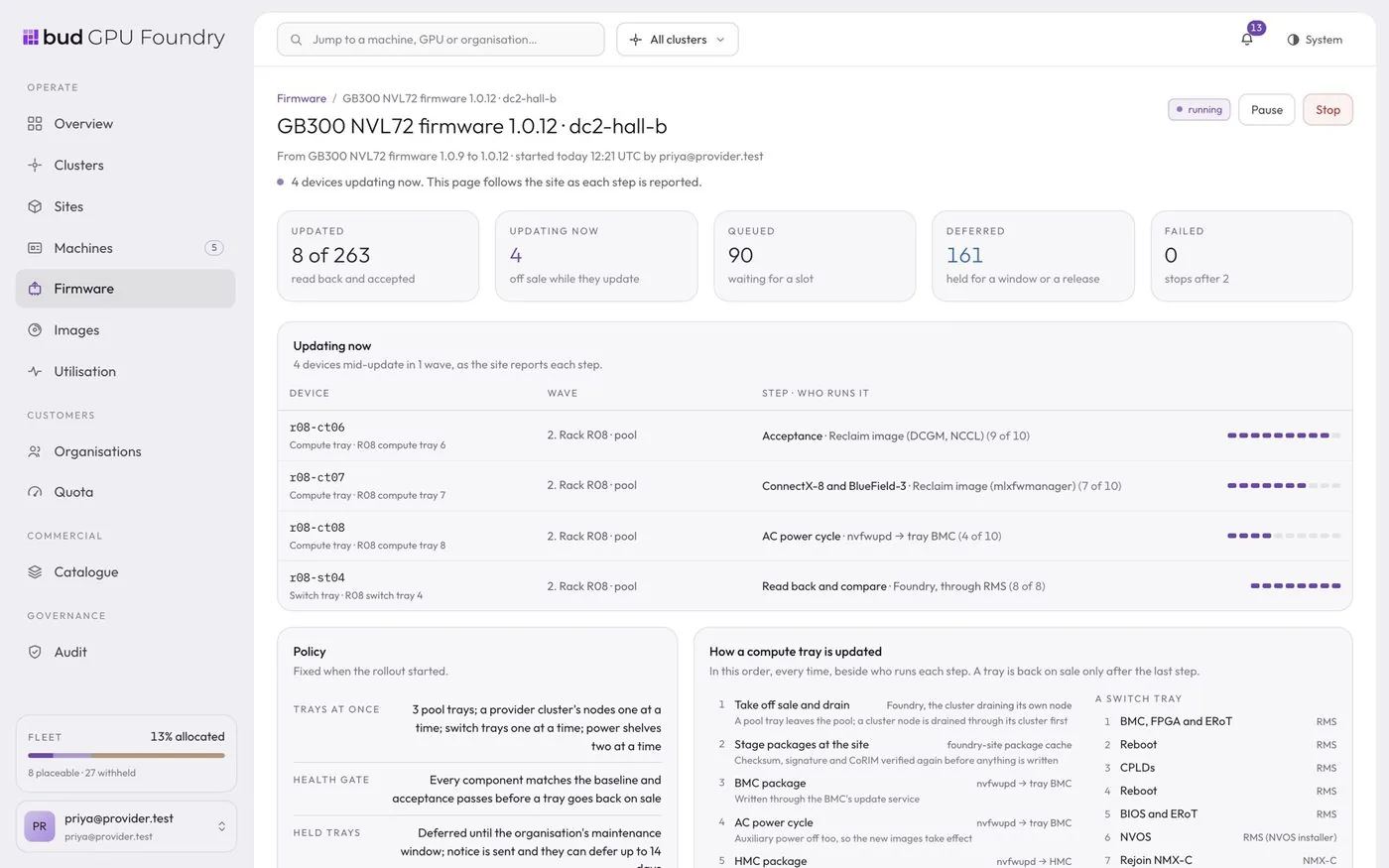
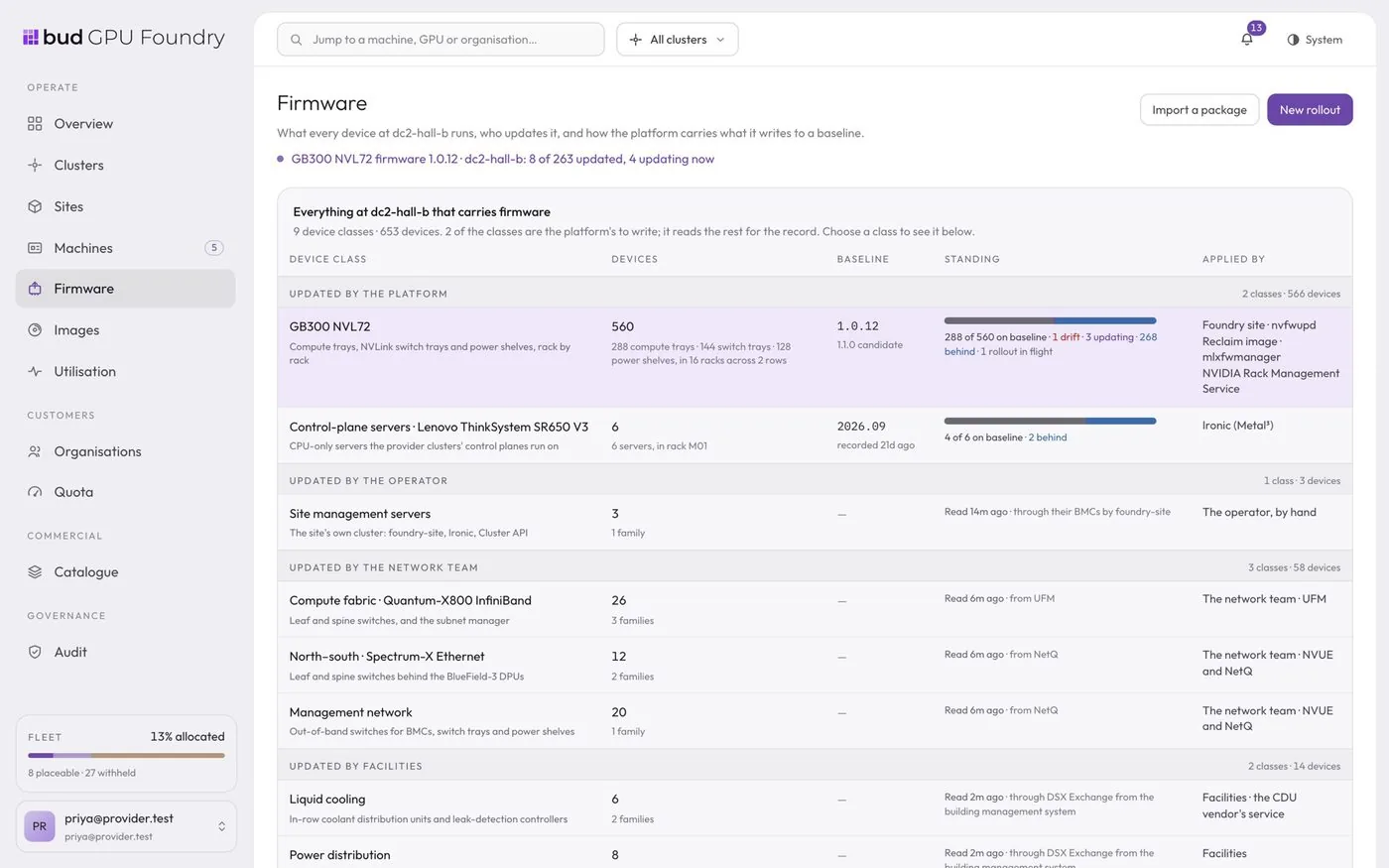
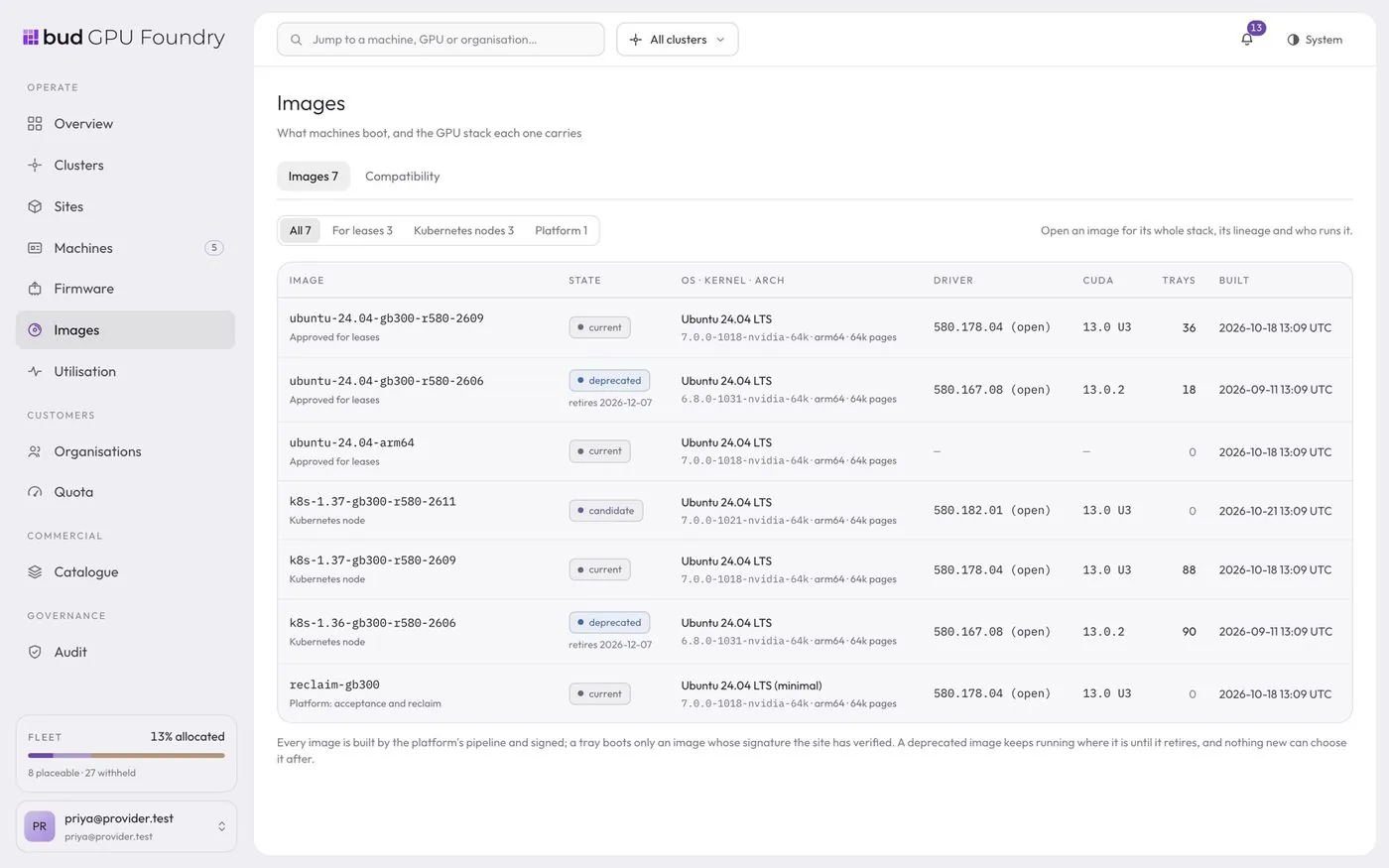
Every image states the accelerator software it carries and each component's version, and is signed and published by digest. Advisories against an image a tenant's cluster runs are shown on that cluster, never applied for them. Outside a window, the platform acts on a held machine only to contain a fault — a leak, a power fault, a failing accelerator — and the tenant is told what was done, when and why.
Runs where you are: installed into your data centers, pinned as one set, upgraded through a canary.
Fonts and assets are self-hosted, images are mirrored into your own registry, and no component needs the public internet to serve a tenant. Register another cluster at runtime and the API, the console and quota span it; withdrawal cordons first and refuses a cluster still holding tenant capacity.
Silicon, environments and delivery
Silicon
Mixed vendors and generations in one fleet. A unit binds to machines by what the hardware publishes about itself, so one catalog serves a fleet of mixed generations without a unit landing on the wrong silicon. 600+ accelerator SKUs supported across the Bud Novaria AI OS.
Environments
An air-gapped deployment is a supported configuration rather than a special case. Each cluster's region is declared by the operator who onboards it, and work is placed inside its project's region, so data residency is a record you can show rather than a setting you assert.
Delivery & operations
Every pin records how mature that component is, so upgrade cadence is planned against real risk. The control plane is restored from backup within a published recovery time, verified by timed drill. Faulty accelerators drain without data loss and are quarantined individually. Every externally visible commitment is validated by a repeatable drill before it is published.
A tenant's life, both halves specified
Onboarding is usually designed carefully and exit usually is not. The exit half is what an enterprise procurement review asks about first, because it decides whether choosing the platform is reversible.
Directory deactivation revokes platform access, active sessions and issued keys within a published time bound. A tenant can move between organizations, resellers, plans or billing models without interruption to what is running and without published addresses changing.
Every headline number, with its basis.
The figures on this page are architectural properties and published commitments, not benchmark results. Each is paired with where it comes from — and the thirty guarantees below are stated in the negative so they can be held to.
Thirty things Bud GPU Foundry will never do
- Bill for capacity that never became healthyMetering derives from the phase log, and starts at one phase and no other.
- Display capacity it cannot placeAvailability is derived from placeability per cluster, with a freshness stamp on every figure.
- Reclaim interruptible capacity on less notice than the tenant's declared checkpoint intervalThe notice period is a property of the unit and is delivered before reclamation begins.
- Discard logs when a workload crashesLines are read from the tenant log store, never from the thing that wrote them.
- Publish a best-case latency figure as a typical oneEvery published figure is a measured percentile with its measurement method stated.
- Require a tenant to detect a platform failure in order to be credited for itCredits are computed from platform telemetry and offered without a claim.
- Charge a stopped resource more than a running one without saying so at the point of stoppingThe stop preview and the unit's metering basis are both shown before the action.
- Withhold compliance documentation or security features behind a spend thresholdA published commercial policy, not a matter of sales discretion.
- Hold the only copy of a key protecting tenant data where the tenant has contracted otherwiseTenant-supplied keys, whose revocation renders the data unrecoverable.
- Suspend a contract-billed tenant automatically for balance reasonsFor that class, enforcement is a quota ceiling and a notification; suspension needs a recorded human decision.
- Present utilization telemetry as a charge basis on any unit where it cannot observe the tenantBlind classes are declared in the catalog in advance and render as a stated absence.
- Offer a fractional tier to mutually untrusting tenants unless the isolation is enforced in hardwareTenant classes are a property of the catalog row, and the generator refuses the combination outright.
- Expose a tenant to another tenant's residual accelerator memoryVerified memory clearing per hardware generation before a device is re-offered.
- Return a machine to the pool without verified erasure of the media that held tenant dataSanitization is part of the reclaim workflow, with evidence retained for the deletion period.
- Sell a dedicated fabric path that is in fact shared with another tenantFabric partitions are per tenant, and a fabric the platform cannot confirm offers no capacity at all.
- Issue a tenant credentials of any kind to the platform's own orchestration control planeAsserted against the API and against the access gateway's certificate issuer. Your cluster is yours; ours is never reachable.
- Require a tenant to hold a long-lived credential to reach what they boughtCertificates, tickets and cluster credentials are minted on demand and expire on their own.
- Let a reseller see inside its customers' workA reseller relation reaches quota, consumption and spend; there is no relation from it to a workload, a session or a log line.
- Allow a capacity request to bypass quota accounting by any pathAdmission policy checks that work is routed by the scheduler, and anything that slips past is counted.
- Promise live migration of accelerator-attached guestsStated as impossible rather than deferred, so no plan ever quietly assumes it.
- Market an isolation grade it does not enforce on the specific unit being soldRuntime pinning by provenance, and grade constraints checked against what the hardware publishes.
- Give operator personnel an interactive session into a running tenant workloadThe break-glass path is cordon and evacuate; the attempt is refused and audited.
- Offer a machine again after a tenant changed its firmwareIn-band management access is disabled for the allocation, and reclaim reads every component back out of band; a mismatch quarantines.
- Run its own agents or controllers with standing write access on a machine handed to a tenantThe one credential kept to a tenant's cluster stays at the site, is used only for operations the tenant asks for, and is declared.
- Interrupt a machine a tenant holds outside a window they were told of, except to contain a faultEvery operator action on a held machine is named and recorded, and fault containment is notified when it happens.
- Install firmware whose vendor signature has not verifiedPackages are verified at import, air-gapped sites included, and a baseline can name only a package that verified.
- Stop work that is already running because a member's spend cap was reachedA member cap refuses new work at submission; only the organization's own ladder can reach running work.
- Reveal one member's usage to another member who may not read the organization's usageA member reads their own attribution; the breakdown by member needs the relation that reads the organization's usage.
- Smooth, clamp, interpolate or discard a metered quantity before it is ratedThe quantity rated is the quantity metered, and a late correction is spent the moment it lands.
- Show a tenant any signal derived from another tenant's cached or in-flight stateCache scope on a shared serving engine is set by the platform, never taken from the request.
How these claims are framed. Counts on this page — service classes, grades, phases, guarantees, capability groups — are properties of the catalog and the lifecycle, not benchmark results. Deployment-specific numbers (utilization gains, start times on your hardware, metering accuracy against your own accounting) are established in a proof-of-concept on your infrastructure. Independent assessment is completed before the first external tenant and repeated at least annually; the platform is validated against the accelerator vendor's own requirements for AI clouds — service delivery by API, hard and soft multi-tenancy, telemetry, metering accuracy and lifecycle operations.
Not NVIDIA's platform, not Rafay's: the open control plane between them and your customers.
Bud GPU Foundry is compared with two things it is not. NVIDIA's own software runs the hardware and the jobs on it, but does not sell it. Rafay sells it, on a closed platform built around NVIDIA. Bud GPU Foundry is the layer that turns any vendor's fleet into a governed, metered, invoiced service, and it is open source under Apache 2.0.
Where Bud GPU Foundry sits relative to NVIDIA's software
NVIDIA's reference software for GPU-cloud providers — Infra Controller, Base Command Manager, Mission Control, UFM for InfiniBand and NMX for NVLink — provisions, schedules, recovers and monitors. None of it meters, rates or invoices a tenant, and NVIDIA's own documentation leaves the tenant portal to an independent software vendor. That is the layer Bud GPU Foundry occupies. On NVIDIA systems it reads and drives the vendor's own managers — the network planes it reports are controlled by UFM and NMX-C, and rack firmware is applied through NVIDIA's rack management service — rather than replacing them.
Rafay: parity where it is due, and where Bud GPU Foundry goes further
Rafay is the name most sovereign operators, neoclouds and telcos meet first in this lane, and it is the closest competitor on scope: bare metal, VMs, Kubernetes, SLURM, notebooks, inference and, since April 2026, Token Factory, sold with white-label portals and SKU management. It is NVIDIA AI Cloud-Ready validated, certified with NVIDIA Run:ai and deploys it as a one-click catalog item. The difference is not the feature list's length. It is license, silicon, how a bill is produced, and how much of the hardware's lifecycle the platform owns.
| Capability | Rafay | Bud GPU Foundry |
|---|---|---|
| Parity — both platforms do this | ||
| Service classes | Bare metal, GPU and CPU VMs, Kubernetes, SLURM-as-a-Service, notebooks (Jupyter, Ray, Kubeflow), inference and serverless inference | Bare metal (incl. rack-scale trays) · VMs · Kubernetes · SLURM · serverless containers, from one catalog |
| Self-service catalog | Self-service catalog with SKU designer (PaaS Studio) and marketplace | Catalog discovered from the hardware, filtered by tenant class and isolation ceiling before display |
| GPU sharing | Full passthrough, MIG and time-slicing, chosen per SKU | Five ranked isolation grades, from bare-metal host to memory-capped slice, claimed per unit sold |
| Network isolation | Per-tenant VRF, VLAN and EVPN; InfiniBand partition keys via UFM | Routing domains north-south, fabric partitions east-west, verified by probing from inside the tenant's segment |
| White-label | Logo, colors, domain, product name, locale and currency per partner | Brand, domain, price book and language as properties of an organization |
| Access & identity | Enterprise SSO, RBAC, zero-trust kubectl proxy, audit logs | One authorizer for SSH, browser terminal, notebooks, kubectl and SLURM login; every session a record |
| API & automation | REST, Terraform/OpenTofu, CLI, GitOps, SDKs | One published specification; console, CLI, Python and TypeScript SDKs, IaC provider and an agent tool server generated from it |
| Deployment | SaaS, self-hosted or Rafay-managed controller; air-gapped package | Installed in your data centers; air-gapped as an ordinary deployment |
| Tokens | Token Factory: token-metered model APIs with pricing, quotas and plans | Bud AI Foundry as a tenant — capacity and token meters on one tree |
| Where Bud GPU Foundry goes further | ||
| License | Proprietary, priced per node | Apache 2.0 — the control plane can be audited, forked and kept |
| Silicon | NVIDIA in all marketing and references; AMD Instinct and Intel Gaudi 3 in a docs support matrix | NVIDIA · AMD · Intel · Qualcomm · Huawei in one catalog, mixed vendors and generations in one fleet |
| Invoicing | Meters usage and exports it; rating and invoices handled by partners | Rating, invoices with purchase-order references, chargeback, prepaid balances and contract billing native, from the same log as the meter |
| When the meter starts | Not specified in published materials | At healthy, and nowhere earlier; failed starts are zero-cost records with a reason |
| Resellers & sub-tenants | Not found in published materials | Nested organizations, quota divided in whole units, a replayable usage feed, no route into a customer's work |
| Reclaim evidence | Hosts "attested and securely wiped"; method not published | Firmware read-back, disk sanitization, memory clearing and acceptance on every return, evidence kept |
| Firmware management | Not found in published materials | One baseline per generation, signed packages, staged rollouts by who holds what, drift quarantines |
| Rack-scale operations | GB200/GB300 NVL72 supported and certified | Racks enrolled whole and sold a tray at a time; leaks and faults take affected machines off sale; digital twin for rehearsing faults |
| Published guarantees | SLAs set per engagement; no figures published | Thirty guarantees, each closed by an automated check; credits computed from telemetry without a claim |
| Above tokens | Stops at tokens | Training, grounding, guardrails and agents on the same fleet — the rest of Bud Novaria AI OS |
If your fleet is NVIDIA end to end and you want a commercially supported Run:ai deployment, NVIDIA validation and a managed-service option, Rafay is the shorter path today. It has the longer list of named neocloud and telco customers, resale and solution partnerships with Cisco and Dell among others, a SaaS controller if you do not want to run one, notebook and Ray environments as catalog items, and an AI-assisted observability product.
Where a Rafay customer runs Run:ai, they are running NVIDIA's orchestration through Rafay's layer, not an alternative to it — and since NVIDIA open-sourced Run:ai in October 2026 as the KAI Scheduler, that orchestration is available beside any control plane, Bud GPU Foundry's included.
Platform risk. Rafay describes itself as hardware-agnostic, but its story and references are NVIDIA-only. The question to put to an NVIDIA-certified credential is what happens to the control plane when the next rack is not NVIDIA. Bud GPU Foundry runs a mixed fleet as one catalog, on an open stack you can audit, with 600+ supported accelerator SKUs across five vendors.
The bill. Rafay meters and hands rating and invoicing to billing partners. In Bud GPU Foundry the meter, the invoice and the enforcement decision read one log, so a screen and an invoice cannot disagree and a disputed charge is answerable per window.
What sits above. Rafay stops at tokens. Bud GPU Foundry is Layer 02 of Bud Novaria AI OS, so training, grounding, guardrails and agents run under the same tenancy and audit trail.
Where you are starting from. Greenfield fleets run on Bud GPU Foundry today. A migration path for Rafay-managed fleets is on the roadmap.
Comparison current as of Q4 2026 · Rafay facts from rafay.co and docs.rafay.co, checked 30 Oct 2026 · NVIDIA facts from nvidia.com and docs.nvidia.com · "not found" means not stated in published materials
Two kinds of operator. Every kind of tenant.
Bud GPU Foundry is for every organization with accelerators in racks and demand in queues — whether the tenants are internal departments, paying customers, or AI services of its own.
Enterprise platform teams
Give every department governed self-service on a shared fleet — quota by department, chargeback by project and cost center, every isolation grade available, idle headroom borrowed inside the organization.
Service providers & neoclouds
Sell GPU-as-a-service to mutually untrusting customers on your own hardware — hardware- and fabric-enforced isolation only, prepaid or contract billing, spend caps that act, and a usage feed for your own rating.
Sovereign & regulated operators
Run a full GPU cloud in disconnected, air-gapped and regulated environments — regions declared not discovered, export-control screening and evidence as platform features, tenant-held keys.
Systems integrators & resellers
A reseller organization with its own brand, domain, price book and sub-organizations — quota divided in whole instances, consumption rolled up the same tree, no route into a customer's work.
Research & HPC groups
SLURM delivered as a governed tenancy — login nodes, partitions, QoS, fair share, a shared POSIX filesystem, topology-aware job placement — with accounting that reconciles to the platform's record.
Teams shipping inference
Serverless containers that scale to zero and wake on demand, and Bud AI Foundry's endpoints, model catalog and token metering running on the same fleet as a tenant.
What evaluators ask first.
What is Bud GPU Foundry?
Bud GPU Foundry is an open-source (Apache 2.0) GPU-as-a-service control plane from Bud Ecosystem. It turns the accelerators an organization already owns into a governed, multi-tenant cloud inside its own data centers: bare metal (including rack-scale systems sold a tray at a time), virtual machines, Kubernetes, SLURM and serverless containers from one catalog, isolated per tenant, metered from the hardware and billed on one invoice. It is Layer 02 of the Bud Novaria AI OS.
Is Bud GPU Foundry an NVIDIA product?
No. Bud GPU Foundry is built by Bud Ecosystem and is silicon-neutral: NVIDIA, AMD, Intel, Qualcomm and Huawei accelerators run in one catalog, and mixed vendors and generations run in one fleet. On NVIDIA systems it works with NVIDIA's own hardware managers (such as UFM and NMX for fabric and NVIDIA's rack management service for firmware) rather than replacing them.
Does Bud GPU Foundry replace NVIDIA Run:ai, Mission Control or Base Command Manager?
They do different jobs. NVIDIA's software provisions hardware, schedules jobs, manages fabrics and recovers failures; none of it meters, rates or invoices tenants. Bud GPU Foundry is the business layer above: the catalog, tenancy, isolation per unit, metering from healthy, billing, resellers and reclaim with evidence. Schedulers such as Run:ai (open source since October 2026 as the KAI Scheduler) run on capacity Bud GPU Foundry sells.
How is Bud GPU Foundry different from Rafay?
Both sell GPU capacity as bare metal, VMs, Kubernetes and SLURM with self-service and white-label. Bud GPU Foundry differs in five ways: it is open source under Apache 2.0 where Rafay is proprietary; it runs a mixed-vendor fleet where Rafay's marketing and references are NVIDIA-only; it rates and invoices natively from the same log as the meter, where Rafay hands invoicing to billing partners; it supports nested resellers; and it owns the hardware lifecycle — firmware baselines, reclaim with evidence and rack-scale operations — backed by thirty published, tested guarantees.
Rafay is the shorter path for an all-NVIDIA fleet that wants a commercially supported Run:ai deployment, NVIDIA validation or a SaaS-hosted controller.
What are the five service classes?
Bare metal (sole occupancy, metered in node-hours; rack-scale systems are sold here a tray, several trays or a whole rack at a time), virtual machines (no shared kernel, allocation-seconds), Kubernetes (a conformant cluster of the tenant's own, access brokered just in time), SLURM (partitions, QoS and fair share, accounting reconciled to the platform's record) and serverless containers (scale to zero, wake on demand). Each is an entry in the same catalog with one isolation mechanism and one metering basis.
When does billing start?
At healthy, and nowhere earlier. Every allocation passes seven observed phases — admitted, scheduled, image ready, device attached, healthy, released, failed — and metering starts at phase 5, healthy. Provisioning, image pulls and failed starts are never charged; a failure is a zero-cost record with a reason from one closed vocabulary.
How does Bud GPU Foundry keep tenants isolated?
Every sellable unit carries one of five ranked isolation grades: bare-metal host and whole node (rank 0), dedicated GPU in a guest (rank 1), hardware partition (rank 2) and memory-capped slice (rank 3, enterprise only). Service-provider tenants, whose customers may be rivals, are offered only grades enforced in hardware or by the fabric. Network separation is enforced by routing domains and fabric partitions, accelerator memory is verifiably cleared between tenants, and operator staff hold no standing access to tenant work.
What happens to a machine when a tenant gives it back?
Reclaim runs every step on every return: firmware is read back out of band against the hardware generation's baseline, every disk is sanitized, accelerator memory is cleared and acceptance is re-run. A machine that fails any step is quarantined and never resold, and the evidence is retained for the deletion period.
Can Bud GPU Foundry run air-gapped or in a sovereign environment?
Yes. It installs into clusters the operator runs, and no component needs the public internet to serve a tenant, so an air-gapped site is an ordinary deployment. Firmware packages carried into an air-gapped site are signature-verified at import. Each cluster's region is declared by the operator, so data residency is a placement record. Accounts are screened against sanctions and restricted-jurisdiction lists at creation and recurrently.
What are the thirty guarantees?
Thirty capabilities stated in the negative — for example, never bill for capacity that never became healthy, never display capacity it cannot place, never return a machine to the pool without verified erasure, never let a reseller see inside its customers' work. Each is closed by an automated check that attempts the forbidden behavior and fails if it succeeds. The full list is in section 07 of this brief.
Which accelerators are supported?
NVIDIA, AMD, Intel, Qualcomm and Huawei, across 600+ accelerator SKUs supported by the Bud Novaria AI OS. A unit binds to machines by what the hardware publishes about itself, so one catalog serves a fleet of mixed vendors and generations without a unit landing on the wrong silicon.
The platform around the fleet.
This brief is the reference for Bud GPU Foundry. For the platform-level argument — why compute, training, serving, grounding and governance belong on one plane — read the whitepaper, or return to the product overview.
White Paper
Bud GPU Foundry Whitepaper
The GPU-as-a-Service Control Plane
Five service classes from one catalog, isolation scoped to the unit sold, metering that starts at healthy and nowhere earlier, every machine returned with evidence, and the thirty guarantees the platform is held to.
Read the white paperBack to overview
Bud GPU Foundry
The GPU-as-a-service control plane
Return to the product page — the film, the figures, the service classes and the positioning at a glance.
Back to the product pagePut your fleet on it.
The fastest way to see what a GPU-as-a-service control plane does for the accelerators you already own is a proof-of-concept on your infrastructure, with your tenants.